Notes for owners · Industry playbooks
Dental marketing ideas to attract more patients
Dental marketing ideas that bring new patients are unglamorous: a complete Google Business Profile, a page per treatment, a recall list somebody calls.
The GullySales team · Updated 15 Sept 2026 · 7 min read
Rules for this trade differ by state and professional body, and they change. Check the current position with your own council or adviser before you act on anything here.

On this page
New patients come from four places. Someone searching on Google or Maps, or someone referred by an existing patient or a nearby doctor. Someone who saw your clinic while walking past, or someone you treated two years ago whom you never called back. Almost every worthwhile dental marketing idea makes one of those four larger. Fix the plumbing first. A complete Google Business Profile, a page per treatment and a recall list that gets called cost very little and work immediately.
Fix the Maps listing before anything else
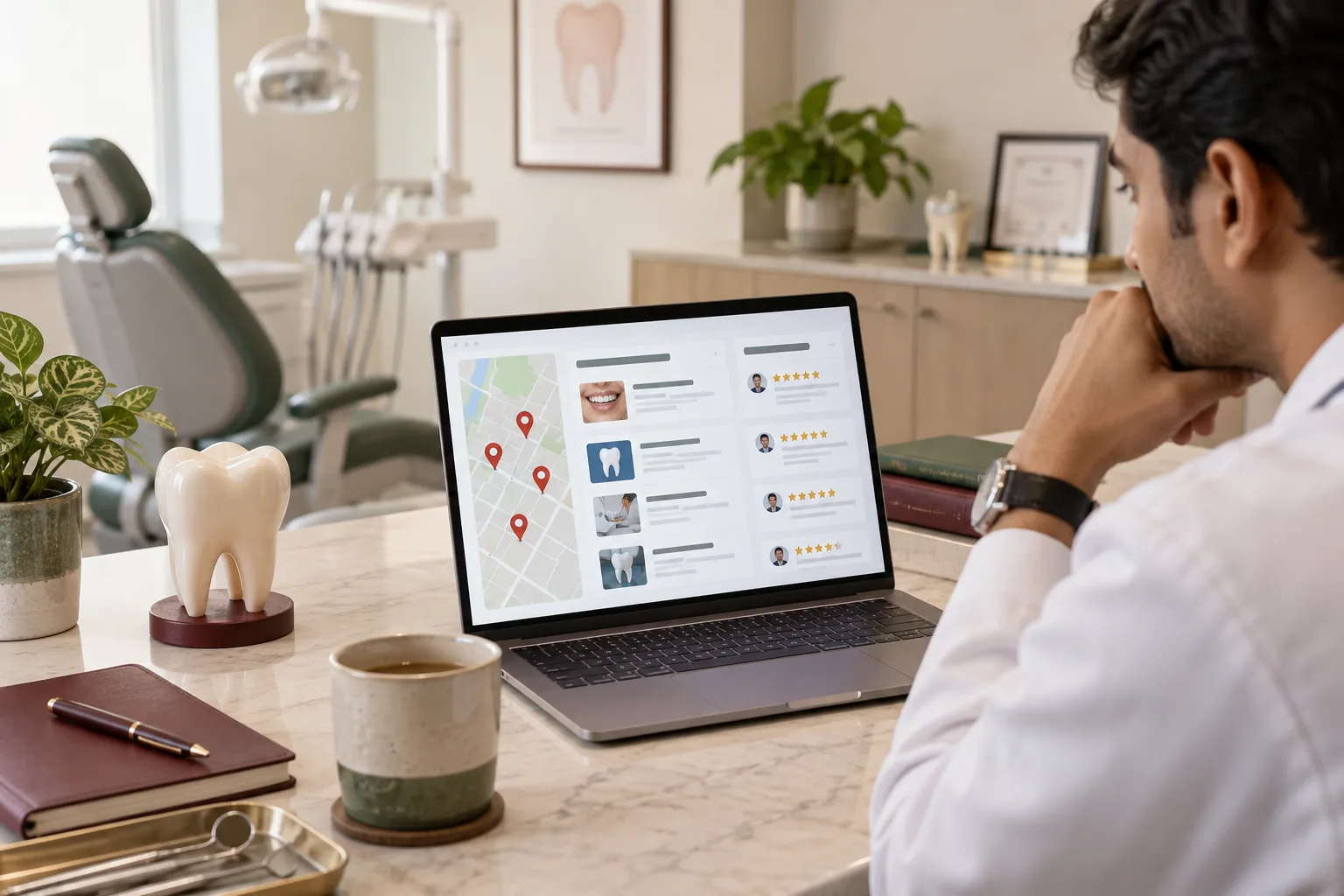
For a single-location clinic, the Google Business Profile does more than the website. A patient searching "dentist near me" in Basavanagudi sees three map results, and the choice between them is made on reviews, photographs and hours.
Make it complete. The category should be Dentist or Dental clinic, with secondary categories for orthodontist, endodontist and paediatric dentist if you have them. List every treatment as a service with a one-line description. Put twenty real photographs in: the reception, the chairs, the sterilisation area, the dentists, the building from the road so people can find it. Add evening and Sunday hours if you keep them, because that is a deciding factor for anyone working in an office park. Turn on messaging only if somebody will read it.
Then post to the profile twice a month. A short post about a treatment, a new machine, or a camp keeps the listing active and gives you somewhere to put an offer without printing anything.
A page for every treatment, named the way patients ask
A clinic website with one "Services" page listing eighteen treatments ranks for nothing and answers nothing. Patients do not search for dentistry. They search for "root canal cost", "wisdom tooth removal", "braces for 12 year old", "dentures price", "teeth cleaning near me".
Each of those deserves a page that states the price band and why it varies, the number of visits, and what happens in each visit. It should also cover whether anaesthesia is used, the recovery time, and which dentist does it. Put the answer in the first paragraph, in the words of the question. That paragraph is also what Google quotes in the answer box and what an AI assistant repeats when someone asks it for a recommendation.
Add the locality name where it is honest to do so. A page for root canal treatment that mentions your area and the nearby landmarks helps a patient decide you are close enough to visit on a weekday evening.
The checklist most clinics have not finished
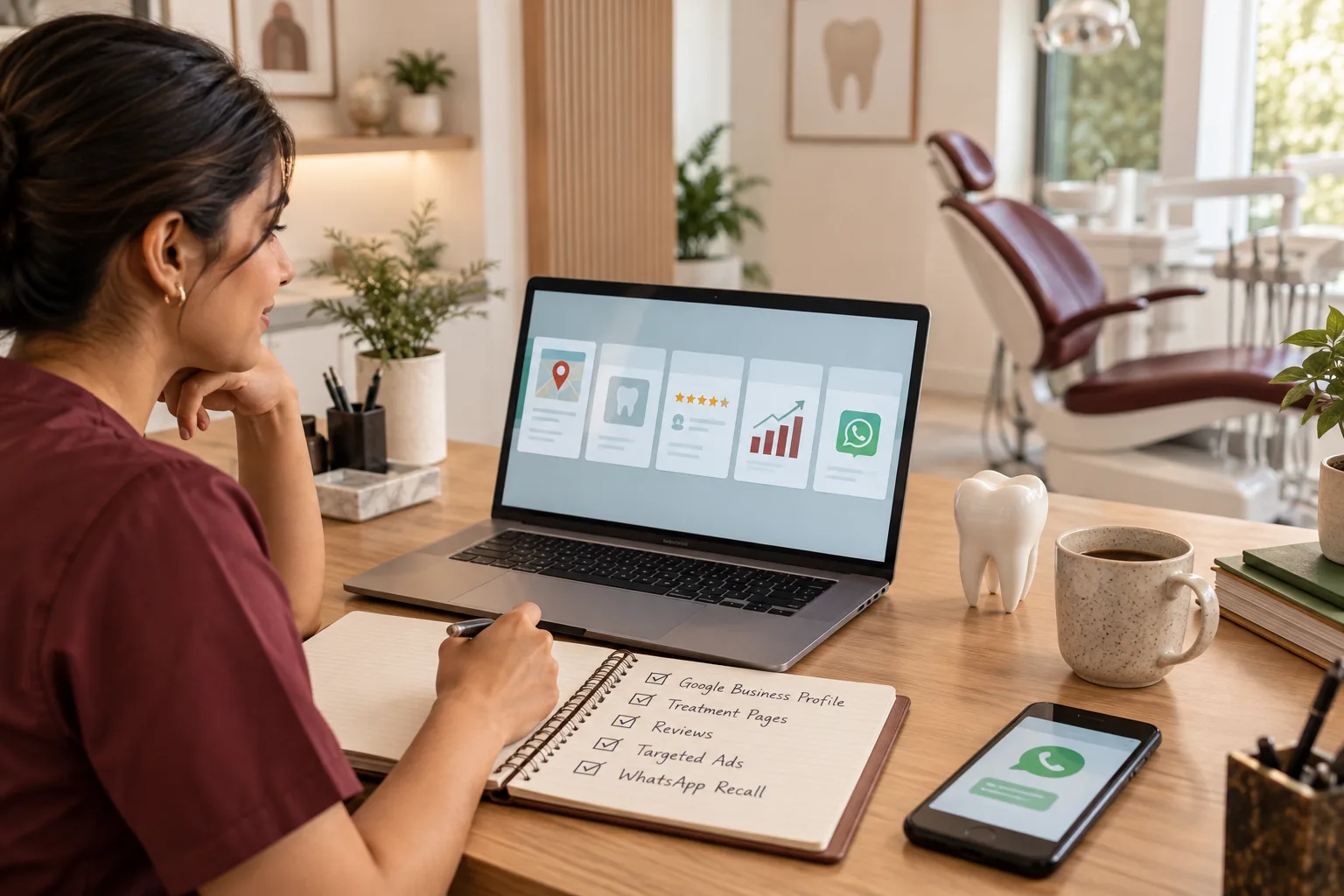
- Google Business Profile complete, with categories, services, twenty photographs and correct hours
- The same clinic name, address and phone number on the website, Maps, Practo, JustDial and the signboard
- One page per treatment with a price band, visit count and the dentist's name
- A WhatsApp number on the website that a real person reads during clinic hours
- Calls diverted to a mobile after the front desk closes
- An enquiry register that records source, treatment asked about, and outcome
- A review request at the billing counter, every day, by name
- Replies to every Google review, including the unhappy ones
- A recall list of patients due for scaling, review or the next stage of treatment
- A referral card or message for patients who have finished a large treatment
- Before-and-after photographs with written patient consent, for aligners and smile design only
- Directions, parking and the nearest landmark stated in plain words
Work down that list and most clinics find three or four items nobody owns. Assign each one to a person, not to the practice.
Ideas that reach patients who are not searching
Search reaches people with a problem today. These reach the rest.
Check-up camps with follow-up. A camp at a nearby apartment association, factory or school produces a sheet of names with findings. The value is in the call a week later, treatment by treatment, from someone who can book an appointment. Without that call the camp is charity.
Doctor referral relationships. Paediatricians send early orthodontic cases. General physicians and cardiologists send patients needing clearance before procedures. ENT specialists send jaw pain. Meet four nearby doctors a quarter, leave a card with your direct number, and send a short note back on every patient they refer. This is the highest-value marketing channel most clinics ignore entirely.
Corporate tie-ups. An office park near your clinic can be asked for a dental check-up day and a small discount for employees. The clinic gets a list, the employer gets a benefit, and the patients live or work within ten minutes.
Recall messages. Six-month scaling, orthodontic reviews, crown fitting after a root canal, implant follow-ups. A WhatsApp message with the patient's name and the reason, sent by the clinic, refills chairs at no media cost. This is the cheapest new revenue in dentistry and the most commonly skipped.
A worked example
For example, take a two-chair clinic in Vijayanagar, Bengaluru, run by a husband-and-wife team with a visiting orthodontist. The figures below are illustrative. It spends ₹12,000 a month on Google Search ads, and the dentist feels the ads are not working.
The register shows why. Of last month's forty-one enquiries, nine were never returned because they arrived after 7.30 pm. Six asked about braces and were told to come in without being given a fee band, and four were existing patients asking when their crown would be ready. Nothing on that list is an advertising problem. Diverting the phone, writing a braces page with a fee band, and calling the eighty-one patients overdue for scaling would add more appointments next month than doubling the ad budget.
What to measure
Count enquiries by source and by treatment. Count how many were answered within ten minutes. Count how many became appointments, and how many of those turned up. Count reviews received this month, and recall calls made. Those five numbers tell a dentist more than any dashboard, and they can be kept on one sheet at the front desk.
What to do next
Print last month's enquiry register and mark every line that was never followed up. That figure is your first marketing budget, and it costs nothing to recover. Then complete the Maps listing and write your three most profitable treatments as three separate pages.
If you would like your enquiry handling and your listing checked against what patients in your area see, tell us what you need.
Put the reading to work
Try this with your own records.
Bring the pages for the products or services you want to sell, the search queries available in your reports, and examples of enquiries from search. Separate branded searches from buyers discovering you for the first time.
How to review the result
Follow the trail from a relevant query to its landing page and then to an enquiry. Review whether those enquiries fit your offer, alongside indexing and search visibility.
Industries