Notes for owners · Industry playbooks
Facebook content ideas for dental practices
Facebook works for a dental clinic when it shows the room, the people and real patient questions. Post ideas that bring appointments and referrals.
The GullySales team · Updated 13 Nov 2026 · 6 min read
Rules for this trade differ by state and professional body, and they change. Check the current position with your own council or adviser before you act on anything here.
On this page
- Who is actually looking at a dental clinic's page?
- Post ideas that show the room and the people
- Post ideas built on real patient questions
- A simple two-post-a-week plan
- Which posts deserve paid money behind them?
- What stops working quickly
- Post ideas for the families and the older patient
- What to put in the comments
- Reels, photographs and plain text: what to use when
- Keep a consent and permissions folder
- Let the front office read the page too
- A starter list for the first four weeks
- What to do next
Facebook earns a dental clinic appointments when the posts show the room, the people and real patient questions. It wastes money on stock images of perfect teeth with a health day greeting. The Facebook audience for a clinic is local, older than your Instagram audience, and includes the person who decides for the whole family. So post what would reassure a nervous parent, or a fifty-year-old weighing up an implant. Then keep posting.
Who is actually looking at a dental clinic's page?
Three people, and they want different things.
The nervous new patient has put off treatment for two years. They are checking whether the clinic looks clean, whether the dentist seems gentle, and whether anyone like them has been there.
The parent is deciding where to take a seven-year-old with a decayed milk tooth, or a fourteen-year-old who needs braces. They want to see a child in the chair, not a graphic.
The existing patient is your referral engine. They are not choosing a clinic. They are being reminded that you exist so they mention you to a colleague with toothache.
Post ideas that show the room and the people
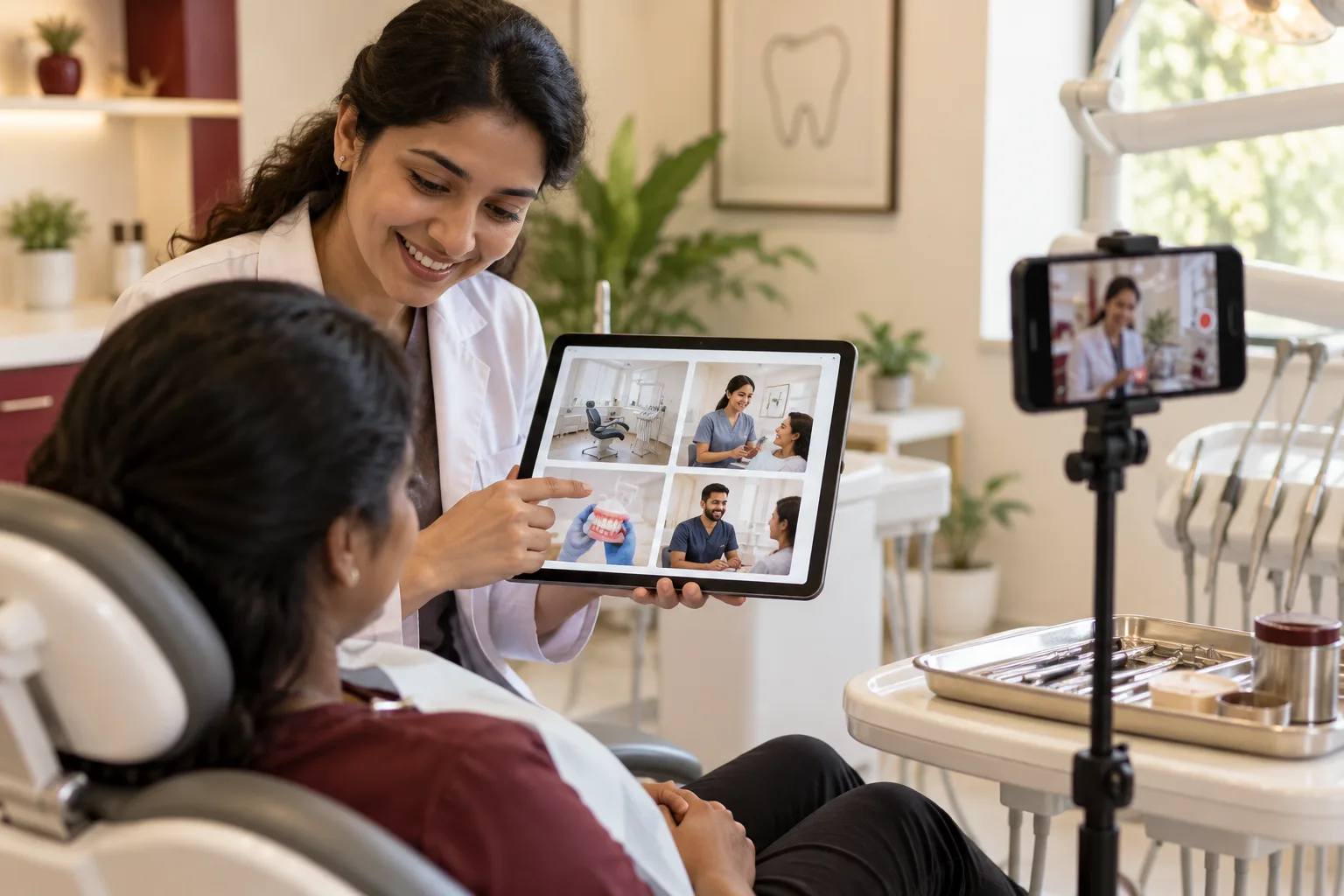
- A short video walk-through of the operatory, the autoclave running and the instrument pouches being sealed. Cleanliness is the single biggest silent worry and almost no clinic shows it.
- The dentist introducing themselves in forty seconds: name, where they studied, what they treat most, and one sentence about nervous patients.
- The team on a normal working day, with names and roles, including the dental assistant and the person who answers the phone.
- The new equipment arriving, whether it is a rotary endo motor, an intraoral scanner or a new chair, with one line on what it means for the patient.
- Sunday and evening timings, posted as a plain image with the phone number, in the week before a long weekend.
Post ideas built on real patient questions
Take the questions your reception answers on the phone and answer them one at a time.
- Why some root canals need one visit and others need two.
- What actually happens in a scaling appointment, and why the gums bleed a little afterwards.
- Implant or bridge for a single missing molar, with the trade-off in plain words.
- Do clear aligners work on crowded lower teeth in an adult?
- When a child's first fluoride application is due.
- Why one chipped front tooth is bonded and the next one is crowned.
Each of these is thirty seconds of the dentist talking to a phone camera. No script, no editing, no music.
A simple two-post-a-week plan
| Week | Tuesday post | Friday post |
|---|---|---|
| One | Dentist answers one treatment question on camera | Patient review screenshot, with a thank you |
| Two | Behind the scenes, sterilisation or a new instrument | Before and after case, with written consent |
| Three | Paediatric or family post: a child's visit, school check-ups | Timings, Sunday availability, phone and WhatsApp number |
| Four | Myth correction: something patients believe that is not true | Team member introduction, with name and role |
Repeat the cycle. After three months you will have twenty-four posts and a bank you can reuse and improve, which matters in a clinic where the dentist is chairside all day.
Which posts deserve paid money behind them?
Not the greetings and not the team photos. Put budget behind two kinds of post only.
The first is a treatment post aimed at a small radius, five to eight kilometres, for something with a clear buying trigger. Implants, aligners, full mouth rehabilitation, or paediatric dentistry before the school reopening season. The second is a retargeting post shown to people who visited your website or watched more than half of a treatment video, because those are patients already deciding.
For example, a clinic in Rajajinagar, Bengaluru put roughly ₹8,000 a month, an illustrative figure, behind two posts only. Two posts. An aligner explainer, and an implant case published with the patient's consent, aimed at an eight-kilometre radius. Every enquiry from them went to one WhatsApp number the front office owned, and the first reply offered two slots. The clinic could then say which post produced which appointment. Most social media spending never answers that.
What stops working quickly
Stock photographs of models with unnaturally white teeth. Health day greetings with the clinic logo, which are scrolled past by everyone including your own patients. Long paragraphs of medical explanation copied from a website. Claims of a guaranteed or painless result, which Indian advertising rules do not permit and which patients do not believe anyway. And posting from a page with no phone number, no timings and no address in the about section, which makes every good post a dead end.
Post ideas for the families and the older patient
Parents and older patients decide quietly, and a page that speaks to them earns referrals without a single advertisement.
- A school check-up visit, with the permission of the school and of the parents, and one line on what the dentist looked for.
- A short post on how to brush a toddler's teeth, shown with a doll or a model rather than a real child.
- A denture care post for the grandparent who wears one, written for the family member who will read it aloud.
- A post for the person who has put off treatment because of fear, saying plainly what the first visit includes and what it does not. A first visit that is only a conversation and a look is a real offer for a nervous patient.
- A reminder aimed at the household, not the individual: "Who in your home has not had a check-up this year?"
None of these needs a discount. They need a dentist who sounds like a person.
What to put in the comments
Comments are where a clinic page is either alive or dead. Decide who replies, how long a reply should take on a working day, and what the reply says.
A good reply thanks the person, answers the question in a sentence, and moves the detail to a call or a WhatsApp message. A reply that gives a diagnosis in public is a mistake. Never discuss a named patient's treatment in a comment, even when the patient has praised you. Thank them, and leave it there.
For a negative comment, reply once, politely, offer a call, and do not argue in public. Readers judge the clinic by the tone of that single reply.
Reels, photographs and plain text: what to use when
| Format | Best for | Watch out for |
|---|---|---|
| Short video | Answering a patient question, a walk through the room | Sound in a clinic with a drill running; record in a quiet room |
| Single photograph | The team, a new instrument, timings | Dark pictures taken with the overhead light behind the subject |
| Text post with an image card | A myth correction, an announcement | Long paragraphs; keep it to a few lines |
| Case photographs | A finished treatment, with written consent | Anything that identifies a patient without agreement |
Pick the format by the job, not by what looks fashionable this season.
Keep a consent and permissions folder
Every photograph with a patient in it needs a written consent that states what the photograph will be used for and where it may appear. Keep the signed form with the date, and note which posts used the image. If the patient later asks you to take it down, remove it that day and record that you did.
Staff photographs need the same courtesy. Ask the team member, and remove the post if they leave and ask you to.
Dental advertising is also governed by your dental council's rules and by the advertising standards that apply to health claims. Your own council or adviser decides what wording you may use, so ask before you publish a claim about a treatment, a result or a comparison with another clinic.
Let the front office read the page too
The person at the reception desk is the one who answers when a post works. Show them each post before it goes live, and tell them which questions it may produce. If a video explains why a root canal sometimes needs two visits, the receptionist should be ready for the caller who says "I saw your video and I think I need that".
Ask the front office to keep a tally on paper: the date, the caller's words, and whether the call became an appointment. After a few weeks, the tally shows which posts the neighbourhood talks about. That evidence is better than the number of reactions a post received, because reactions are free and appointments are not.
A starter list for the first four weeks
If you are starting from nothing, work in this order: complete the about section, pin a post with your timings and contact numbers, introduce the dentist on video, introduce the team, and then begin the two-post plan above. Each step is small, and each one makes the next post more useful to the person who finds you.
What to do next
Record four thirty-second videos in one sitting, each answering a question your reception is tired of answering, and schedule them across the next month. Then check the about section of your page. It needs the phone number, the WhatsApp number, the address and the real timings. A good part of your reach looks there before going anywhere else. If you want the posting plan tied to enquiries and appointments rather than to likes, tell us what you need. We will look at how enquiries reach you and what happens in the first ten minutes.
Put the reading to work
Try this with your own records.
Bring questions from sales calls and examples of objections that delay a decision. Choose a subject expert who can check the substance, and identify evidence that can be published.
How to review the result
Ask a colleague to use the draft in a real buyer conversation. It should answer the question, support its claims, and make the next step clear without requiring a sales pitch to explain it.
Industries