Notes for owners · Digital marketing
Why are Google Ads important for dental marketing?
Google Ads for a dental clinic pays for itself on implants, aligners and full-mouth work, and wastes money on scaling, check-ups and small fillings.
The GullySales team · Updated 15 Sept 2026 · 7 min read
Rules for this trade differ by state and professional body, and they change. Check the current position with your own council or adviser before you act on anything here.
On this page
Google Ads matters in dentistry because it reaches a patient in the minute they have decided to act, which is a minute you cannot reach any other way. Somebody searching "dental implant cost near me" at nine in the evening is not browsing. On high-value treatments such as implants, aligners and full-mouth work, that timing is worth paying for. On scaling, check-ups and small fillings, the click costs more than the treatment justifies, and the same patient can be reached free through your Google Business Profile.
What the ads actually buy you
Three things a clinic cannot get elsewhere at that speed.
Presence at the moment of decision. Search advertising puts you in front of a patient who is already looking for the treatment, not someone who might need it later.
Control of the geography. You can restrict a campaign to a radius that matches where patients will actually travel from, which for most clinics is four to eight kilometres. Nobody drives across Bengaluru for a filling.
A test you can run in a fortnight. If you want to know whether there is demand for aligners in your area, a small campaign answers that in two weeks. Waiting for search rankings to answer it takes months.
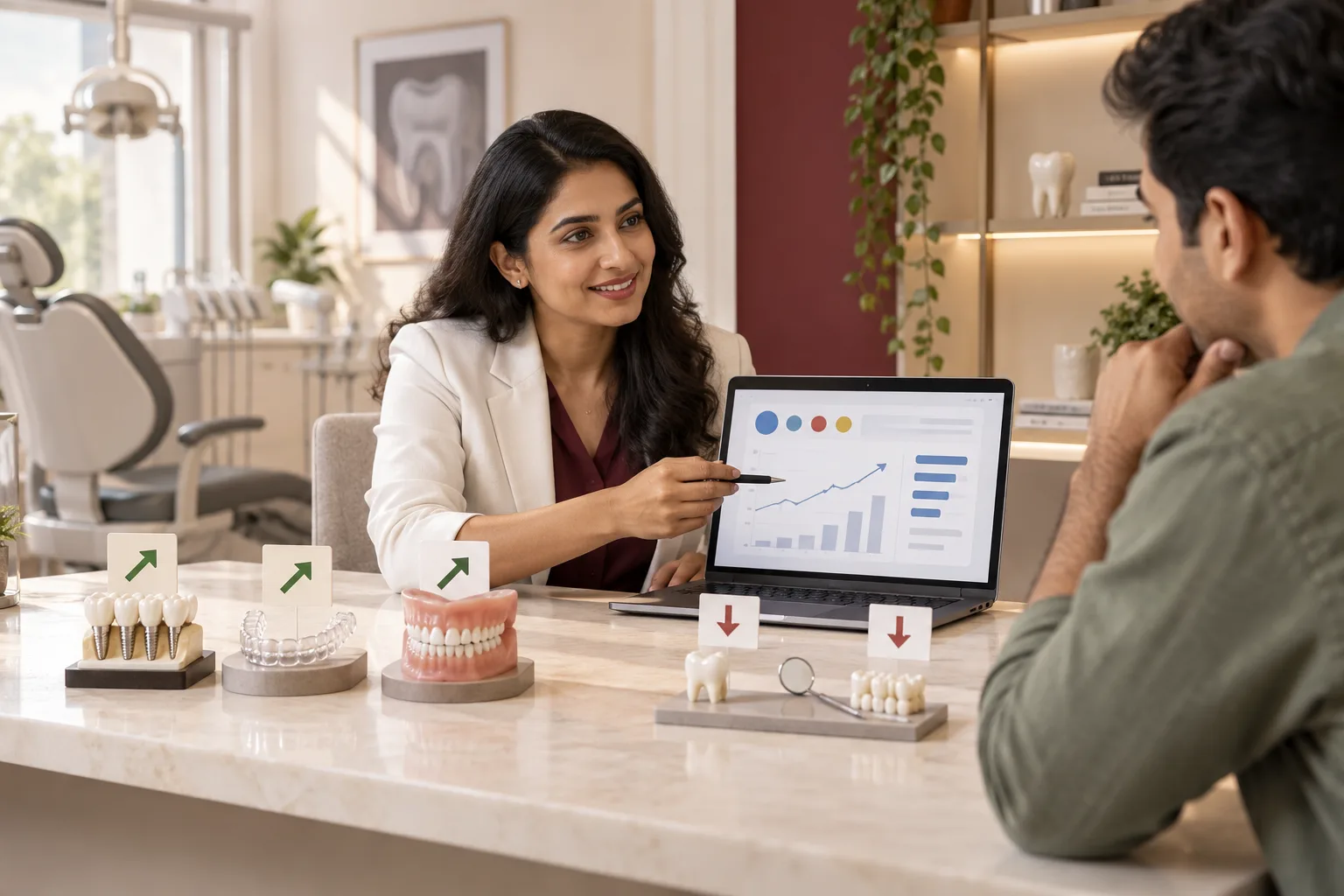
Where the money is worth spending, and where it is not
| Treatment | Why ads work or do not | Verdict |
|---|---|---|
| Dental implants | High value, patients compare, searches are specific | Worth it |
| Clear aligners and braces | High value, long consideration, adults search by brand | Worth it |
| Full-mouth rehabilitation | Very high value, low volume, searches are informational | Worth it, on a small budget |
| Root canal treatment | Urgent, often decided in the map pack before any ad is read | Marginal |
| Crowns and bridges | Medium value, usually recommended in the chair | Marginal |
| Scaling and polishing | Click cost close to the treatment value | Not worth it |
| Tooth extraction | Low value, urgent, map-driven | Not worth it |
| General "dentist near me" | Expensive, and your profile can win it free | Not worth it |
Work out the arithmetic for yourself before believing the table. For example, the figures below are illustrative. If an implant case is worth ₹35,000 to the clinic, one in three consultations proceeds, and one in eight clicks produces a consultation. At those numbers, the clinic can spend a few hundred rupees per click and remain comfortably ahead. Run the same sum on a ₹1,500 scaling and the answer is obvious. Put your own case values and conversion rates in.
The campaign structure that works for a clinic
One campaign per treatment, not one campaign for the practice. The keywords, the landing page and the budget all need to differ, and mixing them means the cheap clicks eat the budget and the valuable searches never show.
Send every click to a page about that treatment, with the answer in the first paragraph, the number of visits, what the cost depends on, and the dentist's name. Sending implant clicks to your home page wastes most of them.
Use call-only or call-focused campaigns on mobile for the urgent treatments. A patient in pain taps a number; they do not fill a form.
Match the ad schedule to when somebody can answer. Running ads at eleven at night when the clinic opens at nine and nobody returns the missed call is paying for a lost patient.
Negative keywords, which is where most budget is saved
An untended dental campaign in India bleeds money on searches that will never produce a patient. Build the negative list on day one and add to it weekly.
- Course, admission, BDS, MDS, college, university, syllabus
- Jobs, vacancy, salary, recruitment
- Government, free, ESI, camp
- Instruments, chair, equipment, dealer, price list for suppliers
- Insurance claim, policy
- Remedies, home treatment, natural cure
- Any competitor's practice name you do not want to pay for
Review the search terms report every week for the first month. Clinics that skip this often find a good part of their spend went to people who were never going to sit in the chair.
An honest note on when a clinic should not advertise
If your Google Business Profile is unverified, your phone number is wrong somewhere, or your newest review is a year old, do not start ads. The same is true if you have no page for the treatment you want to promote. The click will arrive, the patient will check your reviews and your page, and they will call the clinic with twelve recent reviews and a proper implant page instead. You will have paid for a competitor's patient.
Likewise, if nobody answers the phone within the working day, advertising converts money into missed calls. Fix the answering before the spending. This is not us talking a clinic out of work; it is the order that produces patients.
Measuring it so the decision is not an argument
Four numbers per campaign, monthly. Clicks, calls and form enquiries, appointments booked, and treatments started. The last two come from the front desk log, not from Google, and they are the only two that matter.
Record the treatment asked about on every call. A campaign that produces thirty calls for scaling from an implant budget is a keyword problem, and you will only see it in the log.
What to do next
Pick one treatment. Work out what a case is worth to the clinic, and what you can afford per click at your own conversion rate. If the number is comfortable, run one campaign for that treatment, with a proper page behind it and a negative keyword list. If it is uncomfortable, put the effort into the Google Business Profile and reviews instead. We look at both together, so you are not paying for clicks that a corrected profile would have brought you free.
Related services
Industries