The process is in one person’s head
And when they are busy the enquiries wait. A process that lives in one person is not a process; it is a bottleneck with a name.
A sales process for day-care centres is the sequence from enquiry to order — who answers, how fast, what is sent, when the follow-up happens, what counts as won or lost — written down and actually run. Most businesses have a process in one person’s head. When they are busy, on leave or gone, the enquiries die.
Where it usually goes wrong
And when they are busy the enquiries wait. A process that lives in one person is not a process; it is a bottleneck with a name.
Most day-care centres stop after one attempt. Count the attempts per lost deal — one is not a follow-up process, and fixing it changes the close rate before any new spend.
No stages, no definitions, no way of knowing what is actually in the pipeline. The forecast is a feeling.
What we would do
The order is decided by where enquiries are actually lost, and that is almost always in the first hour — so the answering is fixed before the later stages, the scripts and the software. A stage tidied up after the point of loss changes nothing.
From enquiry to order, with an owner, a time limit and an exit rule for each stage — designed with the team, then run with them until it sticks.
A named owner and a reply rule for every enquiry, and a written follow-up sequence after the quote.
The first reply, the follow-ups, the answer to the common objections — so the process does not depend on who is on duty.
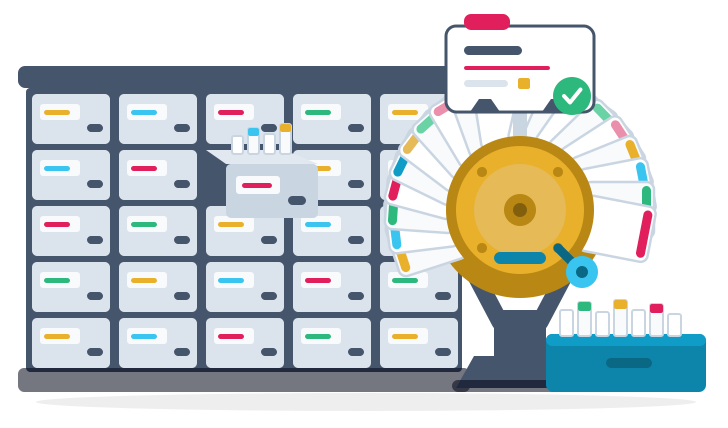
The stages, the tasks and the reminders in a CRM set up around how you sell — adopted rather than abandoned.
We ask how long a new enquiry waits for a human reply, and almost nobody knows, so we time the last twenty. That measurement costs nothing, and for most day-care centres it is the whole problem — no new channel will rescue a business that takes two days to ring back. We do not publish a price; we scope the work in the free audit and put the fee in writing, split into our time, your media spend and production, before anything begins.
A baseline is recorded first, so a report can say what changed rather than describe activity. If something is not earning, we say so and stop it.
We are a small team in Nagarbhavi, Bengaluru. Clients include Chord Road Hospital, SB Engineering, NewCom Logistics, Kerur Pain Clinic and Natural Gases, across healthcare, manufacturing, logistics and services.
More for day-care centres
What a day-care centre stands for, said plainly, and looking the same everywhere a buyer sees it.
Every step from a parent’s first search to the order, and where the enquiries are being lost along it.
A precise description of who buys from a day-care centre, and who does not, so everything after it aims better.
Plain answers to the questions a parent asks before they enquire, published where they search.
A CRM set up around how you actually sell, and adopted by the team rather than abandoned by it.
Staying in front of the enquiries that were not ready yet, until they are.
You need the two or three rules that stop enquiries dying: who answers, how fast, and what happens after the quote. For most day-care centres that is a page, not a manual — and it is worth more than any campaign.
Designing it takes a couple of weeks. Getting the team to actually run it takes a couple of months of reviews, which is the part most consultants skip and the reason most processes fail.
Fixing reply time and the Maps profile shows in weeks, because the searches are already happening. Building reviews and local search takes a few months to compound. We tell you which you are looking at in the first meeting.
There is no price list. A single clinic and an exporter are different orders of work, and a range wide enough to cover both tells you nothing. We scope it in the free audit and put the fee in writing before anything begins.
Talk to us
A short note is enough. We will come back with a straight answer about whether we can help, usually within one working day.