Buyer journey mapping · Marketing
Find the exact step where buyers currently give up on you.
A buyer rarely goes straight from noticing a business to buying from it. They search, compare a few options, ask someone they trust, delay for a reason that has nothing to do with price, and only then enquire. Most businesses can describe their product in detail but cannot describe this path at all.
A 90-minute audit call and a written, scored report. Turnaround, reporting and term are agreed in writing after the audit.
In one paragraph
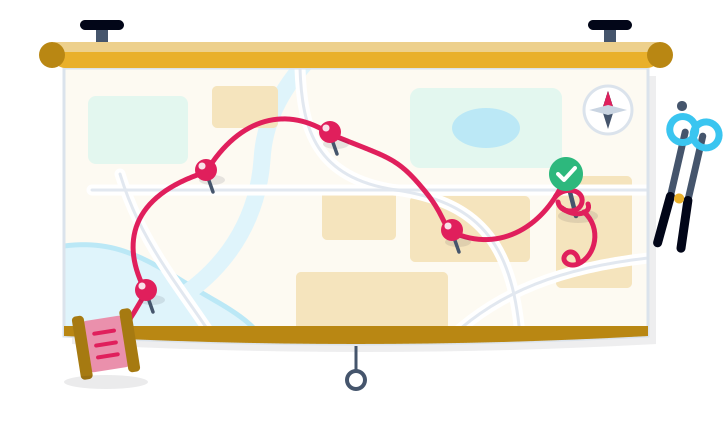
Buyer journey mapping lays out, stage by stage, everything a buyer does between first hearing about you and becoming a customer, including where they research, compare, hesitate and decide. GullySales builds this from your own enquiry data and customer conversations, then points to the stage losing you the most people.
We map the journey for your specific buyer, using your own website analytics, call logs and CRM notes rather than a generic funnel diagram. An interior design firm in Indiranagar, for example, might find most enquiries stall between the site visit and the quotation, not at the first call. The map shows where people currently drop out, and whether that is a marketing gap, a slow reply, or a genuine objection nobody has answered.
The map is only useful if it changes something. Each stage in the finished map is paired with one thing to fix, so it becomes a to-do list rather than a wall chart.
The problem
Does this sound like your business?
What owners tell us on the first call, in their words.
“Enquiries come in but most go quiet after the first reply”
People show interest, get a response, and then disappear, and nobody has worked out what happens between that reply and the next expected step.
“The website gets visits but almost no enquiries”
Traffic looks healthy in analytics, but the page a visitor lands on does not match what they were looking for at that stage of their decision.
“A quotation goes out and is never mentioned again”
The buyer's journey after the quotation stage is a blank; nobody knows if they compared it, shelved it or chose someone else.
“Different team members describe the sales process differently”
Ask three people how a customer actually moves from enquiry to order and you get three different answers, which means nobody is managing the real path.
What we do
Everything that is included.
Each deliverable, and what it gets you. Nothing here is an extra.
Journey stage map
The stages your specific buyer moves through, from first awareness to purchase and repeat business, named in their own words.
Touchpoint audit
Every place a buyer interacts with you at each stage: search results, the website, WhatsApp, a call, a site visit.
Drop-off analysis
Where in the journey the largest share of people currently leave, using your own enquiry and CRM data.
Objection and delay list
The specific reasons buyers hesitate at each stage, gathered from sales conversations rather than assumed.
Fix list by stage
One recommended action per stage, ranked by how many people it is likely to affect.
How the result is measured
- Enquiry-to-customer conversion by stage
- Drop-off rate at the largest identified stage
- Time spent by buyers at each stage
- Fixes implemented against the map
Recorded as a baseline before work starts, so every later report has an honest comparison.
Who it is for
This is written for you if these sound familiar.
- Businesses that get plenty of traffic or enquiries but a low rate of them turning into customers
- Owners who cannot say at what point in the process most people are lost
- Businesses with a considered purchase where the buyer researches for weeks before contacting anyone
- Teams planning a new website or campaign who want it built around the real path, not a guess
- Multi-step sales processes involving a site visit, quotation or committee decision
Not for
It is not the right fit if.
- Very simple, single-step purchases where a buyer sees the product and buys immediately
- Businesses with too little enquiry history to see a pattern
- Anyone wanting a theoretical diagram rather than a list of fixes tied to real data
How it works
From your first message to the first report.
No open-ended retainer. Each step has a point in time and something you receive.
01 · Day 1
Free audit call
90 minutes with whoever handles your enquiries: how they arrive, how fast they are answered, where they are lost.
02 · After the call
Written, scored report
Six areas scored, fixes ranked by return and cost. If you want our help, the scope, the fee and the reporting come with it, in writing.
03 · Before work starts
Baseline recorded
Enquiries by source, reply time, conversion and cost per order, written down so every later month has an honest comparison.
04 · Month 1
The first fix goes live
Usually the cheapest one on the report: reply time, a follow-up sequence or the marketing-to-sales handover.
05 · As agreed
Report against the baseline
What moved, what did not, and what changes next, in plain words. How often you get it is set in writing before work starts.
06 · At the end of the term
Renew on the numbers
The term ends and you decide whether to continue from the results. The length is agreed in writing before anything starts.
How the buyer journey mapping work runs
- 1
Understand the sales process
We walk through how a sale actually happens today, from the person who first answers an enquiry to the one who closes it.
- 2
Audit the data
Website analytics, call logs and CRM records are pulled together to see where people actually drop out, not where they are assumed to.
- 3
Interview buyers and staff
A handful of recent customers and the team who speak to them fill in the reasons behind the numbers.
- 4
Build the map
Stages, touchpoints and drop-off points are set out in one document everyone can read the same way.
- 5
Fix and measure
Each fix is implemented against the stage it addresses, and the drop-off rate at that stage is checked afterwards.
Proof
What happened when owners fixed this.
Real clients, the work we did, and the result as it was recorded. Where no number was recorded, none is claimed.
Hotel Felicity Inn
- Situation
- A traveller compares three hotels on a phone and books one. The website was not built for that.
- What we did
- The site rebuilt around booking
- Photography and one look
- Search work for destination searches
- Content a traveller reads
- Result
- Online bookings increased 35%
- Organic traffic increased 50% within six months
- Positive reviews on Google and TripAdvisor increased 30%
SB Engineering
- Situation
- Buyers searching for laser cutting and sheet metal work in Bengaluru were finding other suppliers first, because the company did not rank for the terms its own customers type.
- What we did
- The site redesigned for mobile
- Search work on the buyer's terms
- Content that shows the work
- Social channels managed
- Result
- Website traffic rose 60% within six months, against a target of 50%.
- High-quality leads rose 45%, with a rise in conversion rates alongside them.
- Fifteen target keywords moved up the rankings, five of them into the top three positions.
Chord Road Hospital
- Situation
- Patients who knew the hospital trusted it. Patients who searched for a department or a treatment in the area did not find it.
- What we did
- Website rebuilt around patient needs
- Search visibility
- Social media on a schedule
- Review management
- Result
- Organic traffic increased 60% within six months
- Online appointment bookings increased 40%
- Social following grew 45%, and engagement on it rose 70%
Also worked with
Curtain Label · Difesa Security Services · Hands On CSR · Implevista · Kambar Group · Kalessi · Kerur Pain Clinic · LL Trust · Lucky Deals · Natural Gases · NavaShakthi Souhardha · NewCom Logistics · Proton Technical Services · Shakthi Foundation · Shakthi Group · Urbanest · Insyde Studio · Venkateshwara Laser Tech · Vivara Studios
Why us
Why owners pick GullySales over an agency.
Marketing and sales, as one job
Most agencies stop at the enquiry. We also fix what happens after it: the reply, the follow-up, the quote and the CRM.
The person on the first call does the work
No account managers in between. You are never handed to someone you have not met.
A baseline before anything starts
Your numbers are written down on day one, so every later report compares against something honest.
The fee in writing, split three ways
Our time, your media spend and production on separate lines. You always see what goes to us.
No guarantees we cannot keep
The term is agreed in writing and never a default twelve months. We never promise a ranking or a lead count, because nobody controls those.
One office, and we say so
Nagarbhavi, Bengaluru. We work across India by call and WhatsApp and travel when a session needs to be in person.
#257, 3rd floor, Sri Nanjundeshwara Complex, Nagarbhavi 8th Block, Outer Ring Road. How we work.
Engagement options
Ways to work with us.
Pick the size of commitment that fits. Every option starts with the free audit.
Option 1
The audit on its own
A 90-minute call and a written, scored report. It says honestly whether you need outside help, and many fixes are ones your own team can make.
Option 2
One fix, scoped
Start with the fix the audit ranks first, such as reply time or follow-up. The fee is in writing before anything starts.
Option 3
An ongoing programme
We run the work, report against the baseline, and you renew on the numbers. The term and the reporting are agreed in writing first.
Option 4
Guidance for your own team or agency
We plan, brief and check the work of your in-house team or current agency, instead of replacing them.
The offer
Start with a free audit of how you sell.
It is useful on its own, whether or not you hire us.
What you receive
- A 90-minute call with the person who will do the work
- A written, scored report on the six places orders leak
- Every fix ranked by what it returns and what it costs
- The one thing to do first, and why
- An honest line on whether you need outside help at all
- If you do, the scope and the fee in writing
No invoice. No obligation. No sales script.
FAQ
Questions owners ask before they call.
Not here? More answers, or ask on WhatsApp.
How is this different from a sales funnel?
What data do you need from us?
Will this tell us why people leave, or just where?
How long does this take?
Is this part of the free audit?
How much does it cost?
How long is the contract?
Who will actually do the work?
What if we are not happy with the work?
By industry
Buyer journey mapping, written for your industry.
Related services
Often bought with this, or instead of it.
Your next practical step
Get a free audit of how you sell, and a scored report of where the work is.
90 minutes. A written, scored report. No invoice and no obligation.