Facebook marketing · Marketing
Your town talks about you on Facebook, and your Page is not part of the conversation.
A caterer is recommended in a neighbourhood group on a Sunday evening. The Page has an old phone number, no WhatsApp button and a closed shop timing. The enquiry goes to the next name on the list.
Scope, fee, reporting and term are agreed in writing after we have read your brief and spoken to you.
In one paragraph
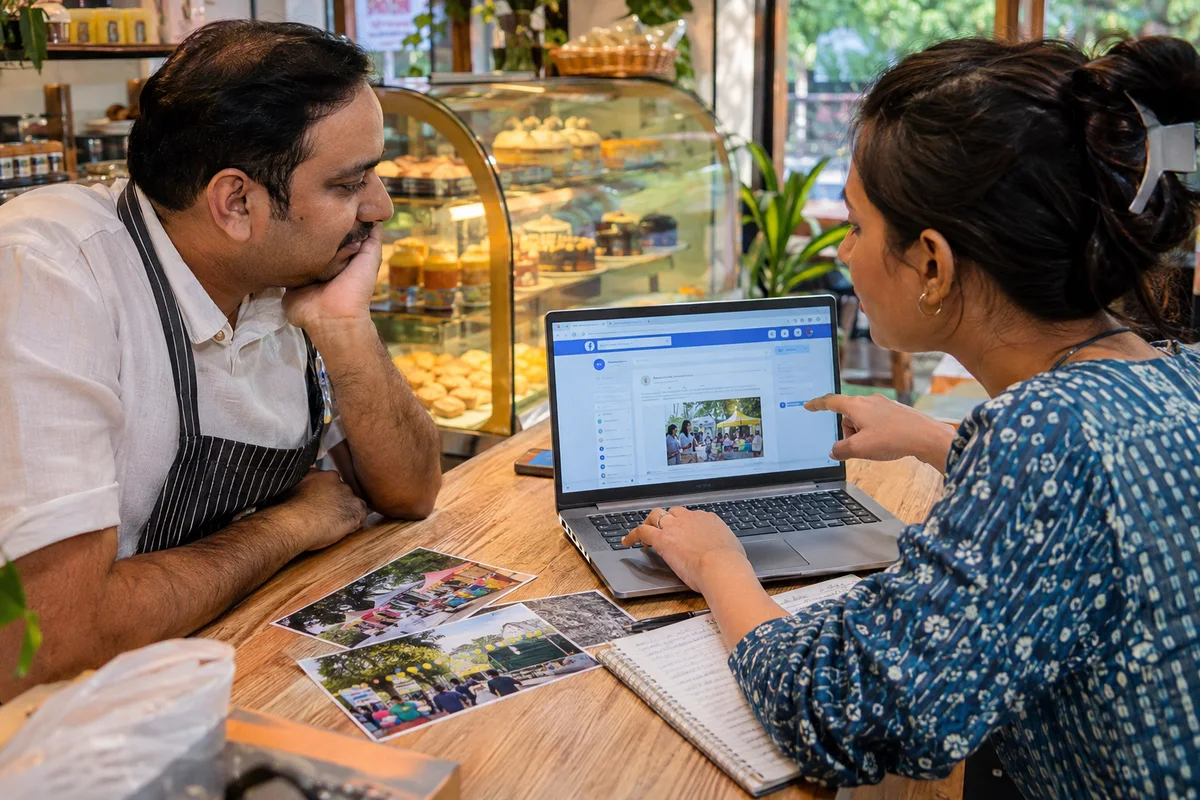
Facebook marketing is the work of using Facebook as a local channel: a Page with correct details, posts and events, groups, Messenger and WhatsApp routes, and recommendations. GullySales sets the channel up, decides with you whether Facebook suits your trade, and records which enquiries it produces.
Facebook suits some businesses well: those that sell locally to families, parents, homeowners and community members. For others, such as a firm selling to a handful of procurement heads, it adds little, and we say so before any work starts.
The line between this and its neighbours is simple. Day-to-day posting and inbox cover is Instagram and Facebook page management. Paid reach is Meta advertising. Groups and communities across several platforms are community marketing. This page is for deciding how Facebook itself should work for your business and setting it up.
Who it is for
This is written for you if these sound familiar.
- Local shops, caterers and service providers whose customers ask for recommendations in neighbourhood groups
- Clinics, coaching centres and schools whose parents and families already use Facebook
- Event venues and organisers who need public event listings with a clear enquiry route
- Owners with an old Page, a personal profile used as a business, or an unclear admin
- Businesses that get Messenger messages but have no record of what they led to
Not for
It is not the right fit if.
- A firm selling to a few named buyers, where direct calls and LinkedIn do the work better
- Owners who want a Page filled with posts but will not name anyone to answer messages
- Regulated trades expecting outcome claims or testimonials as content; those follow neutral rules and your own adviser's guidance
The problem
Does this sound like your business?
Common situations this work addresses.
“Our Page has our old number and timings”
Customers who find you through a group or a search reach a dead end. Wrong details cost enquiries before anyone has read a post.
“People message the Page and nobody answers”
Messenger sits unread because the one person with access has left. The buyer asked a simple question and moved on.
“We posted for months and cannot say what it brought”
Posts get likes but no record links them to a call, a visit or an order. Without that record, no one can say whether Facebook is worth the effort.
“Someone gave us a bad recommendation and we never replied”
A neighbour reads the complaint and the silence beneath it. A short, factual public reply matters to the next reader.
What we do
The work we can include.
Each deliverable and the purpose it serves. Your written scope confirms what is included, who is responsible, and what it costs.
Page ownership and access review
A record of which person or Business portfolio owns the Page, who has full control, and who has task access. A Page held only on a former employee's profile is flagged first.
Page information sheet
Name, address, map pin, service area, phone, WhatsApp number, hours and festival closures, checked against your own signboard and invoices. You approve every line.
Enquiry paths
The action button, Messenger greeting, WhatsApp link and away message, each set to reach a named person. We test every path from a phone outside your team.
Post and event plan
A short list of post types that fit your trade, plus an events plan for launches, workshops, open days or seasonal offers. Photographs and prices come from you.
Recommendations reply guide
Wording for answering public recommendations and complaints in a factual tone, with a rule on when to move a conversation to a call.
Group participation plan
Which local and interest groups suit your trade, what each group's rules allow, and how your name appears without breaking them. Starting your own group is scoped as community marketing.
Facebook enquiry register
A sheet recording each enquiry's source on Facebook, the reply time and the outcome, so results are compared with the starting baseline.
Channel fit note
A written view on whether Facebook, Instagram, Google Business Profile or direct outreach should carry more of your effort.
How the result is measured
- Enquiries traced to Facebook
- Reply time on Messenger and WhatsApp
- Event responses and visits
- Recommendations received and answered
- Enquiries that became orders or appointments
Recorded as a baseline before work starts, so every later report has an honest comparison.
Before you decide
Agree the work. Know how to judge it.
Facebook marketing: use these checks to prepare, choose the scope, and review what changes.
Bring the right evidence
Review the posts that produced useful conversations, not only the ones with the most views. Gather buyer questions and decide which team member can contribute credible material.
Make the scope clear
Choose the audience and channel before setting a posting volume. Agree who supplies material, approves posts, and handles messages, including complaints or questions the agency cannot answer.
Check the work in use
Follow a post through to the profile, website, and response. A useful report explains the quality of conversations and enquiries, alongside reach and engagement.
Know when to change course
If publishing takes time away from unanswered buyer messages, fix the response routine first. Do not expand to another channel without a clear reason for being there.
These are discussion points, not a fixed package. GullySales confirms the deliverables, responsibilities, fee, and term in writing after reading your brief and speaking with you.
How it works
How the Facebook marketing work runs
The work itself, in order. How an engagement starts, from your brief to a written scope, is set out on our method page.
- 1
Fit conversation
After your requirements brief, we talk through who your buyers are and where they ask for recommendations. If Facebook is the wrong channel, the scope says so.
- 2
Ownership and details fixed
We review access, then correct the Page information. You hold the admin account under your own login.
- 3
Enquiry paths tested
Messenger, WhatsApp and the action button are set up and tried from outside your team. A named person receives each message.
- 4
Content, events and groups
You approve the post types, the event listings and the groups to join. Nothing goes live with an unconfirmed price or claim.
- 5
Recording and review
Enquiries enter the register with their source. We compare them with the baseline recorded before work began and adjust the plan.
Before you hire anyone
Do this first yourself.
Ten minutes on your own Page will show how much work stands between a neighbour and an enquiry.
- Open your Page on a phone you do not normally use and read the phone number, address, map pin and timings aloud against your signboard.
- Check who has full control of the Page and whether that person still works with you.
- Send a Messenger message and a WhatsApp message to the Page from a friend's phone and note how long each takes to be answered.
- Search your area name and your trade in Facebook groups and read what people ask for.
- List your last twenty enquiries and mark where each one first heard of you.
Judge any provider
What to ask any provider of this service.
Useful whoever you choose, including us.
- Will the Page sit under my own login and Business portfolio, and who else gets access?
- How will you tell me if Facebook is the wrong channel for my trade?
- Which enquiry paths will you test, and how?
- How do you record which enquiries came from Facebook?
- What do you do about recommendations or comments that are negative?
- Where does your scope end and paid advertising or group-building begin?
Where this fits
Three pieces of sales work, in this order.
This work sits inside sales process design, at stage 1, prospecting and lead generation. The audit comes before it, and sales management keeps it running.
Step 1
Sales audit
Find where deals are being lost and what to fix first.
Start here if you cannot say where orders are lost.
Step 2 · you are here
Sales process design
One written way to sell, from first enquiry to repeat order.
Start here if every salesperson sells differently.
Step 3
Sales management
A target, a review routine and someone who owns the number.
Start here if the team has targets and no routine.
FAQ
Questions owners ask before they call.
Not here? More answers, or ask on WhatsApp.
Is Facebook right for my business?
How is this different from Instagram and Facebook page management?
Do you run Facebook ads or groups?
Can you get us recommendations or reviews?
Can you post for a clinic or school?
What does it cost and how long does it run?
How long is the contract?
Who will actually do the work?
What do you need from us?
What if we are not happy with the work?
By industry
Facebook marketing, written for your industry.
Related services
Often bought with this, or instead of it.
Your next practical step
Tell us what you are trying to grow, and we will read it before we call.
Eight short steps, mostly taps. Skip anything you would rather answer on the call.