Skip to content
GullySales

What customers say on a call stops disappearing the moment it ends.

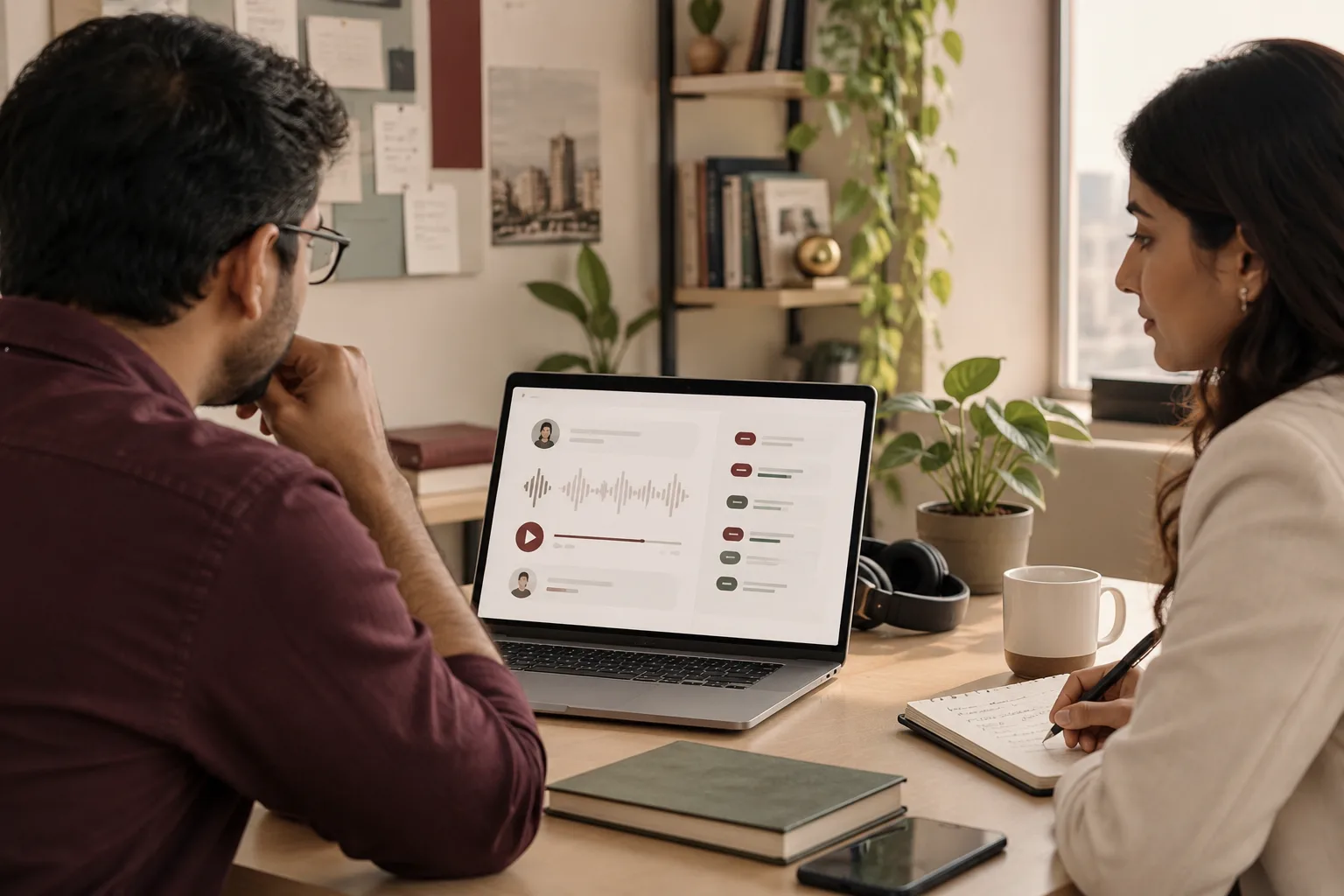
Conversation intelligence captures your customer calls with consent, converts them into searchable text, and pushes the themes, risks and coaching moments into the CRM your team already works in.

  • Every call is captured with consent, not only the ones someone remembers.
  • Objections, competitors and pricing talk get counted, not guessed at.
  • Risk signals reach the deal record while the deal is still open.

Gully Sales Private Limited works with businesses across India, and no call is recorded or analysed without the consent your customers have given.

In one paragraph

What is Conversation Intelligence for Sales Teams?

Conversation intelligence is the practice of capturing customer calls with consent, turning them into searchable text, and reading them for patterns nobody can count by hand. Gully Sales sets up the recording, consent and transcription layer, defines the topics and risk signals worth tracking, writes the output back to your CRM, and keeps a human review step so the system stays trustworthy.

The problem

Your most valuable revenue data is spoken, and then it is gone.

Ask what happened in last week's calls and you will get a summary: the client wants a discount, the competitor is cheaper, we are waiting for their approval. All of it is true and all of it is second-hand. The call itself — the question that went unanswered, the price said out loud, the hesitation at minute nine — was never written down. So the business decides on pricing, product and hiring from remembered impressions, while the actual evidence sits unopened on a phone system nobody logs into.

You will recognise it as

  • Your phone system has been recording calls for months and nobody has opened the folder.
  • Two people describe the same customer meeting differently in the same review.
  • You hear that price is the problem, but cannot say how often price is actually raised.
  • CRM notes read the same on every deal: discussed, will follow up.
  • A competitor's name keeps coming up in lost deals and appears nowhere in your CRM.
  • New joiners take months to sound like your strong sellers, because nothing is written down.

What it costs the business

  • Pricing and product decisions rest on the loudest anecdote rather than on what customers repeatedly ask for.
  • Coaching is aimed at the wrong habit, so the same objection keeps ending deals quarter after quarter.
  • Forecasts move on optimism, because nobody can see which open deals have gone quiet or turned defensive.
  • Marketing writes in language customers never use, so campaigns and calls pull in different directions.

Why it persists. It persists because listening does not scale. A manager with ten sellers and forty calls a day can sample two of them and hope they were typical. Recording tools get bought, switched on, and then abandoned, because nobody agreed what to look for, who reviews the output, or what happens to a recording after a month. Without that agreement the system produces hours of audio and no decisions, and the team quietly goes back to memory.

If it stays unresolved. The gap widens as you grow. Ten sellers make ten private versions of your pitch, and the version that works stays locked inside one person's habit. Every new hire is trained on somebody's recollection of it. When that person leaves, the pitch leaves with them, and the business starts again from nothing.

What changes

What changes once your conversations become evidence.

In the first weeks

  • Calls are captured and stored under one written consent, access and retention rule.
  • Every recorded call has a searchable transcript within hours instead of never.

In how the work runs

  • Managers coach from named moments in real calls instead of general advice.
  • Deal reviews open with what was actually said, so they get shorter and calmer.
  • New joiners learn from a library of real calls, not from whoever is free that week.

In sales and marketing

  • Repeated objections are counted, so pricing and packaging debates get evidence.
  • Quiet or defensive deals surface while there is still time to act on them.

In what management can see

  • You can see which topics rise and fall across a quarter, not only inside one deal.

Over the longer term

  • Your selling knowledge lives in the business rather than in individual memory.
  • Conversation signals sit beside CRM data, so judgement rests on two sources.

Gully Sales controls the capture, consent, transcription, signal design, CRM wiring and review rhythm. Whether revenue improves also depends on your pricing, your product and whether managers act on what the calls show.

Who it is for

This fits businesses where deals are decided on a call.

The businesses it suits

  • Teams of five or more sellers whose customers buy after a spoken conversation.
  • Inside sales, tele-calling or appointment desks handling repeatable call volume.
  • Companies whose calls already run through a cloud phone system, dialler or online meetings.
  • Owners who want coaching to be specific rather than motivational.
  • Businesses where a handful of objections decide most outcomes.
  • Multi-branch operations trying to make the pitch consistent across locations.

What usually prompts the call

  • You have hired sellers faster than anyone can listen to them.
  • Win rates fell and nobody can explain what changed in the conversation.
  • A CRM went in, and the notes inside it are too thin to be useful.
  • You are preparing to standardise the pitch across branches or regions.
  • A customer dispute turned on what was promised, and there was no record.

What Gully Sales does

The work, component by component.

Recording and consent

We agree what gets recorded, on which channels, and how customers and staff are told. That covers the consent line spoken at the start of a call, an internal policy your team signs, where audio is stored, who may listen to it, and how long it is kept before deletion.

Why it matters:
Recording without a stated rule creates legal exposure and, worse, quiet resistance from the team that kills the programme in its first month.
You receive:
A written consent, access and retention policy, plus the consent script your callers speak.
Business value:
You can run the programme openly, and explain it to a customer, a client audit or your own staff without discomfort.

Transcription and search

Recorded calls become text you can search, including calls that mix English with Hindi, Kannada or another regional language. Speaker separation shows who said what, and timestamps let anyone jump straight to the moment instead of sitting through the whole call.

Why it matters:
A manager will not listen to forty minutes of audio, but will read two minutes of transcript and click into the part that matters.
You receive:
Searchable, timestamped transcripts with speaker labels, attached to the deal record.
Business value:
Reviewing a call becomes a five-minute job, so it actually happens every week rather than once a quarter.

Topic and sentiment signals

We define the handful of things worth counting in your market: pricing talk, named competitors, delivery and credit terms, your specific objections, next-step commitments, and the tone shifts that usually come before a deal stalls. Each is detected across calls and reported as a trend, not a one-off note.

Why it matters:
One call is an anecdote. Two hundred calls carrying the same objection is a decision waiting to be made about your pricing, product or script.
You receive:
An agreed signal dictionary and a monthly trend view showing how each signal moves.
Business value:
Arguments about price and competition move from opinion to counted evidence everyone can see.

Coaching insights

Each seller gets a small, evidence-backed picture of their own calls: talk-to-listen balance, questions asked before pitching, how objections are answered, and whether a next step was fixed before the call ended. Clips are pulled so a manager can show the moment rather than describe it.

Why it matters:
General advice changes nothing. A seller who hears their own call and a strong one back to back changes within a week.
You receive:
Per-seller coaching cards with linked call moments and one habit to work on.
Business value:
Coaching becomes short, specific and repeatable, so it survives a busy month.

Deal-risk alerts

Open deals are watched for the patterns that usually run ahead of a loss: no conversation for a set number of days, no agreed next step, a new name entering late, procurement or budget language appearing suddenly, or a deal resting on a single contact with no second stakeholder.

Why it matters:
Risk found in the monthly review is history. Risk found this week is still a deal somebody can save.
You receive:
Rules-based risk flags on open deals, delivered to owners and managers on a set rhythm.
Business value:
Manager attention goes to the deals that are slipping instead of being spread evenly over the ones that are fine.

CRM integration

Transcripts, call summaries, signals and risk flags are written back into your CRM against the right contact and deal, so nobody works in two systems. Where fields are missing we add them, and where it helps we set call outcome and next-step fields from the conversation itself.

Why it matters:
A signal that lives in a separate dashboard gets ignored. A signal sitting on the deal record gets acted on.
You receive:
Mapped fields, write-back automation and a call view inside your existing CRM.
Business value:
Your CRM starts filling itself with evidence instead of depending on somebody's typing discipline.

Human review

A person checks the machine. Each cycle we sample transcripts and signals, confirm the tagging is right, correct the dictionary wherever the model misreads your market's vocabulary, and look at any flagged call before it turns into a performance conversation.

Why it matters:
Automated language tools misread jargon, accents and sarcasm. Left uncorrected, they teach a team to distrust the whole system.
You receive:
A documented review cycle with sampling rules, accuracy notes and a correction log.
Business value:
The output stays trustworthy enough that managers act on it instead of arguing with it.

What you will have at the end.

  • A written recording, consent, access and retention policy, with the consent line your callers speak.
  • Capture set up on your phone system, dialler or meeting tool, with a test log proving it works.
  • Searchable, timestamped transcripts with speaker labels, attached to the right deal record.
  • A signal dictionary naming every topic, objection and risk phrase tracked, in your market's own words.
  • An anonymised sample transcript and coaching card from your own calls, shown before any wider rollout.
  • Per-seller coaching cards with linked call moments and one named habit to correct.
  • Deal-risk flags on open opportunities, with the rule behind each flag written down.
  • CRM field mapping and write-back automation, documented so your administrator can maintain it.
  • A monthly conversation trend report covering topics, objections and competitor mentions.
  • A human review and correction log showing what was checked and what was fixed.
  • A short runbook so a new manager can run the review cycle without us.

How it runs

The engagement, step by step.

  1. 1

    Consent, policy and scope

    We agree which teams and channels are in scope, draft the consent wording customers hear, write the internal policy your staff sign, and decide where audio sits and how long it is kept. Nothing is recorded until this is signed off.

    You provide:
    Leadership sign-off, the list of teams in scope, and details of any recording arrangement already running.
    We produce:
    A signed consent, access and retention policy and the caller consent script.
    Done when:
    Leadership, sellers and customers all know what is recorded and why.
  2. 2

    Capture and transcription setup

    We connect your phone system, dialler or meeting tool so calls are captured reliably, then set up transcription for the language mix your team actually speaks. We test with a small group and read the output ourselves before anyone else is switched on.

    You provide:
    Administrator access to the phone, dialler, meeting and CRM systems, and a pilot group of sellers.
    We produce:
    Working capture, transcription and storage, plus a test log showing what worked and what did not.
    Done when:
    A week of pilot calls is captured and readable end to end.
  3. 3

    Signal design from your own deals

    We read a sample of your recent won and lost deals with your sales lead and name what is worth counting: your real objections, the competitors who appear, the terms that come up in negotiation, and the phrases that tend to show up before a deal goes quiet.

    You provide:
    Two hours with your sales lead and access to a set of recent won and lost deals.
    We produce:
    A signal dictionary written in your own vocabulary, agreed line by line.
    Done when:
    Your team agrees the list describes their market, not a generic template.
  4. 4

    CRM wiring and alert routing

    Transcripts, summaries, signals and risk flags are mapped to CRM fields and written back automatically. We agree who receives which alert, how often, and what they are expected to do with it, so no notification arrives without an owner attached.

    You provide:
    A CRM administrator, approval for field changes, and the routing rules for alerts.
    We produce:
    Field mapping, write-back automation and a documented alert routing table.
    Done when:
    A call ends and its record appears on the right deal without anyone typing.
  5. 5

    Pilot, review and correction

    The pilot group runs for a full cycle while we sample transcripts, check the tagging by hand, correct misreadings of your jargon and accents, and sit in on the first coaching conversations to see whether the output is genuinely usable.

    You provide:
    Managers who attend the review sessions and say plainly what is wrong.
    We produce:
    A corrected dictionary, a written accuracy note and revised coaching cards.
    Done when:
    A manager uses the output in a real coaching conversation without arguing with it.
  6. 6

    Rollout and manager handover

    The remaining teams are switched on in stages. We train managers on the weekly review rhythm, hand over the runbook, and stay alongside for the first cycles so the habit forms before we step back.

    You provide:
    Time inside the existing sales meeting and a named owner for the review rhythm.
    We produce:
    Trained managers, a written runbook and the first two trend reports.
    Done when:
    Your own manager runs a full review cycle with us only watching.
  7. 7

    Measurement and next cycle

    We compare the agreed metrics against the baseline recorded before rollout, report what moved, and decide what to change: the dictionary, the alert rules, the coaching focus or the scope. Signals that produced no action are removed rather than kept for decoration.

    You provide:
    Access to CRM outcome data for the measurement period and one decision meeting.
    We produce:
    A measurement report against baseline and a written plan for the next cycle.
    Done when:
    You can see what changed, what did not, and what happens next.

Ways to work with us

You can start small or hand over the whole cycle.

Conversation intelligence setup

A one-time build: consent policy, capture and transcription, signal dictionary, CRM write-back and manager training, handed over with a runbook your own team runs afterwards.

Managed conversation review

We run the cycle with you each month — sampling, correction, coaching cards, trend report and risk flags — while your managers keep their attention on the coaching conversations themselves.

Assessment and architecture review

A short review of what your calls, phone system and CRM already capture, what is missing, and what a workable setup would look like, before you commit budget to building anything.

Why Gully Sales

What you are actually choosing when you choose us.

We start with consent, not with software.

The first document is your recording, access and retention policy, agreed with leadership and explained to your team. A programme that surprises people gets quietly sabotaged, whatever the tool cost.

The signals come from your deals, not a template.

We read your own won and lost calls before naming a single topic. An industrial distributor and a diagnostics chain do not argue about the same things, and a generic dictionary reports noise.

Everything lands where your team already works.

Transcripts, summaries and risk flags are written into your CRM against the deal. Nothing useful is left sitting in a separate dashboard that only the person who bought it ever opens.

A person checks the machine every cycle.

Language tools misread accents, jargon and code-switching. We sample, correct and log it, so the output stays something a manager can put in front of a seller with confidence.

We hand over the habit, not only the setup.

Managers are trained on a weekly review rhythm and given a written runbook. The measure of the engagement is that your own people can run the cycle after we step back.

Calls are one input, and we say so.

Conversation signals sit beside your CRM numbers and your pipeline reviews. We connect them rather than pretending that call data on its own explains why revenue moved.

Where it applies

The same service, in different businesses.

Industrial equipment and distribution

The situation:
Inside sales handles enquiry calls across several branches, and each branch quotes and negotiates in its own way.
How it applies:
Calls are captured per branch and read for pricing talk, credit-term requests and competitor mentions, then compared branch by branch.
Likely benefit:
Leadership can see where discounting begins and standardise the negotiation script using evidence rather than instinct.

Healthcare clinics and diagnostics

The situation:
The front desk answers patient enquiries all day, and conversion varies sharply between staff working the same shift.
How it applies:
Enquiry calls are recorded under a clear consent line and reviewed for questions answered, appointment offers made and follow-up promised.
Likely benefit:
The desk gets one consistent way of handling enquiries, and missed appointment offers become visible instead of invisible.

IT and software services

The situation:
Discovery calls are run by different consultants, and proposals are written from notes that vary in depth and accuracy.
How it applies:
Discovery transcripts feed the proposal, and the required questions are tracked so nobody writes a proposal from half a discovery.
Likely benefit:
Proposals reflect what the client said, and scoping arguments later in the deal become far less frequent.

Real estate and interiors

The situation:
Enquiries arrive from several campaigns, and sales blames lead quality while marketing blames follow-up.
How it applies:
Recordings show what enquirers actually asked for and how quickly they were called back, matched to the campaign that produced them.
Likely benefit:
The lead-quality argument gets settled with recordings, and both teams change the thing that is genuinely broken.

Education and training

The situation:
Counsellors speak to parents and students all season, and the pitch drifts as the intake deadline gets closer.
How it applies:
Counselling calls are reviewed for promises made, how the fee conversation is handled and which objections recur, with a weekly trend view.
Likely benefit:
Promises stay within what the institution can deliver, and admissions coaching targets the objections that actually appear.

Financial services and lending

The situation:
Tele-callers explain products to customers, and the business must be able to show that what was said matches what was approved.
How it applies:
Calls are captured under a stated consent and retention rule, and scripted disclosures are checked against the transcript.
Likely benefit:
Review moves from occasional spot checks to a recorded trail the business can produce when it is asked for.

Questions buyers ask

Before you enquire, the answers you will want.

How will our conversation data be governed, and how does it turn into an action?

Governance comes first. We write a policy naming what is recorded, where audio is stored, who may listen, and how long it is kept before deletion, and leadership signs it before capture starts. Action comes from routing: every signal has an owner, a rhythm and an expected response, so a risk flag reaches the deal owner weekly and a coaching card reaches that seller's manager. A signal nobody acts on is removed at the next review rather than left running.

Is recording customer calls acceptable practice in India?

Recording is common in Indian sales and support work, and the practice most businesses follow is straightforward: tell the customer at the start of the call that it is being recorded, tell your staff in writing, keep the audio secure, and delete it on a stated schedule. We build that disclosure into the call opening and the internal policy. We are not your legal advisers, so we ask you to have your own counsel approve the policy before rollout.

Our calls mix English with Hindi or a regional language. Will transcription cope?

Mixed-language calls are normal here, and transcription handles them unevenly. Common English and Hindi business speech transcribes well, while heavy dialect, poor mobile lines and unusual product names transcribe less well. That is exactly why the human review step exists: we sample transcripts, correct recurring misreadings, and add your product names and jargon to the dictionary. You see accuracy measured on your own calls during the pilot, before committing to a wider rollout.

Will my sales team feel they are being watched?

Some resistance is normal, and hiding the programme makes it worse. We introduce it as a coaching tool, publish the policy openly, and make sure managers spend the first cycles showing strong calls rather than catching mistakes. Sellers see their own cards. The teams that adopt this fastest are usually the ones where the manager reviewed their own call first, in front of everybody, before reviewing anyone else's.

How long before the calls start producing insight?

The setup work — policy, capture, transcription and the first signal dictionary — is normally the shortest part, and the pilot then runs for one full review cycle. Rollout to further teams happens in stages. We do not publish fixed timelines, because the schedule depends on your CRM, your phone system, how quickly legal sign-off arrives and how many sellers are in scope. The plan is dated in the written scope after the assessment.

What inputs are required from us to start?

Four things. Leadership sign-off on the recording policy. Administrator access to your phone system, dialler or meeting tool and your CRM. A couple of hours with your sales lead to read recent won and lost deals. And a pilot group of sellers whose managers will actually attend the review sessions. Without a manager who turns up to review the output, the system produces reports and changes nothing at all.

How is the value of listening to calls measured?

Against a baseline recorded before anything is switched on. The measures are data completeness, lead-response speed, lifecycle conversion by stage, adoption of the review cycle by managers, forecast reliability against flagged deals, reporting time, and revenue per seller. Capture and adoption move within weeks. Conversion effects need at least one full sales cycle before they mean anything, and we report them on that basis rather than earlier.

What does conversation intelligence not cover?

We do not give legal opinions on recording law, we do not act as your data protection officer, and we do not use call recordings to make employment decisions on your behalf. We also do not run your sales team. Building a full training programme, redesigning your CRM or rewriting your pricing sit in separate engagements, though what the calls reveal very often shapes what those engagements should do.

3 more questions

Do we need to buy an expensive tool for this?

Usually not at the start. Most businesses already record something through a cloud phone system, a dialler or an online meeting tool, and the first job is to use what exists rather than to buy. Where a licence is genuinely needed, we tell you which capability is missing and why, and you purchase it directly from the vendor. We take no commission on any software you buy.

What happens to a recording after it has been analysed?

It follows the retention rule you signed. Audio is normally kept for a defined window for coaching and dispute reference and then deleted, while the summary and signals stay on the CRM record because they carry the business meaning without the raw voice. Access is limited to named roles. If a customer asks for their recording to be removed, the policy already states who handles that and how.

Can this work for a team that only handles inbound enquiry calls?

Yes, and inbound desks often gain fastest, because the volume is high and the calls are short and comparable. The signals change: instead of deal risk you count questions answered, appointment or quotation offers made, response time and repeat callers. The coaching cards keep the same shape. What does not change is the consent policy and the manager review rhythm, which carry the whole programme.

Talk to us

See what a single week of your own calls already contains.

Request a Revenue Operations Assessment. It is a conversation about how your calls are captured today, what your CRM actually records, and whether conversation intelligence would tell you anything you do not already know.

  • No obligation and no sales script
  • A reply from someone who does the work
  • Your details are never sold or shared

Your details are used only to reply to this enquiry. We do not sell or share them, and anything you tell us about your customers, your calls or your numbers stays confidential.

Protected by reCAPTCHA — Google’s privacy policy and terms apply.

Get a free audit of how you sell, and a scored report of where the work is.

Book a free audit