Educational institutions · Standee and event banner design
An admissions-day board is read by a parent walking in, so it carries one message.
Standee and event banner design for an educational institution is the artwork for the tall boards and wide banners used on an admissions day, an open house, an exhibition or a career fair. GullySales designs each one around one message, using words you supply, and delivers layout, colour and print-ready files.
Scope, fee, reporting and term are agreed in writing after we have read your brief and spoken to you.

What standee and event banner design means
A standee is the tall freestanding board and an event banner is the wide printed sheet that hangs or stands in a lobby, a hall or a stall, and both are read while people walk past. GullySales designs the artwork for each one and hands over layout, colour and print-ready files, using words you supply.
Also for educational institutions
- PPC ads for educational institutions
- SEO for educational institutions
- Lead generation for educational institutions
- Digital marketing for educational institutions
- Reputation management for educational institutions
- Local SEO for educational institutions
- Branding and identity for educational institutions
- Social media marketing for educational institutions
Sales and marketing for educational institutions, the overview.
Last updated 14 Nov 2026. Rules for this trade differ by state and professional body, and they change. We describe restrictions in general terms, so check the current position with your own council or adviser before you publish anything.
For educational institutions
Where it usually goes wrong, and what we would do.
“A parent reads the board while walking, with a child by the hand”
On an admissions day the foyer is crowded, a child is pulling at a hand and a family is looking for the right queue. A standee has the time of a glance. The bulk of what a school wants to say, such as its history and its facilities, belongs in the prospectus. The board says one thing: where to go, or what the day offers.
“A fair or exhibition stall competes with fifty others”
At an education fair, a stall sits in a hall with other schools, colleges and coaching institutes, each with a similar board. A banner that shows the institution's name and one line at the right size is seen from the aisle. A banner full of small text, affiliation logos and group photographs is read by nobody, and looks like all the rest.
“What the board states is an advertisement”
A line on a banner about a rank, a result, a placement or an approval is advertising, and rules on how educational institutions may advertise differ by place and by authority. Your own adviser or board decides what may be printed. The design keeps such lines out unless you supply them as cleared, and never gives a result more weight than it has.
“The same board is reused, and the date is wrong”
A standee made for one admission round stands in the lobby for the next, still showing a closed date. A banner with a fixed session on it cannot be reused. Planning for reuse means the permanent part, such as name, crest and the way to apply, is separated from a change-panel that carries the dates.
What we do
What we deliver for educational institutions.
The work available for this need. We agree the deliverables and responsibilities for your engagement in writing.
A concept for each board
A first layout for the standee and a first layout for the banner, built from your words and your colours. You see the reading order, the empty space and the position of the crest before the detail is finished, and choose between directions on one sheet.
Result: One direction per board is approved before artwork is polished.
A reading-order sheet
A one-page note showing what the eye meets first, second and third on each board at the distance it will be read from. You can ask for a different order before the artwork is final, for example putting the admission date above the school's name for a one-day event.
Result: You can state on one sheet what each board says first.
Final artwork for each size
The finished design for every size you named: a roll-up standee, a flat board at the gate, a hall banner above the stall. The crest, any picture and the contact line sit inside the safe area, so the stand frame or the hanging edge does not cut anything off.
Result: Nothing important sits where a frame, a hem or a table will cover it.
A change-panel for dates and venues
A section of the design set aside for what changes each round, such as dates, a venue, a registration line or a counter number. The permanent area stays untouched, so the same standee is reprinted in part, or fitted with a new panel, instead of being redesigned.
Result: A date can be changed by editing one panel.
Print-ready files to your printer's specification
Files set to the specification your printer gives: bleed, colour mode, embedded fonts and resolution for a large print. If the printer gives none, you are told exactly what to ask. Large boards are checked at full size on screen for crop marks and for thin lines.
Result: The printer takes the files without rebuilding the artwork.
Matched versions and a screen version
A matching invitation graphic or a social post, built from the same design, so a family that saw the announcement recognises the board in the hall. A small screen version is made for the event page and for a message sent to parents before the day.
Result: The board, the invitation and the post are recognised as one campaign.
How the result is measured
- Visitors at the stall or the lobby who mention the board's message when asked how they heard of you
- Enquiries that name the offer or service shown on the board
- Forms, QR code scans or calls traced to the board's contact line
Recorded as a baseline before work starts, so every later report has an honest comparison.
Who it is for
This is written for these educational institutions.
- Pre-schools and play schools
- CBSE and ICSE schools
- State board schools
- Coaching institutes for competitive exams
- Degree colleges
- Vocational and skill-training institutes
- Ed-tech linked hybrid learning centres
- Multi-branch tutorial chains
Before you decide
Agree the work. Know how to judge it.
Standee and event banner design for educational institutions: use these checks to prepare, choose the scope, and review what changes.
Bring the right evidence
Name the buyers you want to meet and the reason for them to speak with you. Bring a product or service story that can lead to a useful next conversation after the event.
Make the scope clear
Agree the event activity, demonstration material, enquiry capture, and follow-up responsibilities. Separate venue or sponsorship spend from production and sales preparation.
Check the work in use
Review the conversations that had a recorded need and agreed next step. Track them through proposals and orders instead of treating badge scans as qualified opportunities.
Know when to change course
If nobody can follow up after the event, reduce the activity to what the team can handle. A full contact list with no next action is not a sales pipeline.
These are discussion points, not a fixed package. GullySales confirms the deliverables, responsibilities, fee, and term in writing after reading your brief and speaking with you.
Before we start
What to have ready before the work starts.
The records, access and decisions this work needs from educational institutions. Anything missing is noted in the written scope, with who will supply it.
- The event, date and venue in one line
- Write the one sentence the board must say, with the date and the place. If the day carries several events, such as a talk, a campus walk and a scholarship test, choose which belongs on this board. Without a choice, the board carries all of them and a parent reads none.
- Sizes of the standee and the banner
- Give the stand's dimensions, or the printer's list of standard sizes, and where the board will be placed. A board designed for a shape the stand cannot hold must be redrawn. If a hall banner hangs low or stands behind a counter, tell us what covers it.
- Crest, logo and colour values
- Large prints show every flaw in a small or blurred logo. Provide the crest as a vector file, with the exact colours. If only a photograph of a signboard exists, tell us early, because the crest has to be redrawn before it can be enlarged to banner size.
- Cleared wording on results and recognition
- If the board states affiliation, approval, a rank or a result, your own adviser or board should clear the exact wording. Give us the line and the person who cleared it. If no one has cleared it, we leave it off and the board relies on the name and the invitation.
- The printer and the date they need files
- Printers of large formats have their own specifications and their own queue before an event. Tell us who prints the boards and by when they need files. We prepare the files to that, and flag anything the printer must confirm, so no board arrives late or cut off.
How it works
How the standee and event banner design work runs
The work itself, in order. How an engagement starts, from your brief to a written scope, is set out on our method page.
- 1
Choose the one message for the day
We begin by asking what the board must do on this occasion: direct families to the admissions desk, announce an open house, invite students to a scholarship test, or mark a career fair stall. Only one answer is used per board. Other messages are moved to a leaflet, the prospectus or a table nearby.
- 2
Measure where the board will stand
You tell us the size of the stand, how far visitors see it from, and what stands in front of it: a reception desk, a table, a staircase. We mark which part of the board is hidden or hard to read. The contact line and the crest are placed where they are really visible.
- 3
Receive the words and the cleared lines
You supply the words, including the event name, date, venue and any line about affiliation or approval your adviser has cleared. We do not write them and we do not add claims. If the lines are too long for the board, we propose cuts and your approver decides.
- 4
Draw two directions per format
We design two layouts for each board, using the crest and colours, and show them at the size they will be seen. A hall banner and a gate standee do not share a layout. The principal or the admissions head chooses, and the direction chosen is then finished.
- 5
Check at full size and with the printer
The artwork is viewed at full size and from the distance of a visitor. Small text is enlarged or removed. Files are matched to the printer's specification and a proof is checked for colour, trimming and cut-off edges. A coloured crest that prints darker than expected is corrected before the order is placed.
- 6
Use on the day and read the record
After the event, we look at what the admissions desk recorded: families who asked where to go, who mentioned the board, and who stopped at the stall. Before the work began, the desk noted the same for the previous event. We read the two records side by side and report what changed.
Where this fits
Three pieces of sales work, in this order.
This work sits inside sales process design, at stage 1, prospecting and lead generation. The audit comes before it, and sales management keeps it running.
Step 1
Sales audit
Find where deals are being lost and what to fix first.
Start here if you cannot say where orders are lost.
Step 2 · you are here
Sales process design
One written way to sell, from first enquiry to repeat order.
Start here if every salesperson sells differently.
Step 3
Sales management
A target, a review routine and someone who owns the number.
Start here if the team has targets and no routine.
FAQ
Questions owners ask before they call.
Not here? More answers, or ask on WhatsApp.
How much text should an admissions-day standee carry?
Can the board show our rank or the latest results?
Can the standee be used again next round?
Do you also design the stall itself?
Can photographs of students be on the banner?
Will the print match the screen proof?
How long is the contract?
Who will actually do the work?
What do you need from us?
What if we are not happy with the work?
From the blog
Further reading for educational institutions.
 5 min read · 6 Oct 2026How families and companies choose between institutesA parent, a student, a candidate and an HR head each pick an institute differently. Who decides, what each checks and what admissions should have ready.
 8 min read · 21 Sept 2026How to advertise to studentsThe student chooses and the parent pays, so you run two campaigns at once. Under eighteen, platforms also limit how you can target them.
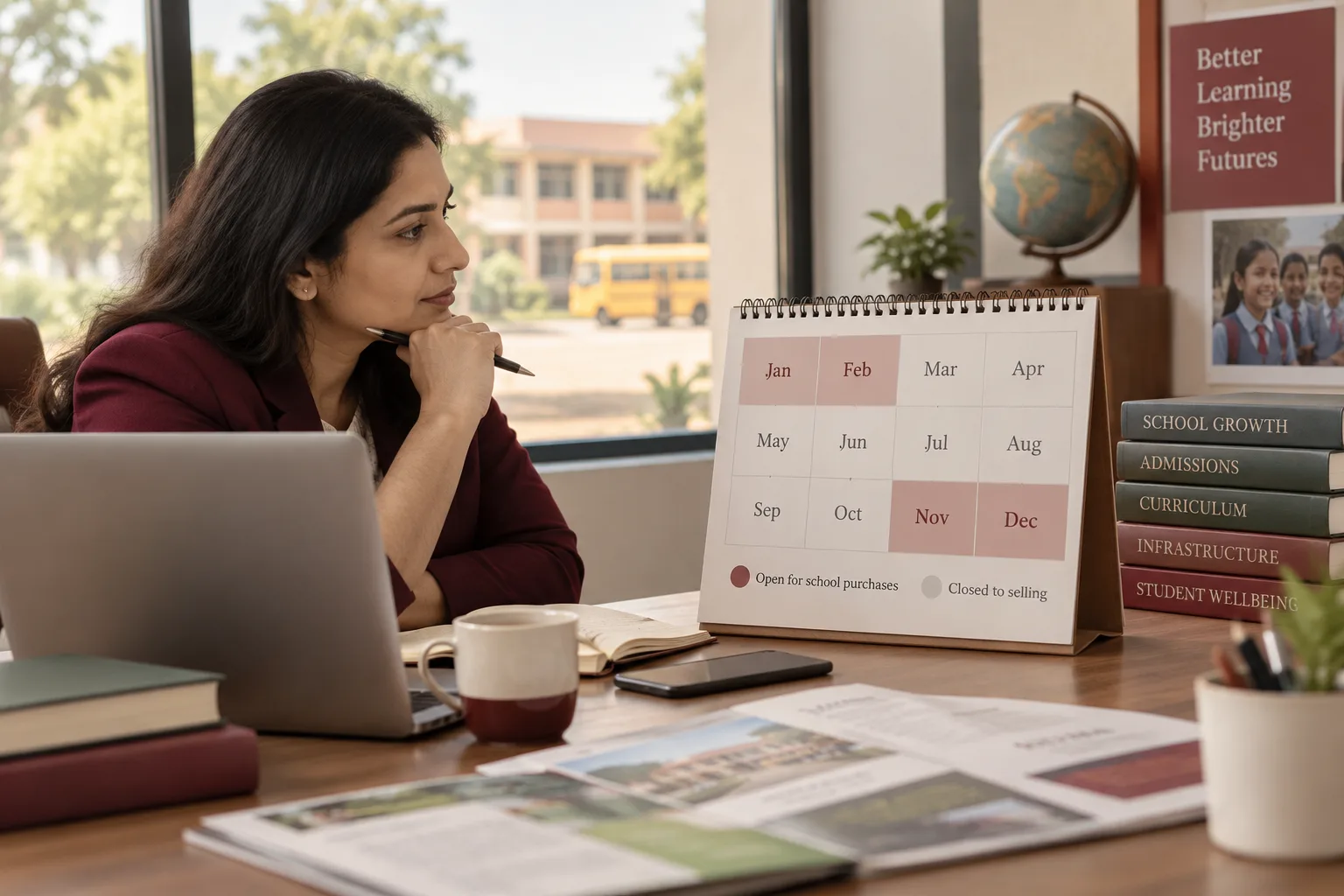 7 min read · 21 Sept 2026How to advertise to school ownersA school buys in a four-month window and is closed to selling the other eight. Miss November to February and you have missed the year.
More for educational institutions
Related work to consider.
Closest to this: paid and media
Also for educational institutions
Or start from the overview: sales and marketing for educational institutions.
Your next practical step
Tell us what you are trying to grow, and we will read it before we call.
Eight short steps, mostly taps. Skip anything you would rather answer on the call.