Football academies · Follow up systems
A trial that ends with no call is a child lost to the academy down the road.
A follow-up system for a football academy is the set of messages and calls that take a family from enquiry to trial, to enrolment and on to each season's renewal. GullySales works on the timing, the wording and the person responsible for each step.
Scope, fee, reporting and term are agreed in writing after we have read your brief and spoken to you.

What follow up systems means
A follow-up system is the set routine for calling, messaging or emailing an enquiry more than once, since most buyers do not decide on the first conversation. GullySales sets the number and timing of follow-ups so an undecided buyer keeps hearing from you until they decide either way.
Last updated 14 Nov 2026.
For football academies
Where it usually goes wrong, and what we would do.
“The child enjoys the trial and the family hears nothing”
The session ends, the parent drives home, and a week of silence follows. By the time a rival academy calls, the child's enthusiasm has found a new home.
“Renewal is a conversation, not an invoice”
A fee reminder at the end of the season reads as a bill. A call that mentions how the child progressed, which batch comes next and what the next season holds reads as care.
“Families who drift away are asked once and then forgotten”
A child who stops attending has a reason: a clash with exams, a coach change, a bad experience. A kind check-in finds the reason and sometimes brings the child back.
“A cancelled session needs a better message than silence”
Rain or a closed ground happens. A family told early, with a make-up date, forgives it. A family told late, or not at all, remembers it at renewal time.
What we do
What we deliver for football academies.
The work available for this need. We agree the deliverables and responsibilities for your engagement in writing.
Enquiry-to-trial sequence
The reply, the trial booking, a reminder and a welcome, with a named person for each.
Result: Each enquiry has a next step and an owner.
Post-trial call script
A short script and a trial note, so the call talks about the child's session and suggests the right batch.
Result: The follow-up is specific to the child.
Season renewal conversation
A plan to speak to every family before the season closes, covering progress, next batch and any concerns.
Result: No family reaches the end of the season unspoken to.
Lapsed-family check-in
A kind message to families whose child has stopped attending, with a way to share the reason.
Result: You learn why children leave.
Cancellation and make-up routine
A message format for rain and closures, with a make-up plan and a person who sends it.
Result: Families hear the change from you first.
How the result is measured
- Follow-up completion rate
- Average number of follow-ups before close
- Enquiries closed after repeat follow-up
Recorded as a baseline before work starts, so every later report has an honest comparison.
What to capture or send
Decide the message a family should receive after the trial, mid-season and at the season's end.
- Thanks after the trial
- A message the same evening with the coach's note on what the child did well and the batch on offer. Record what the parent asked.
- Joining details after the family says yes
- The ground, the days, the kit and the fee, in one message. A parent with the details at hand does not call back to ask.
- Mid-season note to the parent
- A short message from the coach on the child's progress and the next fixture. It shows the parent the academy is paying attention.
- Season-end renewal conversation
- A call by the coach or manager before the batch ends, with the next season's dates and fee. Log the answer and the reason for a no.
- Family who has stopped coming
- A friendly message asking if the child is well, and whether a different batch would suit. Record the reason.
Who it is for
This is written for these football academies.
- Grassroots football academies
- Academies affiliated to clubs
- School-based football programmes
- Five-a-side and turf-based academies
- Academies with girls' teams
- Residential and elite football programmes
- Academies running holiday football clinics and weekend leagues
- Academies training goalkeepers and specialist positions
Before you decide
When this may not be the right fit.
- No one is named to call after a trial, so a planned message would go out and the replies would wait.
- The next season's dates and fees are not decided, so a renewal call would ask a family to commit to an unknown.
- The coach and manager disagree about who speaks to parents, so a follow-up would reach families in two voices.
Before you decide
Agree the work. Know how to judge it.
Follow-up systems for football academies: use these checks to prepare, choose the scope, and review what changes.
Bring the right evidence
Trace recent enquiries from arrival to the last recorded action. Include a won enquiry, an unsuitable one, and one that went quiet, with personal details removed for the initial discussion.
Make the scope clear
Agree who accepts each enquiry, what makes it qualified, and how ownership changes. Include a rule for missed replies and a clear reason for closing an enquiry.
Check the work in use
Pick an enquiry at random and ask the team to find its owner, latest conversation, and next action. Check that the record agrees with what actually happened.
Know when to change course
If no one has capacity to respond, assign that responsibility before buying more leads. Automation can support the owner, but it cannot replace an unresolved handover.
These are discussion points, not a fixed package. GullySales confirms the deliverables, responsibilities, fee, and term in writing after reading your brief and speaking with you.
Before we start
What to have ready before the work starts.
The records, access and decisions this work needs from football academies. Anything missing is noted in the written scope, with who will supply it.
- The trial register and enquiry notebook
- Follow-up starts from who is waiting for a call. Bring both as they are. If trials were not recorded, the baseline undercounts the families lost.
- A note from the coach on each trial child
- One line per child helps the call: shy, quick, tired, loved the goalkeeping. Without it the call is a template, and the parent senses a script.
- Season end dates and the next group's details
- Renewal talks need dates and the plan for the next group. Write both. Without them the conversation is about the fee and not about the child.
- A rule for who makes which call
- Decide whether a coach, the front desk or the head makes trial calls, renewal calls and check-ins. Without a rule, calls are made by whoever remembers, and some families receive none.
- Your wording for a polite check-in
- Show how you already speak to a parent whose child has missed sessions. Without your voice, the messages we draft are stiff and go unsent.
How it works
How the follow up systems work runs
The work itself, in order. How an engagement starts, from your brief to a written scope, is set out on our method page.
- 1
List the families who went quiet after a trial
We go through the trial register and enquiry notebook and list families who attended a trial and never joined, and families who asked about a batch and never came. You mark the ones you know the reason for. The count is the baseline for the follow-up work and shows where the chain breaks.
- 2
Write the call that follows a trial
We draft a short script for the call after a trial: thank the parent, ask how the child felt, tell them the batch and place, and ask one question about the next step. The coach who saw the child adds a line. You read it aloud and change it until it sounds like the academy. We also write a shorter version for a family who attended with a friend, and one for a parent who could not stay for the whole session.
- 3
Plan the renewal conversation before the season ends
We write the renewal conversation as a talk with the parent, not a fee notice. It covers what the child worked on, what the next group offers and what the family needs to decide. You decide who talks to which families, and the head coach contributes a line for each group. We also write a version for a family whose child has not progressed to the next group, so that the conversation stays honest and the child is not made to feel left behind.
- 4
Set up the check-in for families who drift
A family that stops coming gets one honest message asking if everything is well, and a second only if they reply. We write both, with a line for an injury and a line for a school exam. You approve them and name who sends. We also set what happens when a parent replies with a reason for leaving, so that the reason is written in the record and read by the head coach.
- 5
Write the cancelled-session and make-up routine
When a session is cancelled for rain or a ground clash, parents get a message that says what is cancelled, when the make-up is and whom to ask. We draft it in two versions and attach it to the batch list. You test it on one cancellation.
- 6
Read the results against the starting figures
We compare trials that became enrolments, renewals confirmed and lapsed families who returned with the figures from the start. You tell us which messages parents disliked. You change one rule and keep the others fixed, so that the next reading shows what that single change did. We also read the reasons families gave for leaving, and compare them with the earlier log. We do not claim a rise in enrolments.
Where this fits
Three pieces of sales work, in this order.
This work sits inside sales process design, at stage 2, qualification. The audit comes before it, and sales management keeps it running.
Step 1
Sales audit
Find where deals are being lost and what to fix first.
Start here if you cannot say where orders are lost.
Step 2 · you are here
Sales process design
One written way to sell, from first enquiry to repeat order.
Start here if every salesperson sells differently.
Step 3
Sales management
A target, a review routine and someone who owns the number.
Start here if the team has targets and no routine.
FAQ
Questions owners ask before they call.
Not here? More answers, or ask on WhatsApp.
How many follow-ups are too many?
Do we need software for this?
Who should make the renewal call?
What should we say when a family chooses to leave?
How soon after a trial should the family hear from us?
What if the family says the child lost interest?
How much does it cost?
How long is the contract?
Who will actually do the work?
What do you need from us?
From the blog
Further reading for football academies.
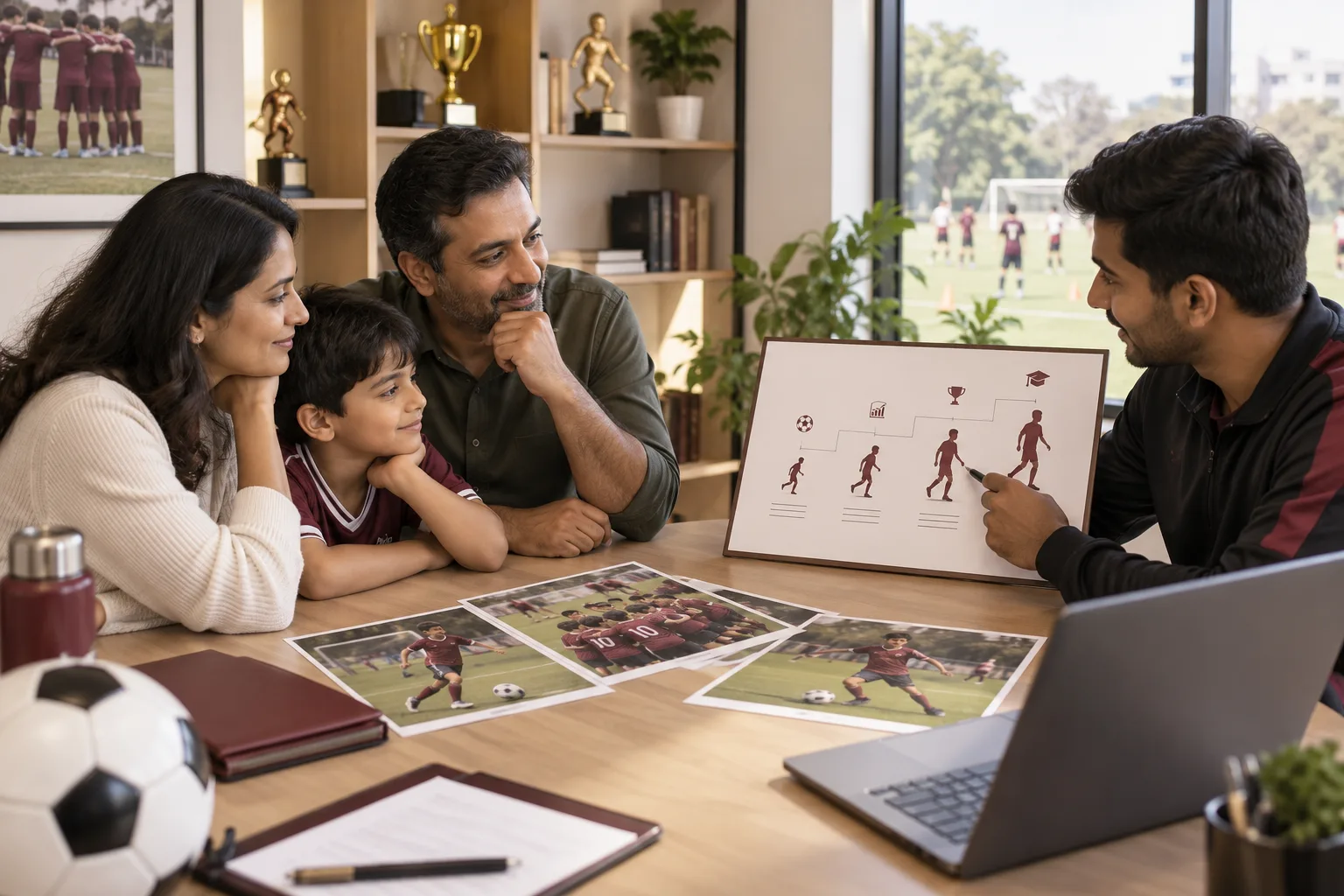 8 min read · 22 Apr 2026How football academies keep families season after seasonFamilies leave a football academy between seasons, not during one. A renewal conversation, match photographs and a written pathway bring them back.
 5 min read · 28 Jul 2026Using parent groups and community to bring in admissionsParents ask other parents first. How an academy, school or tuition centre can be useful in local parent groups without spamming, with house rules.
 5 min read · 28 Dec 2025An enquiry-to-enrolment tracker an institute can run on a spreadsheetA ten-column spreadsheet that shows where admissions are lost, from source to decision, each with an owner and a date. Layout, rules and a worked read-out.
More for football academies
Related work to consider.
Closest to this: leads and follow-up
Also for football academies
Or start from the overview: sales and marketing for football academies.
Your next practical step
Tell us what you are trying to grow, and we will read it before we call.
Eight short steps, mostly taps. Skip anything you would rather answer on the call.