Carpet cleaning companies · CRM
Keep every quote, site visit and contract renewal in one place, not in memory.
A CRM for a carpet cleaner is a record of each buyer, site, carpet and quote, with the next action beside it. GullySales works on setting up the fields, the stages and the habits so your team can see which quotes are waiting and which contracts are due.
Scope, fee, reporting and term are agreed in writing after we have read your brief and spoken to you.
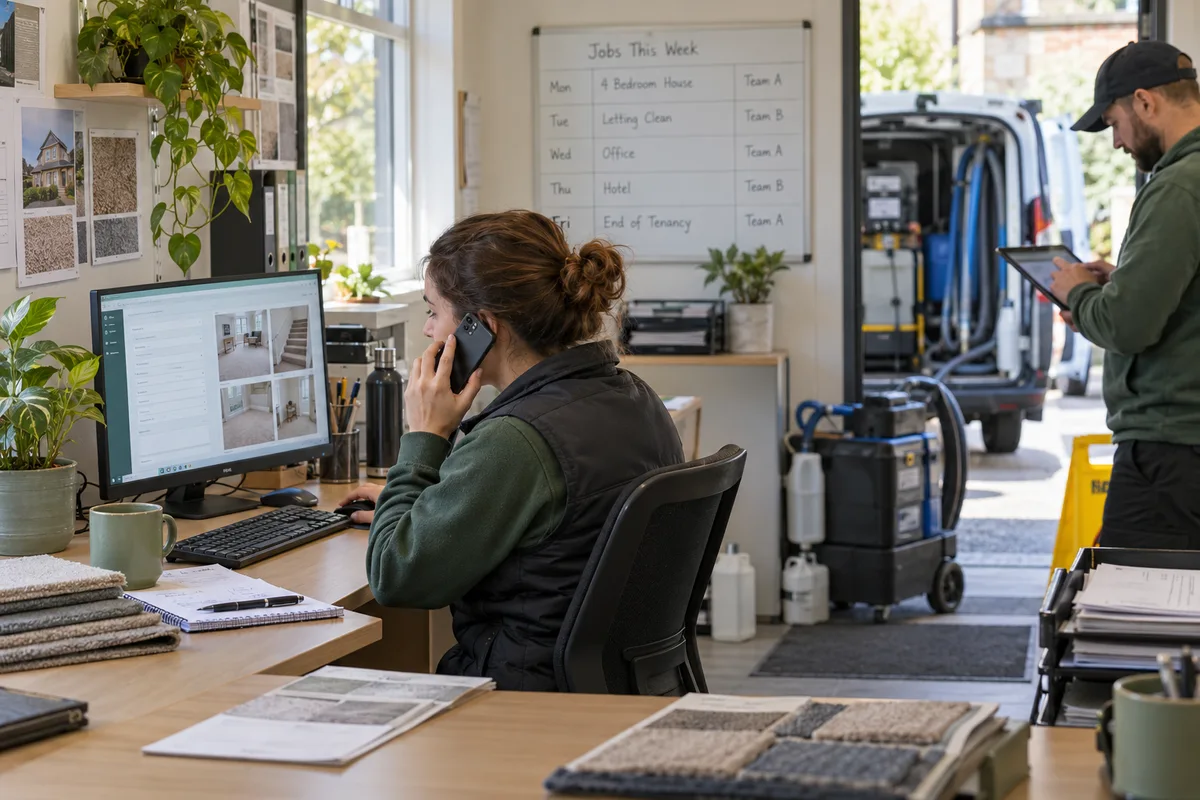
What CRM means
A CRM is the record where every enquiry, call and quote is kept against a customer, replacing separate notebooks, spreadsheets and memory. GullySales sets up or cleans an existing CRM and reports from it by enquiry outcome rather than by activity logged.
Also for carpet cleaning companies
- Lead generation for carpet cleaning companies
- Follow-up systems for carpet cleaners
- SEO for carpet cleaning companies
- Local SEO for carpet cleaning companies
- Social media marketing for carpet cleaners
- Content marketing for carpet cleaners
- Buyer personas for carpet cleaning companies
- WhatsApp marketing for carpet cleaners
Sales and marketing for carpet cleaning companies, the overview.
Last updated 14 Nov 2026.
For carpet cleaning companies
Where it usually goes wrong, and what we would do.
“A quote at a purchase office is easy to forget”
The visit happens, the figure goes by email and the file moves to someone else's desk. Without a record of who was sent what and when, the follow-up depends on the owner's memory.
“Contract dates hide in diaries”
A yearly agreement with a hotel or office ends on a date few remember until the other vendor calls. A record with end dates and areas included turns renewal into a planned conversation.
“Carpet detail is lost between visit and job”
The area, fibre, stain type and access hours noted at the visit must reach the crew on the night. If they stay in one person's notebook, the job starts with questions.
“Rug customers return, but not on a pattern”
A homeowner may call again after a function or a monsoon. A history of what was done to which rug lets the next call start from facts rather than guesses.
What we do
What we deliver for carpet cleaning companies.
The work available for this need. We agree the deliverables and responsibilities for your engagement in writing.
A fields and stages design
Buyer type, site, carpet type, area, stains, stage of quote and next action, set up in a tool you already use or a simple one we suggest.
Result: Every enquiry sits in a stage with a named next step.
A site-visit record
A form that holds the visit notes and photographs and passes them to the crew.
Result: The crew on the night has the notes from the visit.
A contract diary
End dates, areas covered, visits agreed and renewal owner for each commercial client.
Result: A list of renewals you can see before they arrive.
Rug history cards
What was done, which method and any condition noted at pickup, per rug.
Result: A repeat customer's rug comes with its history.
A short training for the team
How to log a call, a quote and a result so records stay complete.
Result: Everyone enters the same details in the same way.
How the result is measured
- Enquiries logged in the CRM
- Data completeness
- Reports generated from CRM data
Recorded as a baseline before work starts, so every later report has an honest comparison.
Fields worth keeping
Keep the fields that let you quote and return.
- Buyer type
- Hotel, office, home, designer or dealer. The person who takes the enquiry sets it, and it lets you count which door brings visits.
- Carpet or rug type and area
- Filled in at the site visit. It lets the quote be written from the record instead of from memory when the buyer calls back.
- Contract renewal date
- Entered by the owner when a standing contract is signed. It gives you a prompt to call the facility manager before the renewal, not after.
- Stain or damage noted at visit
- Recorded by the crew head with a photo. It protects you in a dispute and reminds you what to say before work starts.
- Next step and who owns it
- One line and a name. It stops a quote sitting at a purchase office with nobody assigned to chase it.
Who it is for
This is written for these carpet cleaning companies.
- Hotels, resorts and banquet halls with wall-to-wall carpet
- Corporate offices and co-working spaces with carpet tiles
- Malls, showrooms and cinemas with large floor areas
- Premium homes and villas with rugs and area carpets
- Handknotted, silk and woollen rug cleaning specialists
- Plant-based rug washing and drying units
- Car and car-showroom carpet cleaners
- Cleaning companies adding carpet extraction machines to their service
Before you decide
When this may not be the right fit.
- You have only a few clients and the owner remembers each quote, so a system would add typing without adding control.
- Nobody is ready to enter a visit within the day, and an out-of-date record is worse than a notebook.
- You have not decided who owns a quote after the site visit, so fields would be filled by whoever happened to pick up the phone.
Before you decide
Agree the work. Know how to judge it.
CRM for carpet cleaning companies: use these checks to prepare, choose the scope, and review what changes.
Bring the right evidence
List the records your team uses and show how an enquiry becomes an order today. Bring examples of duplicate entries, missing owners, and reports that require manual correction.
Make the scope clear
Agree the stages, required fields, access roles, and integrations before configuring the system. Separate software subscriptions from setup, data work, and training.
Check the work in use
Ask the people who will use the CRM to complete a real handover and find the next action without help. Check that the management report can be traced back to individual records.
Know when to change course
If the process is unclear, buying a more complex CRM adds more places for confusion. Start with the minimum fields and rules the team can use consistently.
These are discussion points, not a fixed package. GullySales confirms the deliverables, responsibilities, fee, and term in writing after reading your brief and speaking with you.
Before we start
What to have ready before the work starts.
The records, access and decisions this work needs from carpet cleaning companies. Anything missing is noted in the written scope, with who will supply it.
- Your present diary, sheets and chats
- Bring the diary, the sheet or the chat lists you use now. We move open jobs and contracts into the record so that nothing in hand is lost at the switch. If nothing is written, we rebuild from invoices and the supervisor's memory.
- A list of contracts with renewal dates
- Write each contract client, the site, the scope and the renewal date. These dates are what the record protects best. Without them, a contract lapses unnoticed, and a rival's visit to the purchase office finds an open door.
- A list of rugs with their cleaning history
- Note the rugs you wash for regular customers, with type, age and the last wash date. The rug history cards are built from it. If the list is missing, the first entries are made as each rug returns, which is slower but accurate.
- Names of those who will type into it
- Say who will enter data and from which device, whether the owner, the supervisor or an office person. A record kept by one person who is away goes stale. We plan around real keepers and give each a login of their own.
- Your choice of sheet or light app
- Choose between a shared sheet and a light CRM app, knowing the sheet is free and the app adds reminders. We explain both on your phone. If you cannot choose, we begin with the sheet and move once the habit of recording is firm.
How it works
How the CRM work runs
The work itself, in order. How an engagement starts, from your brief to a written scope, is set out on our method page.
- 1
Trace one hotel job and one home job
We sit with you and follow two recent jobs from first call to payment: who took the enquiry, who visited, who wrote the quote, who sent the crew and who collected the money. Each hand-off, and the places where purchase offices and homeowners differ, becomes a stage or a field in the record.
- 2
Agree the fields for carpet and site details
We list the facts you need to see at a glance: buyer type, site, carpet or rug type, area, stain notes, quote date, contract renewal date and next action. You approve the list. We keep it short, since every extra field is a chance for the record to go stale.
- 3
Test the record with six old jobs
We set up the record in a shared sheet or a light app and enter six past jobs, including a contract, a rug pickup and a quote that went quiet. You and your supervisor read it together and tell us what is missing. Changes are made before any live enquiry is entered.
- 4
Connect calls, forms and messages to it
We link the places where enquiries arrive so each is entered with its source and carpet details. We check that a purchase office email and a homeowner's rug photograph both land in the right stage. A name entered twice is merged before it confuses the follow-up.
- 5
Let the crew use it on live jobs
Your team enters live enquiries and jobs while we watch. A crew member who finds a field awkward says so, and we change it. The aim is a record the office and the field supervisor can read without a call, so a rug's history is known before the van goes out.
- 6
Close the old diary and read the baseline
When the team is entering jobs on time, the old diary is retired. We compare quotes waiting, contracts due and jobs completed with the figures noted before the switch. You decide which stage or field to change, and any field nobody fills in is removed.
Where this fits
Three pieces of sales work, in this order.
This work sits inside sales management. A target, a review routine and someone who owns the number.
Step 1
Sales audit
Find where deals are being lost and what to fix first.
Start here if you cannot say where orders are lost.
Step 2
Sales process design
One written way to sell, from first enquiry to repeat order.
Start here if every salesperson sells differently.
Step 3 · you are here
Sales management
A target, a review routine and someone who owns the number.
Start here if the team has targets and no routine.
FAQ
Questions owners ask before they call.
Not here? More answers, or ask on WhatsApp.
Do we need paid software?
Our crew are not comfortable with software. Will this work?
Can the CRM send reminders?
Do we keep rug owners in the same list as contract clients?
Should rug owners and contract clients share one list?
Can the record remind us before a contract ends?
How much does it cost?
How soon will we see results?
Who will actually do the work?
What do you need from us?
More for carpet cleaning companies
Related work to consider.
Closest to this: leads and follow-up
Also for carpet cleaning companies
Or start from the overview: sales and marketing for carpet cleaning companies.
Your next practical step
Tell us what you are trying to grow, and we will read it before we call.
Eight short steps, mostly taps. Skip anything you would rather answer on the call.