Notes for owners · Branding and communication
Enquiries arrive in Tamil and nobody writes back properly: six replies and a handover rule
A short set of Tamil WhatsApp replies for the questions that come every day, saved on the shop's phone, and a rule for which messages go straight to the owner.
The GullySales team · Updated 17 Oct 2026 · 6 min read

On this page
When half your WhatsApp enquiries arrive in Tamil and the person on the phone answers "ok sir, pls check catalogue" in English, nobody is writing back properly. Putting it right is a small job. Give whoever holds the phone six ready Tamil replies for the questions that arrive every day, written by a native speaker and saved as quick replies in the WhatsApp Business app. Add one rule for which messages go to the owner. A reply in the language the buyer used, with the price and the next step in it, is what "properly" means here.
What "properly" means to the person who asked
The buyer typed in Tamil because that is the language of the purchase. An English reply can feel as if the shop is somewhere else, even when it is twenty kilometres away. A one-word reply ("4500") can feel as if nobody is really there.
A proper reply does four things. It is in the language the buyer used. It answers the question asked, with a figure where one was asked for. It names a next step. And it carries a person's name, so the second message goes to someone.
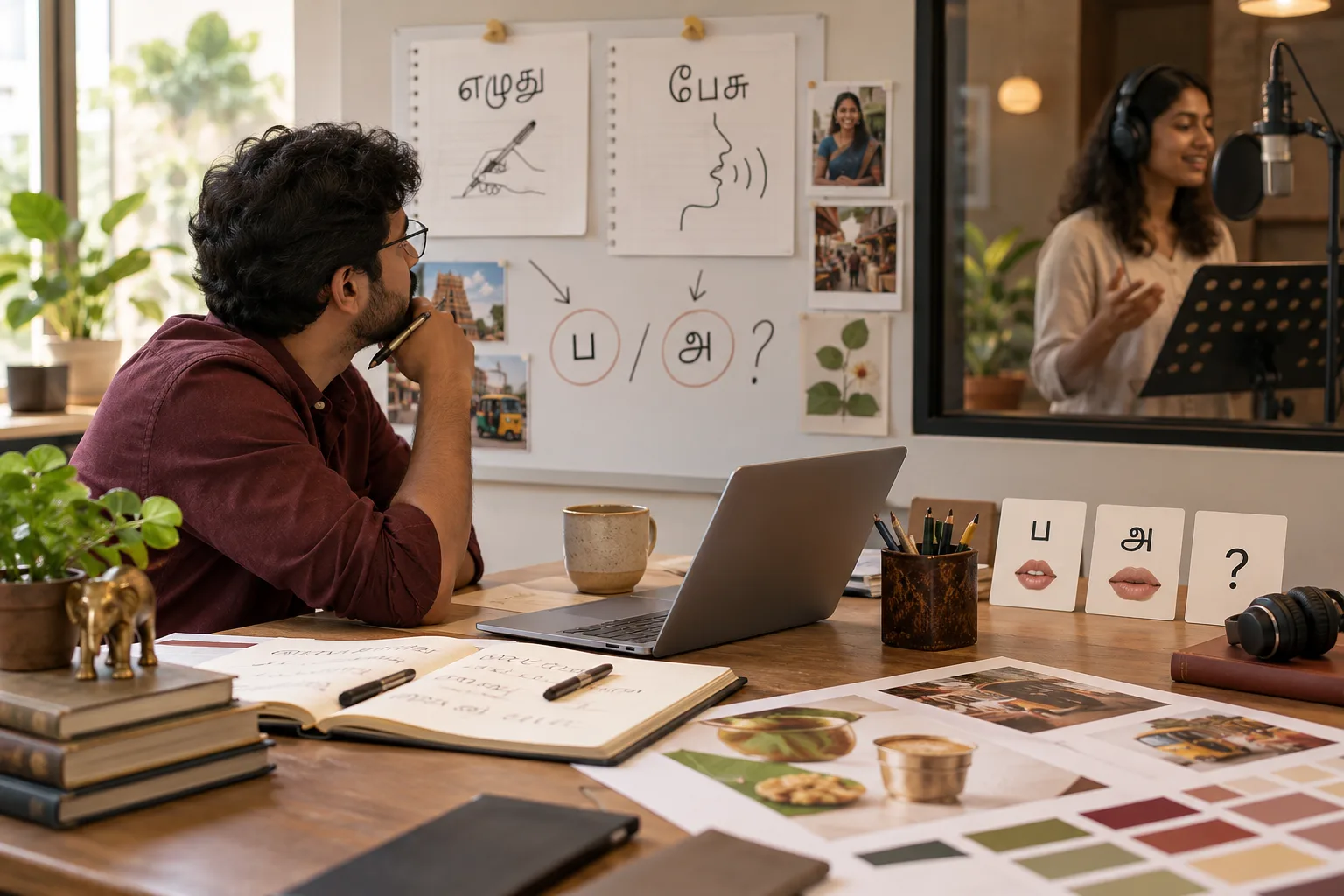
Register matters too. Textbook Tamil can read like an official notice, so the writer should use the way a polite shopkeeper speaks. Our note on Tamil advertising creative explains the gap between written and spoken Tamil, so it is not repeated here.
Six replies to save on the shop's phone
These are written for a lamp and brassware workshop. Change the nouns for your trade and keep the shape. They are in English only to show what each reply must carry. They are templates, not final text: do not send them in English, and do not paste them into a translation app. Ask a native Tamil speaker who sells in Tamil every day to write each one in the spoken Tamil your buyers use, once in Tamil script and once typed in English letters. Then have a Tamil-speaking customer you trust read them aloud before you save them.
1. The first reply to any enquiry.
Vanakkam. This is [name] from [shop]. Please send a photo of the lamp you saw, and I will tell you the price and size straight away.
2. The price.
This [size]-foot kuthuvilakku is ₹[price] and weighs about [weight] kg. Courier charges depend on your town. Send your pincode and I will give you the total.
3. Delivery.
We courier across Tamil Nadu. After payment, your parcel usually takes [number] days to reach [farthest town]. We send the tracking number here when it leaves.
Fill the number from what your courier has actually taken to your farthest town, and change the reply if it moves. Do not copy a number from this page.
4. Payment.
Sorry, there is no cash on delivery for lamps. You can pay by UPI or bank transfer, and we send the bill as soon as the payment arrives.
If you do offer cash on delivery, write that reply instead.
5. After a voice note.
I listened to your voice message. I understood that you want [the item]. Is that right?
6. The handover.
[Owner's name] will handle this personally and will call you by [time] today. What time suits you?
Save each Tamil version with a short shortcut, such as /vilai for the price, so it comes up when the person types a slash. Keep the English line beside each in a notebook, so a new staff member knows what is being sent.
What goes to the owner, and how
Reply 6 is the escalation. Send it, and forward the message to the owner, whenever an enquiry mentions any of these:
- a wedding, a seer set or a temple order;
- engraving a name or a date on the piece;
- damage, a dent or a wrong item on arrival;
- a discount beyond the offer that is already fixed;
- delivery outside India, which raises questions on packing and shipping that the counter cannot answer.
The handover itself is one forwarded message with one line on top: town, what they want, what you already told them, and the time promised. For example: "Thanjavur, wedding seer set, five pieces, price of 3-foot lamp sent, call by 6 pm."
Only promise a time the owner will keep. If the owner is at the foundry until evening, write tomorrow morning. A missed promised call does more harm than an honest later one.
Imagine a Kumbakonam lamp workshop and a wedding enquiry
Imagine a workshop near Kumbakonam that makes brass kuthuvilakku and pooja items, sells from its own showroom and ships across Tamil Nadu. A young relative of the owner handles WhatsApp between packing parcels.
A customer in Thanjavur writes in Tamil asking for lamps for a granddaughter's wedding seer. The relative replies in English with the price of one lamp and "COD not available". The customer goes quiet. Two more wedding enquiries go the same way that month, because each looked like a single-lamp sale.
The mistake was treating every message as a price question. A wedding seer order is several pieces, a budget conversation and engraving on some of them. It belongs with the owner from the first reply.
A cousin who sells in Tamil every day wrote the six replies, and the owner read them aloud before they were saved. The relative learned the handover list, with the words buyers actually type for wedding, seer and temple written on a card beside the packing table. The owner now looks at the handover messages before leaving the foundry. Ordinary orders still go through the relative, in Tamil, with the price in the first reply. It cost a cousin's afternoon and a small fee, and one of the six replies had to be rewritten after a buyer in Nagercoil read it differently.
When ready-made replies make things worse
Do not send a quick reply that does not answer the question asked. A buyer who asked about polish and gets the pasted price reply feels processed, not answered. And never send one with a bracket still in it.
Ready-made replies cannot fix a missing fact. If nobody knows the courier cost to Nagercoil, decide it before saving reply 2. If the website and catalogue are only in English, the same Tamil questions keep coming. A short Tamil page on price, courier and payment is website content writing work.
Get the six replies written this week
List the six questions your shop answers most, from last month's chats, and write what each reply must say in English. Hand the list to a native Tamil speaker who knows your buyers, and save only what they write. Put the handover list on a card beside the phone the same day.
More on the state is on our Tamil Nadu page. When you want the routine built around your counter with the WhatsApp sales process, tell us what you need.