Notes for owners · Branding and communication
Replying in Malayalam when the enquiry started in English
Many Kerala buyers search and fill forms in English, then talk in Malayalam. How to open the call back in Malayalam, the answer card the caller needs by the phone, and when English is the right reply.
The GullySales team · Updated 17 Oct 2026 · 5 min read
On this page
A grower types "rubber roller machine price" into Google and fills in your form in English. Your office rings the grower back in English, who says they will think about it, and that is the last you hear. In Kerala the search is often in English and the conversation in Malayalam. So open every call back in Malayalam, whatever the form was in, and follow the buyer's lead after the first sentence. Give the caller an answer card for the ten questions buyers ask most, with model names and figures in English. Send the written follow-up in the language the call ended in.
Why the form language misleads you
Typing English into Google and filling an English form says little about how a buyer wants to talk about a machine paid for out of this season's rubber money.
A planter in Pathanamthitta, a contractor in Pala or a shopkeeper in Thodupuzha may be more at ease in Malayalam, and an engineer at an estate company in English. You cannot tell from the form, and "Malayalam or English?" sounds odd on a sales call. Greet in Malayalam, and let the buyer's first sentence decide.
The answer card
Switching language is the easy part. The call fails when the caller speaks good Malayalam and cannot say whether the motorised roller runs on a single-phase supply.
Build a one-page card with the works supervisor and keep it by the phone. Questions are written the way buyers ask them; answers are short enough to say aloud. Here is the shape for a maker of rubber sheeting rollers. Fill in your own figures.
Hand or motor? Both. Hand model RH-1, motor model RM-2 (invented codes), and the supply each one needs: single-phase for the motor.
How many sheets an hour? For example, 60 with one person feeding (an invented figure; use your own).
Plain or grooved rollers? The set has both. The grooved pair gives the ribbed finish.
Will it fit in my shed? Footprint in feet, and the height of the feeding side.
Who fixes it in place? Our fitter. Say whether that is in the price.
Where do I get spares? The nearest stockist town, and the fitter's number.
What is the price? Card price with GST. Delivery depends on distance; ask the place.
Can I see one working? A video now on WhatsApp. A visit to the works any working day.
What is covered if it breaks? Your warranty terms, in one sentence.
When can it come? The lead time your floor will actually keep.
The card above and the opening below are English templates. The Malayalam itself, the greeting and every answer the caller will say aloud, should be written or checked by a native Malayalam speaker who knows the product. This post prints no Malayalam script for that reason; a machine-written line can read stiff or wrong to the buyer.
Keep the English words planters already use: roller, motor, HP, feet, GST. Malayalam advertising creative explains why replacing them with formal Malayalam makes a line sound translated.
The first minute of the call
The person calling should be a Malayalam speaker who has watched the machine run, even once. Then the first minute goes like this, said in Malayalam:
- A short Malayalam greeting, then: "This is Anjali from (company), Kottayam. You asked about our sheeting roller on the website." Your Malayalam speaker writes the greeting and the sentence in the form your area uses.
- One question that sizes the job: "Is it for your own holding, or for a group of growers?"
- Answers from the card, in the order the buyer asks, not the order printed.
- A next step with a time. "I am sending you a video of it running now. If you want to talk about the price, our proprietor will call you at five."
If a question is not on the card, the caller says so and gives a callback time. No guessing.
What to send after the call
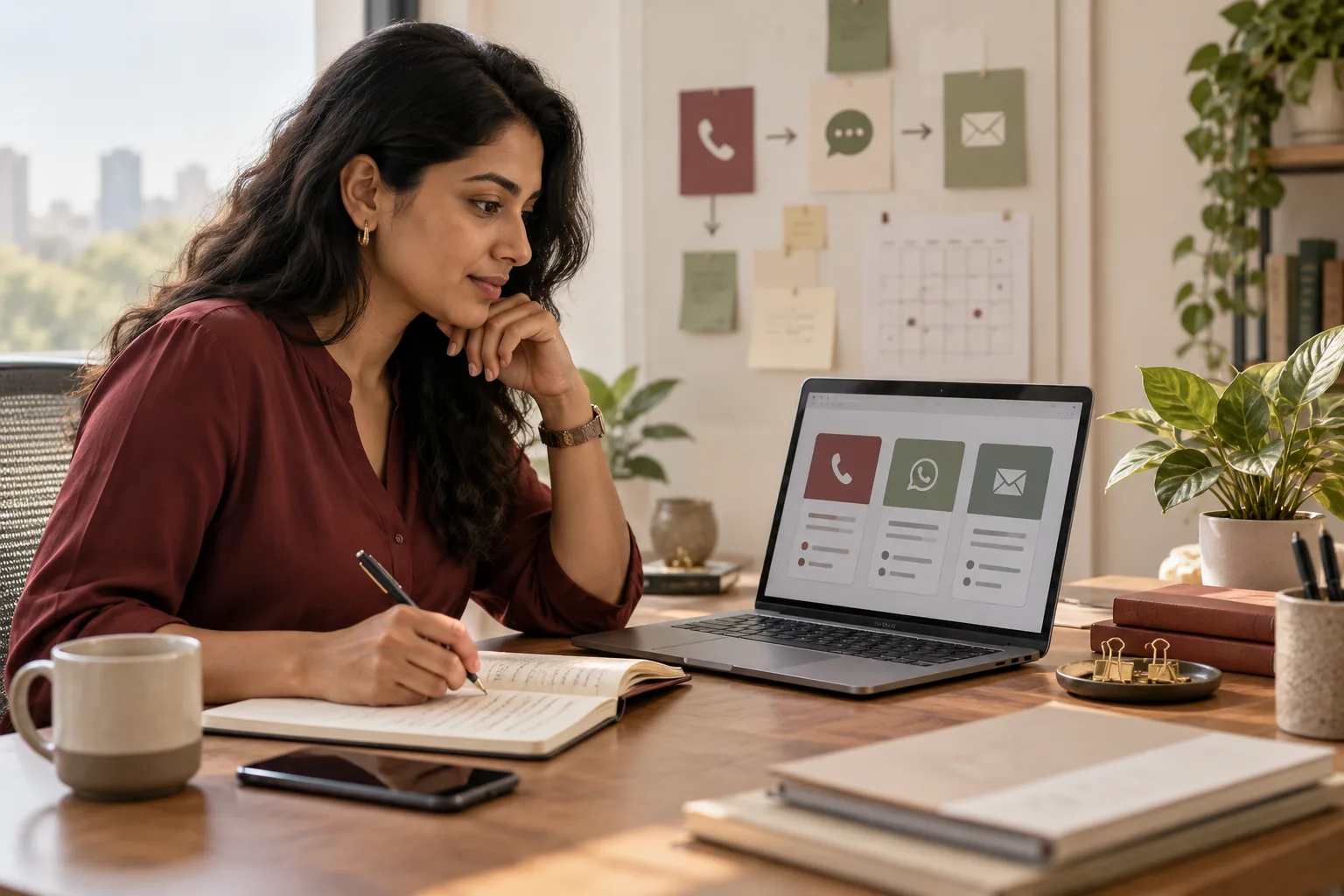
The same day, a WhatsApp message in the language the call ended in. Malayalam for the covering lines, English for model names, and digits for every figure, so nothing is misread.
Send the running video first, then the price. If the buyer sent a voice note before the call, reply with a voice note too.
For example: rubber rollers from Kottayam
Take an invented Kottayam workshop, details illustrative, making hand and motorised sheeting rollers for small growers and rubber producers' societies across Kottayam, Pathanamthitta and Idukki. Its website and enquiry form were in English, written for search.
The first mistake was the one at the top of this post. The office called back in English, and older growers went quiet. The owner told the assistant to call in Malayalam instead. That fixed the tone and exposed the second mistake. The assistant could not say which supply the motor model needed, or how many sheets it rolled in an hour. "Sir will call you", the assistant said, and the owner was at a society meeting until evening. One grower bought a ₹38,000 machine (an invented figure) from a dealer in Kanjirappally the next day.
The card cost one afternoon. The works supervisor and the assistant wrote it together, and the assistant spent an hour beside the machine while it ran. Prices went on the card with GST. Questions off the card got a fixed callback time, which the owner kept. Even so, the card did not save every call: of the first twelve call backs, three still ended with a callback time because the question was new, and one buyer had already ordered elsewhere. The form gained one line: "We will call you back in Malayalam or English, as you prefer."
When English is the right reply
If the buyer answers your Malayalam greeting in English, switch and stay switched. Some buyers prefer English for business, and following their lead is the courtesy.
Procurement staff at large estate companies, exporters and buyers from outside Kerala get English from the start. If nobody in your office speaks Malayalam, say so plainly in English. Then give a time when a Malayalam speaker will call. Do not fake it with half-remembered phrases.
Sit in on five call backs
Listen to the next five call backs your office makes to Kerala enquiries. Note the language each opened in and every question that got "Sir will call you". Those questions are your first card. The card, the call opening and the follow-up messages are sales messaging scripts and follow-up sequences; tell us what you need to start.