E-commerce · Automotive Parts
The buyer has a knock over speed breakers, and your listing names no symptom.
Hardly anyone shops for a ball joint. They shop for a noise: a knock over speed breakers, a car that pulls, a rear end that bounces. The mechanic names the part, the owner searches for it, and the listing that matches the diagnosis gets the order.
Scope, fee, reporting and term are agreed in writing after we have read your brief and spoken to you.
In one paragraph
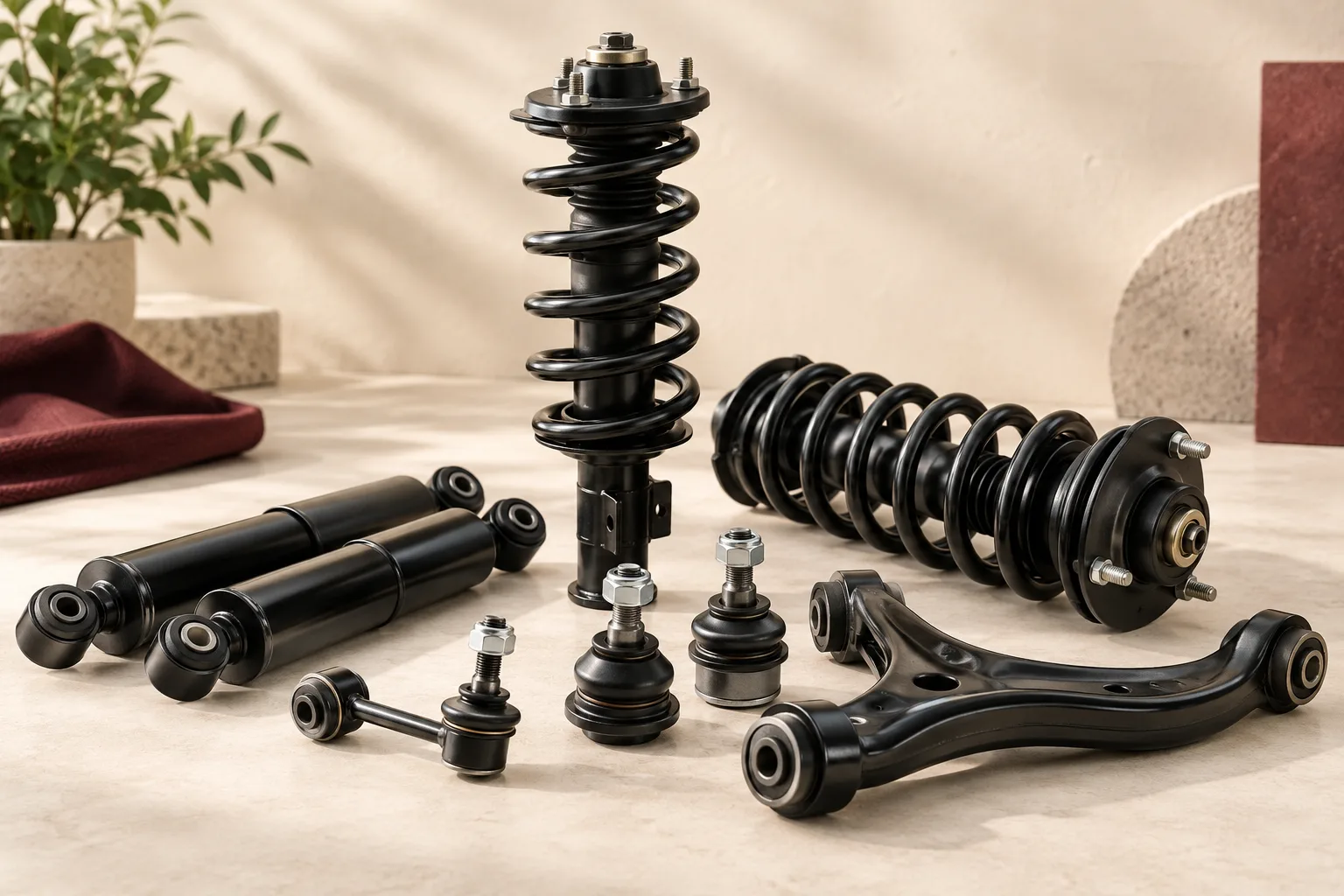
Suspension parts e-commerce is the online sale of shock absorbers, coil springs, control arms, ball joints, bushes, stabiliser links and wheel bearings. GullySales writes pages around the symptom and the exact position on the car, with left and right, front and rear stated, and handles the questions that come before the order.
This category punishes vagueness. Left or right, front or rear, upper or lower, with the bush or without it. Many parts are sold singly and replaced in pairs, and the buyer does not know whether to buy one or two.
Last updated 7 Oct 2026. Product, labelling and advertising rules for automotive parts differ by product and change. We describe them in general terms, so check the current position with your own adviser or the regulator before you publish a claim.
Who it is for
This is written for you if you sell suspension parts online.
- Sellers of shock absorbers and struts for hatchbacks, sedans and SUVs on Indian roads
- Suppliers of bushes, links and arms who sell to workshops and fleets
- Sellers of wheel bearings and hub assemblies with high return rates
- Distributors of heavier springs and shocks for commercial and utility vehicles
Not for
It is not the right fit if.
- Sellers who treat every model as the same and cannot list left, right and position. The returns will wipe out the margin.
- Anyone who wants to sell performance or lowered suspension with claims about handling. Those need your adviser, and we will not write the claims.
How buyers choose
What decides the sale of suspension parts.
Search by symptom
Buyers type what they hear and feel, such as a clunk from the front left or a car that bounces after a bump. Pages and articles that name the symptom and the part that causes it get the first click.
Position and side
A control arm is left or right, upper or lower. A shock is front or rear. The buyer needs these in the title, since the diagram in the workshop manual is not on their phone.
One or a pair
Shocks and springs are replaced on both sides of an axle. Buyers ask whether the price is for one, and a seller who sells the pair as the default avoids the follow-up.
The roads they drive
Buyers in a city with broken roads or a ghat route want parts that last, and read reviews for how long a part survived. Cars used for heavy loads or taxi work are another buyer altogether.
Where sales are lost
What usually goes wrong when you sell suspension parts online.
In the words sellers use on the first call.
“We sold the left arm and the customer needed the right”
The title said control arm and the photograph showed one side. Side and position must be in the title, the photograph and a required field.
“Buyers do not know what is wrong with their car”
They arrive with a noise, not a part name. A short guide from noise to part, with a prompt to have a mechanic confirm, brings in buyers a catalogue would not.
“Customers want a pair but order one”
The listing priced the single part, and the buyer found out at the garage. Showing the pair as the first choice cuts both the second order and the complaint.
“Wheel bearings and bushes come back with no clear fault”
These are fitted by pressing, and a poor fit gets blamed on the part. Fitting notes and a way to describe the fault by photo or video give you something to answer with.
The scope
The work we would propose for suspension parts.
Measured on purchases and, for trade buyers, qualified enquiries, quotation requests and repeat orders. Anything here that needs a platform or tool we have not used with you is confirmed with you before it goes in the scope.
- Symptom-to-part guidesShort pages written around a noise or a handling problem on a named model, with the likely parts and a note to have a mechanic inspect the car before ordering.
- Position-and-side product pagesEach part page names the model, year, axle and side, with photographs from the side that shows the mounting points.
- Pair and kit bundlesShocks, mounts and dust covers offered together, and bushes and links with an arm. The bundle is the default and the single part an option.
- Fitting videos from your own workshopA short video of a part being fitted or checked, filmed with a mechanic who already works with you, and listed on YouTube under the model's name.
- Fleet and workshop enquiriesA route for taxi operators and workshops to ask for a price on a set, with the vehicle and the number of cars on one form.
What we do
What you get for suspension parts.
Each deliverable and what it is there to change.
A part-by-position table for each model
Every suspension part, its side, axle and number. It lets your team answer without opening a catalogue.
A noise-and-symptom guide
A page that links a sound to the likely worn part and the cars most affected. It brings buyers who start from the symptom.
Pair and kit listings
Bundles that list every item in the box. They raise the number of parts in one order.
A fleet quotation form
A form for operators with several vehicles of one model. It collects what is needed to price a full set.
How the result is measured
- Purchases and conversion rate
- Qualified fleet and workshop enquiries
- Orders won
- Repeat orders
- Return rate
- Returns for wrong side or position
Recorded as a baseline before work starts, so every later report has an honest comparison.
How it works
From your first message to the first piece of work.
No open-ended retainer. Every step gives you something in writing.
First
Your brief
You tell us what you need in a few short steps: your business, what you want, where enquiries come from and how they are handled.
After the brief
A conversation and a written scope
We read it, then talk with whoever handles your enquiries. If you want our help, the scope, the fee and the reporting come in writing, and nothing starts before you have read them.
Before work starts
Baseline recorded
The numbers this work is meant to move, such as enquiries, quotations, orders, visits or renewals, written down so every later report has an honest comparison.
After the baseline
The first fix goes live
The fix we agreed to start with is put in place and measured against the baseline, whether that is a reply, a follow-up, a page, a listing or the handover between marketing and sales.
As agreed
Report against the baseline
What moved, what did not, and what changes next, in plain words. How often you get it is set in writing before work starts.
At renewal
Renew on the numbers
The term ends and you decide whether to continue from the results. The length is agreed in writing before anything starts.
What we need from you
What to have ready before we talk.
None of it has to be tidy. We read what you have.
- Your parts list with side, position and part number
- Return reasons with any photographs the buyer sent
- Fitting guides from the manufacturer
- Names of workshops that fit your parts and would appear in a video
- Details of any taxi or fleet buyers you already supply
Selling in India and abroad
Selling suspension parts beyond your own market.
Where you sell decides sizes, units, seasons and returns. We work from Bengaluru and have no overseas office, so for a new country we start from your own sales and the platforms you already use.
Road conditions and vehicle loads
Parts built for the loads and roads in India are not always what a buyer abroad needs. Each page says which vehicle and which market the part was made for.
Sold by the set
Overseas workshops usually buy axle sets. Shipping a set, and the duty on it, is for your forwarder to work out before the page names a price.
FAQ
Questions about selling suspension parts online.
Not here? More answers, or ask on WhatsApp.
Should I sell shock absorbers singly or in pairs?
How can I tell the buyer which side the part is for?
Can an article on car noises really bring buyers?
How much does it cost?
How long is the contract?
How soon will we see results?
Who will actually do the work?
What do you need from us?
What if we are not happy with the work?
More in Automotive Parts
Sellers of suspension parts also need
Also selling from a shop, a workshop or a warehouse? See the page for auto parts and accessories dealers and auto parts manufacturers.
This page is part of the e-commerce section. The D2C brands page covers the arithmetic of acquisition cost and the second order for any brand.
Why us
Why owners pick GullySales over an agency.
Marketing and sales, as one job
Most agencies stop at the enquiry. We also fix what happens after it: the reply, the follow-up, the quote and the CRM.
The person on the first call does the work
No account managers in between. You are never handed to someone you have not met.
A baseline before anything starts
Your numbers are written down on day one, so every later report compares against something honest.
The fee in writing, split three ways
Our time, your media spend and production on separate lines. You always see what goes to us.
No guarantees we cannot keep
The term is agreed in writing and never a default twelve months. We never promise a ranking or a lead count, because nobody controls those.
One office, and we say so
Nagarbhavi, Bengaluru. We work across India by call and WhatsApp and travel when a session needs to be in person.
#257, 3rd floor, Sri Nanjundeshwara Complex, Nagarbhavi 8th Block, Outer Ring Road. How we work.
Engagement options
Ways to work with us.
Pick the size of commitment that fits. Every option starts with your brief and a conversation.
Option 1
The conversation on its own
A call after you send your brief. It says honestly whether you need outside help, and many fixes are ones your own team can make.
Option 2
One fix, scoped
Start with the fix that matters most, such as reply time or follow-up. The fee is in writing before anything starts.
Option 3
An ongoing programme
We run the work, report against the baseline, and you renew on the numbers. The term and the reporting are agreed in writing first.
Option 4
Guidance for your own team or agency
We plan, brief and check the work of your in-house team or current agency, instead of replacing them.
Your brief
Tell us what you need, and we will read it before we call.
Eight short steps about your business, what you want and who decides. Most questions are a tap, and you can skip any you would rather answer on the call.
Your next practical step
Tell us what you are trying to grow, and we will read it before we call.
Eight short steps, mostly taps. Skip anything you would rather answer on the call.