Educational institutions · Buyer persona
Name who decides the admission, who pays the fee and who only visits the campus.
A buyer persona for a school or institute is a written profile of the person who chooses the seat, and that person differs for a pre-school parent, a Class 11 student and a working adult taking a skill course. GullySales builds the profiles from your own admission records and desk conversations, then shapes pages, replies and follow-up around them.
Scope, fee, reporting and term are agreed in writing after we have read your brief and spoken to you.

What buyer persona means
A buyer persona is a plain description of the kind of customer who actually buys from you. It includes what they search, what worries them and who else they ask before deciding. GullySales builds this from real enquiries and past sales rather than a generic template, then uses it to write every page and advert.
Also for educational institutions
- Digital marketing for educational institutions
- SEO for educational institutions
- PPC ads for educational institutions
- Lead generation for educational institutions
- Reputation management for educational institutions
- Local SEO for educational institutions
- Branding and identity for educational institutions
- Social media marketing for educational institutions
Sales and marketing for educational institutions, the overview.
Last updated 14 Nov 2026. Rules for this trade differ by state and professional body, and they change. We describe restrictions in general terms, so check the current position with your own council or adviser before you publish anything.
For educational institutions
Where it usually goes wrong, and what we would do.
“The chooser and the payer may be two people”
In a pre-school one parent researches and the other approves the fee. For a degree course the student shortlists and a guardian signs. Writing both down tells the desk whom to address on the call and whom to invite to the campus tour.
“A coaching aspirant and the parent worry about different things”
The student asks about faculty and the test series. The parent asks about hostel safety and fee instalments. A brochure that answers one and ignores the other loses the household to an institute that answers both.
“Your last admissions are the first personas”
The admission register shows who actually joined: board, locality, how they heard of you and who paid. Grouping those families into a few profiles is more reliable than copying a template from another trade.
“A working adult and a school-leaver do not read the same page”
A skill-training enquiry from a working adult turns on evening batches, instalments and whether employers accept the certificate. A school-leaver's family asks about affiliation and campus life. One page for both answers neither.
What we do
What we deliver for educational institutions.
The work available for this need. We agree the deliverables and responsibilities for your engagement in writing.
A persona sheet for each programme
One page per programme, such as pre-primary, Class 11 science or a diploma, naming the chooser, the payer, their worries and the questions asked on the first call.
Result: The desk knows whom it is speaking to before the second question.
A review of past admissions with your desk
We sit with the register and group enrolled families by board, locality, source and who made the decision.
Result: The profiles rest on your records, not on assumptions.
A bank of questions in families' own words
The questions parents and students ask on calls and chats, written down as they say them and sorted by persona.
Result: Pages and replies use the words your families type.
A message map for each persona
The first things to say on the phone, on the website and during the campus tour, set out for each profile.
Result: Anyone at the desk gives the same opening answer.
A persona field in the enquiry log
One field in the callback log that records which profile an enquiry matches.
Result: You can count which profile actually enrols.
How the result is measured
- Enquiry match to persona
- Conversion rate by persona
- Content aligned to persona
Recorded as a baseline before work starts, so every later report has an honest comparison.
Who is asking
Name the person who asks each question, because the one who visits is not always the one who pays.
- A mother comparing three pre-schools
- Wants to know the staff-to-child ratio, the daily routine and whether a caregiver stays with the child. Visits first and calls the school only after the visit.
- A father paying for a CBSE school fee
- Asks about total fee heads, annual increase and transport cost. Rarely visits, so a clear fee page decides whether the family comes at all.
- A Class 12 student choosing a degree college
- Wants to see the course, the affiliating university and what the hostel and campus are like. Asks friends before the college office.
- A coaching aspirant after a first attempt
- Wants to know the batch format, the faculty and the test series. Needs plain words on what the institute offers, with no promised result.
- A working adult returning for a part-time course
- Wants evening batches, the exam route and the time needed each week. Reads on a phone late at night and calls the next morning.
Who it is for
This is written for these educational institutions.
- Pre-schools and play schools
- CBSE and ICSE schools
- State board schools
- Coaching institutes for competitive exams
- Degree colleges
- Vocational and skill-training institutes
- Ed-tech linked hybrid learning centres
- Multi-branch tutorial chains
Before you decide
When this may not be the right fit.
- The school has not yet looked at who enrolled last session, so the persona would be invented instead of read from admissions.
- The admissions desk and management disagree on which families the school wants, so no persona could be agreed.
- No one will change the pages or the callbacks after the persona is written, so the work would sit unused.
Before you decide
Agree the work. Know how to judge it.
Buyer persona for educational institutions: use these checks to prepare, choose the scope, and review what changes.
Bring the right evidence
Write the decision the research must support, such as entering a market or choosing a buyer group. Separate what you know from sales records from what the team currently assumes.
Make the scope clear
Agree which buyers to speak to, which sources to review, and what access you can provide. Include lost enquiries and people who chose another supplier, where they are willing to take part.
Check the work in use
Look for source dates, sample limitations, and evidence that disagrees with the preferred answer. A recommendation should show how it follows from the findings.
Know when to change course
Do not treat a few positive conversations as proof of demand. Test the proposed offer with an actual buying decision before committing to a wider launch.
These are discussion points, not a fixed package. GullySales confirms the deliverables, responsibilities, fee, and term in writing after reading your brief and speaking with you.
Before we start
What to have ready before the work starts.
The records, access and decisions this work needs from educational institutions. Anything missing is noted in the written scope, with who will supply it.
- Last year's admission records
- Bring the enquiry register and the admission list for the last year, with the class and the source where known. Without them, the persona rests on interviews and desk memory.
- A counsellor who knows the families
- Name the person at the desk who knows why families chose you. They sit in the review. If none is available, the review rests on records alone and we say so.
- Willing families for short conversations
- Ask a few parents or students whether they will speak briefly. They should be asked by the school and be free to refuse. If none agree, the persona is built from the desk's view alone.
- Your privacy promise to families
- Bring what families were told about how their details are used. Our reading of records follows it. Where the promise does not allow sharing, your staff summarise the records without names.
How it works
How the buyer persona work runs
The work itself, in order. How an engagement starts, from your brief to a written scope, is set out on our method page.
- 1
Decide which programmes need a persona
We begin by listing your programmes: pre-primary, middle school, senior classes, coaching batches, adult courses. You choose which ones need their own persona, because a chooser differs for each. A programme with few admissions may share one. We also ask whether the person who pays the fee is the person who chooses the seat, since a grandparent or an employer may pay while a parent decides, and the page must speak to both.
- 2
Review last year's admissions with the desk
We take a sample of families who joined and a sample who did not, and go through them with the desk, without names in our notes. We ask who called, who visited, who paid and who decided. Their answers show who really chooses, who pays and who only attends the visit.
- 3
Speak to a few families who chose you
With the school's invitation and the family's consent, we speak to a few parents, students or adult learners about how they chose. We ask what they weighed up, what worried them and whom they consulted. A family that left is also asked, if willing.
- 4
Write the persona sheet for each programme
For each chosen programme we write a sheet with who chooses, who pays, the questions in the order they are asked and the words that reassure. No real child or family is named. The principal checks that nothing in a persona assumes caste, income or religion.
- 5
Put the personas to work in the log
We add a persona field to the enquiry log and map the messages and pages to each persona. You choose the first three uses. Later we compare the enquiries with the starting record to see whether the questions you expected were the ones asked.
Where this fits
Three pieces of sales work, in this order.
This work sits inside sales process design, at stage 0, foundation. The audit comes before it, and sales management keeps it running.
Step 1
Sales audit
Find where deals are being lost and what to fix first.
Start here if you cannot say where orders are lost.
Step 2 · you are here
Sales process design
One written way to sell, from first enquiry to repeat order.
Start here if every salesperson sells differently.
Step 3
Sales management
A target, a review routine and someone who owns the number.
Start here if the team has targets and no routine.
FAQ
Questions owners ask before they call.
Not here? More answers, or ask on WhatsApp.
How many personas does a school need?
Do we profile individual children?
Does a persona change with the admission season?
Should a persona include a family's caste, income or religion?
How is a persona for an adult course different?
Can a persona be used to target advertising?
How much does it cost?
How long is the contract?
How soon will we see results?
Who will actually do the work?
From the blog
Further reading for educational institutions.
 5 min read · 6 Oct 2026How families and companies choose between institutesA parent, a student, a candidate and an HR head each pick an institute differently. Who decides, what each checks and what admissions should have ready.
 8 min read · 21 Sept 2026How to advertise to studentsThe student chooses and the parent pays, so you run two campaigns at once. Under eighteen, platforms also limit how you can target them.
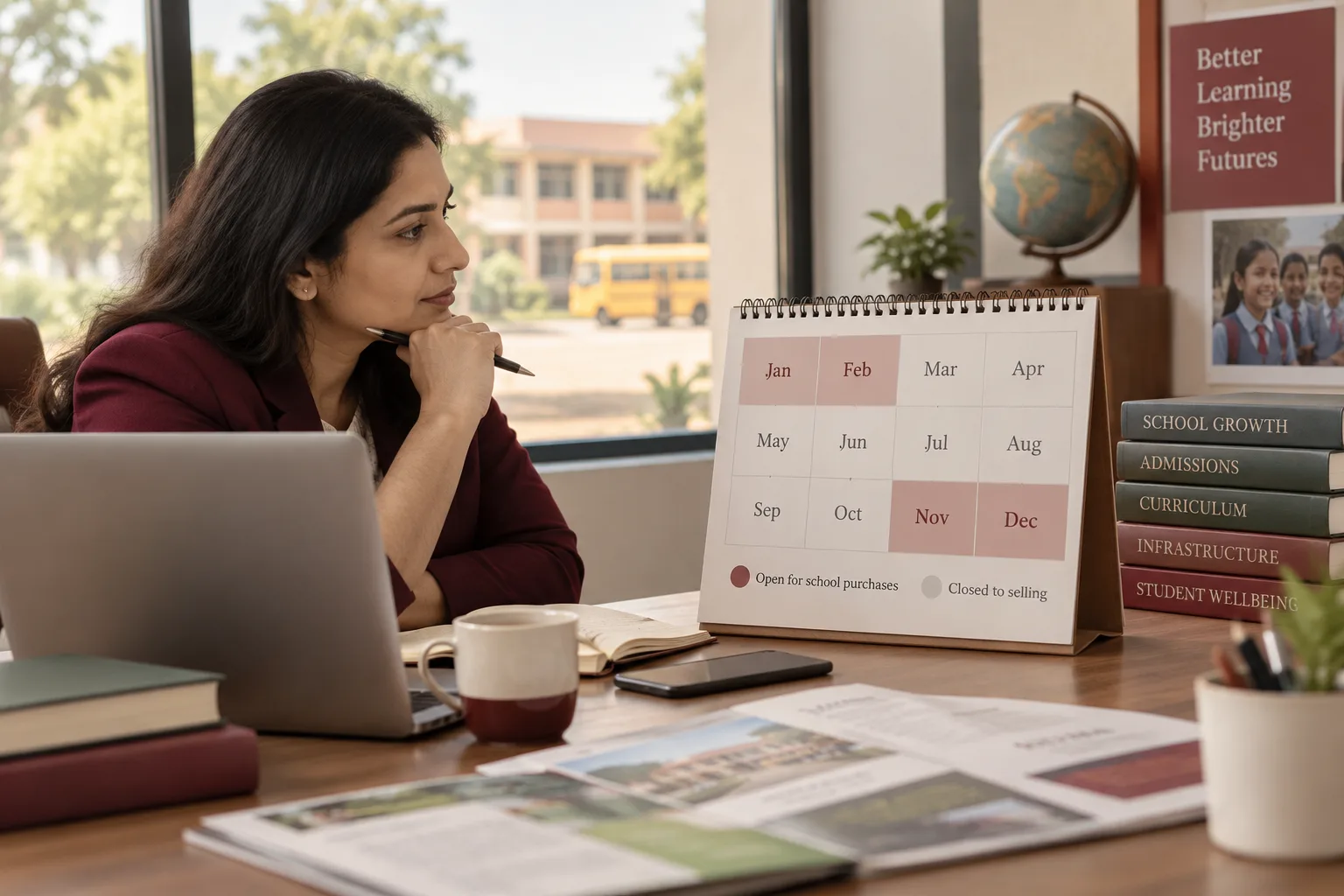 7 min read · 21 Sept 2026How to advertise to school ownersA school buys in a four-month window and is closed to selling the other eight. Miss November to February and you have missed the year.
More for educational institutions
Related work to consider.
Closest to this: strategy and research
Also for educational institutions
Or start from the overview: sales and marketing for educational institutions.
Your next practical step
Tell us what you are trying to grow, and we will read it before we call.
Eight short steps, mostly taps. Skip anything you would rather answer on the call.