Dry cleaners and laundries · Local SEO
Show up for the towers you collect from, not for the whole city.
Local SEO for a laundry is the Maps result a household checks on a Sunday, comparing two shops on distance, recent reviews and whether anybody offers pickup. GullySales fills the Business Profile with your services, pickup area and hours, and keeps it matching the rate card and the other listings.
Scope, fee, reporting and term are agreed in writing after we have read your brief and spoken to you.
What local SEO means
Local SEO is the work of making your business show up for searches that name your town or locality, such as a service plus an area name. GullySales sets up locality pages, local citations and map listings so nearby customers find you before a competitor across town.
Also for dry cleaners and laundries
- SEO for dry cleaners and laundries
- Websites for dry cleaners and laundries
- PPC for dry cleaners and laundries
- Lead generation for dry cleaners and laundries
- Digital marketing for dry cleaners and laundries
- Reputation management for dry cleaners and laundries
- Branding for dry cleaners and laundries
- Social media marketing for dry cleaners and laundries
Sales and marketing for dry cleaners and laundries, the overview.
Last updated 14 Nov 2026.
For dry cleaners and laundries
Where it usually goes wrong, and what we would do.
“Pickup makes distance negotiable”
A shop three kilometres away wins if the listing says it collects. Without that word, the household simply picks whoever is nearest.
“A service area, not only a shop address”
Half your customers never come to the counter. The listing has to name the localities the rider covers as well as where the machines sit.
“Photographs of the press and the packing”
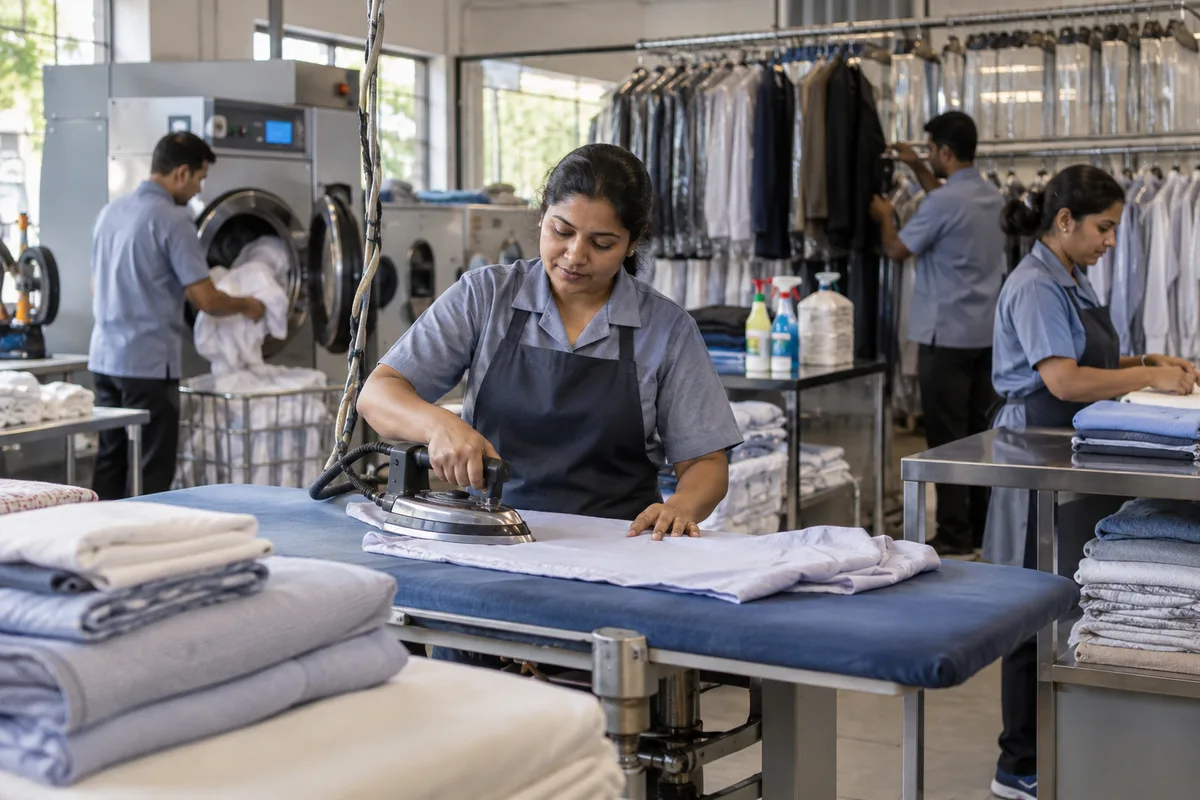
A family handing over a silk saree wants to see the racks, the press and the cover it comes back in. A photograph of the shop board tells them nothing.
“Hours are the promise broken at Diwali”
Festival closures and the one day a week you shut are the commonest reason somebody stands outside a shutter and writes a one-star review.
What we do
What we deliver for dry cleaners and laundries.
The work available for this need. We agree the deliverables and responsibilities for your engagement in writing.
A profile written for garment searches
Services listed as dry cleaning, wash and fold, ironing, curtain and blanket cleaning and shoe care, with categories set to match what people type.
Result: The listing shows for the garment, not only for laundry.
The pickup area named in the profile
Service areas set to the localities and apartment clusters on your route, with collection days and the minimum order stated in the description.
Result: A resident three kilometres away knows you come to them.
Photographs of the counter, racks and packing
The press, the racks, the packing cover and the delivery bike shot properly and added as a set, refreshed when the shop changes.
Result: A family trusts you with something expensive before ringing.
Hours, festival closures and the weekly off
Regular timings, the day you shut and every festival closure entered in advance instead of after somebody has arrived.
Result: Nobody finds a shutter down and writes about it.
One set of details across Maps, JustDial and the site
The same shop name, number, address and rate range wherever the business is listed, including any second outlet.
Result: Search engines and customers see a single business.
Calls, routes and messages reported
How many searches showed your listing, and the calls, direction requests and messages that followed, read against the figures recorded before work starts.
Result: You can tell whether the listing is producing bags.
How the result is measured
- Map pack ranking
- Local search visibility
- Enquiries by locality
Recorded as a baseline before work starts, so every later report has an honest comparison.
What Google weighs here
How a household nearby finds a dry cleaner who collects, and what to fix first.
- Dry cleaner and laundry service
- Set Dry cleaner as the main type and Laundry service as the second, adding Laundromat only for a self-service floor. Mixing types carelessly sends bridal-wear queries to a wash-and-fold counter.
- Services by garment
- List wash and fold by the kilo, steam press, saree polish, curtain cleaning, shoe cleaning and bridal wear care separately. A household searching for saree polish should see the words on your profile.
- Apartments you collect from
- Name the societies and layouts on your pickup route in the description, with the collection days. A household in a large apartment complex checks whether the van comes to its gate before it checks price.
- Justdial, Sulekha and the rate card
- Claim both and use the same shop name, number and rate card as on the profile. Aggregator apps that list your counter must show the same details, or a customer will quote the lower figure.
- Photographs of the press and racks
- Show the counter, the racks of finished garments in covers, the press and the packing area. Avoid photographs with a customer's tag or name on the garment.
- Day off and festival closures
- Mark the day your counter is shut and the festival closures, in special hours. Keep pickup slots in the description. A household that is turned away the night before a wedding does not give a second chance.
Who it is for
This is written for these dry cleaners and laundries.
- Neighbourhood dry cleaners with a single counter
- Laundry and ironing shops offering wash-and-fold by the kilo
- Pickup-and-delivery laundries serving apartments
- Premium garment care for bridal wear, silks and designer pieces
- Commercial laundries serving hotels, PGs and hospitals
- Shoe, bag and leather cleaning specialists
- Carpet, curtain and sofa cover cleaning services
- Multi-outlet or franchise laundry brands
- Self-service laundromats near colleges and hostels
Before you decide
When this may not be the right fit.
- Your hours change with the festivals and nobody updates the listing, so the profile would promise a counter that is closed.
- You have no photographs of the counter, racks or packing, and a profile with bare images looks abandoned.
- Your pickup reaches beyond the area you can name, and listing places you rarely visit would bring complaints.
Before you decide
Agree the work. Know how to judge it.
Local SEO for dry cleaners and laundries: use these checks to prepare, choose the scope, and review what changes.
Bring the right evidence
Confirm the real business address, service area, contact details, and who controls the business listings. Keep examples of calls that came from the wrong location or asked for a service you do not provide.
Make the scope clear
Choose the locations you actually serve and the information each needs. Agree who approves listing changes, responds to enquiries, and keeps opening hours accurate.
Check the work in use
Check the journey from a local search to a call or enquiry on a phone. The address, service area, and description should agree across your website and listings.
Know when to change course
Do not create an office claim for a place where you only serve customers remotely. Clear service coverage is more useful than a misleading local presence.
These are discussion points, not a fixed package. GullySales confirms the deliverables, responsibilities, fee, and term in writing after reading your brief and speaking with you.
Before we start
What to have ready before the work starts.
The records, access and decisions this work needs from dry cleaners and laundries. Anything missing is noted in the written scope, with who will supply it.
- Owner access to the Business Profile
- We need to be added as managers by the account that owns the profile. If it was created by an old helper or a relative, the ownership request comes first. Without it, no detail can be changed.
- Your bills, board and registration details
- A photograph of the signboard and a recent bill shows the name and address as the public sees them. These settle any dispute over the correct version. Missing, the profile carries whatever it already says, which may be wrong.
- A list of the localities you collect from
- Written from the rider's actual route. The service area is built from it. If the list is vague, the area is kept narrow around the shop and widened once pickups are recorded. Include any street the rider avoids at certain hours, such as a market lane, so the profile does not promise a pickup that cannot be made.
- Dates of the day off and festival closures
- Give the day off and the festival days the shop will close or change hours. We enter them ahead. Without the dates, the profile shows the usual hours on a closed day and a customer arrives to a shutter.
How it works
How the local SEO work runs
The work itself, in order. How an engagement starts, from your brief to a written scope, is set out on our method page.
- 1
Check the profile against the signboard
We open the Business Profile beside a photograph of your board and the name printed on your bills, and look for differences in name, address, phone and business-type wording. You confirm which version is correct. Any mismatch confuses a customer who compares them, so what exists afterwards is one agreed set of details used everywhere.
- 2
Name the pickup area in the profile
For a shop with a rider, the area matters as much as the address. We write the localities you pick up from into the profile, drawn from the rider's route and not from hope. You tell us when the route extends, and the area widens then. A household in a street you do not serve sees a clear answer. Where the shop and the pickup line use different numbers, both are entered and labelled so a caller knows which one to dial.
- 3
Photograph the counter, the press and the packing
Someone takes clear daylight pictures of the shopfront, the counter, the racks, the press and a packed bag, with captions naming the work. You decide what to show; customers' garments are kept out of frame. These photographs are what a household studies before choosing between two shops on a map.
- 4
Set hours for the festival weeks in advance
We list the day off, the festival closures and any special hours, and enter them before the dates arrive. You confirm each date with the staff. A profile that says open when the shutter is down is the quickest way to a bad review, so the hours are checked again before every holiday.
- 5
Count calls and routes against the starting figures
The profile's calls, direction requests and messages were noted before changes. Afterwards we set the new figures beside them, together with reviews gathered since. You see whether the pickup area, the photographs or the hours moved anything. No ranking is promised; the reading shows what to refine.
Where this fits
Three pieces of sales work, in this order.
This work sits inside sales process design, at stage 1, prospecting and lead generation. The audit comes before it, and sales management keeps it running.
Step 1
Sales audit
Find where deals are being lost and what to fix first.
Start here if you cannot say where orders are lost.
Step 2 · you are here
Sales process design
One written way to sell, from first enquiry to repeat order.
Start here if every salesperson sells differently.
Step 3
Sales management
A target, a review routine and someone who owns the number.
Start here if the team has targets and no routine.
FAQ
Questions owners ask before they call.
Not here? More answers, or ask on WhatsApp.
We only do pickup and delivery with no shop front. Can we be on Maps?
Does the shop need a JustDial listing too?
Can a drop-off point inside an apartment be its own listing?
Our pickup runs daily but the counter has a day off. What hours should we show?
Should the profile show our pickup phone or the counter phone?
How much does it cost?
How long is the contract?
How soon will we see results?
Who will actually do the work?
What do you need from us?
From the blog
Further reading for dry cleaners and laundries.
More for dry cleaners and laundries
Related work to consider.
Closest to this: search and visibility
Also for dry cleaners and laundries
Or start from the overview: sales and marketing for dry cleaners and laundries.
Your next practical step
Tell us what you are trying to grow, and we will read it before we call.
Eight short steps, mostly taps. Skip anything you would rather answer on the call.