Pet daycare services · Website
Give the owner one page that answers the hours, the packs and the first day.
A website for a pet daycare is the place that shows the space, the day's routine, the packs and the pickup areas in more detail than a listing can hold. GullySales works on what each page says and how it leads the owner to a trial-day booking.
Scope, fee, reporting and term are agreed in writing after we have read your brief and spoken to you.
What website means
A website is the page a customer lands on after searching, clicking an advert or scanning a code, and it decides whether they call or leave. GullySales builds and maintains sites that load quickly, explain the offer plainly and make the enquiry form or phone number easy to find.
Last updated 14 Nov 2026.
For pet daycare services
Where it usually goes wrong, and what we would do.
“The owner arrives with three questions”
Where do you pick up from, what does a day look like and what does a pack cost? A home page that buries these under a story about the founder makes the owner go back and try another daycare.
“A page for a puppy and a page for an adult dog”
A puppy owner asks about shots and safe mixing, and an adult dog's owner asks about grouping and long days. One page for both answers neither well, so each group needs its own entry point.
“Photographs of the real place beat stock images”
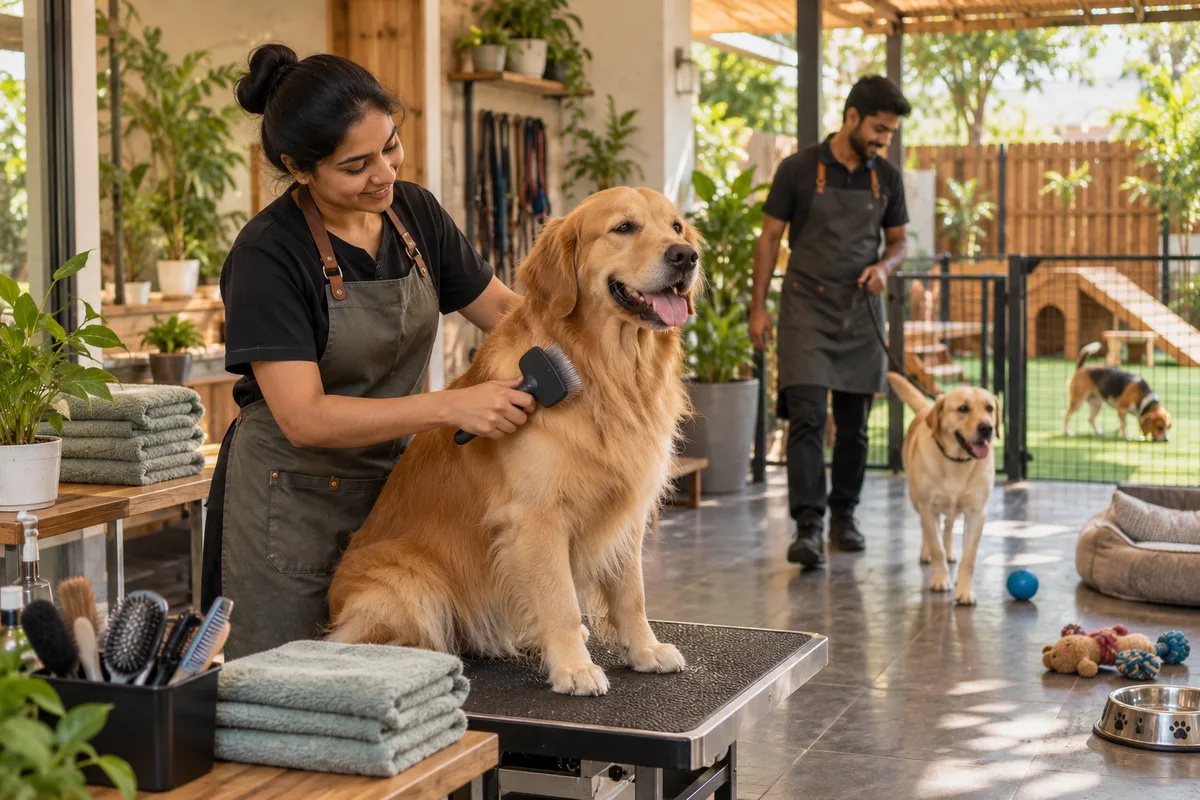
A picture of a happy dog taken somewhere else tells the owner nothing. Your own yard, rest area and staff are the proof, and owners compare them against what they see on the visit.
“A slow or cluttered page loses the phone visitor”
The owner is on a phone, perhaps in a meeting. If the trial-day button sits below a slow image or a pop-up, the visit ends before the enquiry begins.
What we do
What we deliver for pet daycare services.
The work available for this need. We agree the deliverables and responsibilities for your engagement in writing.
A home page built around three questions
Pickup areas, a day in the routine and the packs, each reachable with one tap.
Result: An owner finds the answers without hunting.
Pages for puppies and for adult dogs
Separate entry pages with the relevant shots rule, grouping and first-day steps.
Result: Each owner reads a page written for their dog.
A packs and hours page
Weekday pack, half-day option, trial day and holiday hours laid out plainly.
Result: The owner can see what is offered before calling.
A trial-day booking form
A short form asking breed, age, shots, working hours and locality, connected to your WhatsApp.
Result: A booking arrives with the facts needed to reply.
A page speed and phone check
Each page tested on a small screen for load time, button placement and readability.
Result: The booking button is reachable on a phone.
How the result is measured
- Page load time
- Bounce rate
- Enquiries from the website
Recorded as a baseline before work starts, so every later report has an honest comparison.
Searches your buyers type
A daycare site needs a page for each question an owner brings to it.
- dog daycare hours and packs
- A page showing opening hours, drop and pick-up windows and the packs, so the owner sees what fits the working day.
- puppy daycare and vaccination rules
- A puppy page stating the records asked for and how a first day runs, written plainly for a first-time owner.
- adult dog daycare trial day
- A page for adult dogs explaining the assessment and what happens if the dog needs a different group.
- daycare pickup areas
- A page listing localities and stops the van reaches, with a form for an owner to ask about an area not yet listed.
- daycare photographs of the space
- A gallery of the real play areas, rest area and entrance, taken by the daycare, so the owner can picture the place.
- book a trial day for my dog
- A short form asking for the dog's details and the preferred day, with a line on what to bring.
Who it is for
This is written for these pet daycare services.
- Neighbourhood daycares in apartment-heavy localities
- Daycares near IT parks and business districts
- Daycare run from a grooming salon or pet shop
- Small-dog and puppy-only daycares
- Daycare with an outdoor play space on city outskirts
- Daycare offering pickup and drop vans
- Part-time daycare for dogs of remote workers
- Daycares for cats and small animals
Before you decide
When this may not be the right fit.
- You have no photographs of your own space and would use stock images that an owner can spot
- Your hours, packs or pickup areas change and nobody updates the page, so it would mislead owners
- Nobody can reply to a form the same day, and a booking form with no answer would lose the owner to a daycare that replies
Before you decide
Agree the work. Know how to judge it.
Websites for pet daycares: use these checks to prepare, choose the scope, and review what changes.
Bring the right evidence
List the pages that support a buying decision and the actions visitors must complete. Keep examples of failed forms, unclear product information, and questions your team answers repeatedly.
Make the scope clear
Agree the page list, content ownership, integrations, and who controls the domain and hosting. Include redirects and existing search traffic in a redesign brief, before changing addresses.
Check the work in use
Complete a real enquiry journey on a phone and a laptop. Check that the confirmation appears, the enquiry reaches the right person, and tracking records the action once.
Know when to change course
If visitors can enquire but the team does not follow up, start with the sales handover. A larger website will not resolve that delay.
These are discussion points, not a fixed package. GullySales confirms the deliverables, responsibilities, fee, and term in writing after reading your brief and speaking with you.
Before we start
What to have ready before the work starts.
The records, access and decisions this work needs from pet daycare services. Anything missing is noted in the written scope, with who will supply it.
- The domain and hosting logins
- Bring the account that holds the domain and the host. If an earlier helper holds them, getting them into your name comes first. A site on a domain you do not control can be lost.
- Your fees and pack terms, or a decision
- Decide whether fees will appear on the site. The packs page is built on it. If you prefer to share fees only on request, the page is built with a message button, and that is an acceptable choice.
- Pictures of the room, yard and van
- Clear photographs of the real space on a bright morning carry the home page. If the only pictures are poor, the shoot comes before the build and the launch moves with it.
- The trial-day rules in plain words
- Write the days you take trial dogs, what the owner should bring and the vaccination proof you need. The form and the first-day page depend on it. If the rules are unsettled, the form asks fewer questions.
- A person to answer the website form
- Name the person who will read form submissions and the number they use. A form with no reader is worse than none. If nobody is free in the mornings, we set an auto-reply that says when owners will hear back.
How it works
How the website work runs
The work itself, in order. How an engagement starts, from your brief to a written scope, is set out on our method page.
- 1
Take stock of the site and the logins
We begin by finding what exists: the domain, where the site is hosted, who holds each login and what pages are live. You confirm what is yours. The site is not rebuilt until we know it can be moved, and the access is written in one place.
- 2
Ask the three questions owners arrive with
We confirm with you that owners arrive asking about hours, packs and the first day, and add any you hear that we have missed. Each question gets a place on the home page, answered in a line with a link to more. You tell us which answers you want to speak about by phone instead.
- 3
Draw the pages for puppies and adult dogs
A puppy owner and an adult dog's owner look for different reassurance, so we sketch a page for each: socialisation and rest for puppies, space and handling for adults. You say how the daycare treats each group. The plan sketch is agreed before design starts.
- 4
Photograph the real place for the pages
We choose with you the pictures that go on each page and arrange a short shoot for any gap: the room, the yard, the rest area, the van. Photographs of the real place beat stock pictures, and dogs appear only where the consent line allows.
- 5
Build the packs page and the booking form
We build the packs and hours page from your pack terms and a trial-day form that asks for the dog's name, size, vaccination and hours. You test the form from your own phone. A form that reaches nobody is fixed before anything goes live.
- 6
Launch, test on phones and read the results
At launch we test the pages on ordinary phones, measure how slow each page is and fix the heavy ones, then hand over the logins. Afterwards we compare enquiries and trial days that came from the site with the figures noted before, and you tell us which page owners said they read. You choose what to rewrite, and the site is not presented as a promise of full days.
Where this fits
Three pieces of sales work, in this order.
This work sits inside sales process design, at stage 1, prospecting and lead generation. The audit comes before it, and sales management keeps it running.
Step 1
Sales audit
Find where deals are being lost and what to fix first.
Start here if you cannot say where orders are lost.
Step 2 · you are here
Sales process design
One written way to sell, from first enquiry to repeat order.
Start here if every salesperson sells differently.
Step 3
Sales management
A target, a review routine and someone who owns the number.
Start here if the team has targets and no routine.
FAQ
Questions owners ask before they call.
Not here? More answers, or ask on WhatsApp.
What pages does a daycare site need?
Must the daycare take payments online?
Who holds the domain and the site logins?
Should the site list the fees?
Do we need to list our fees on the site?
How will we know the site is fast enough on a phone?
How long is the contract?
How soon will we see results?
Who will actually do the work?
What do you need from us?
More for pet daycare services
Related work to consider.
Closest to this: search and visibility
Also for pet daycare services
Or start from the overview: sales and marketing for pet daycare services.
Your next practical step
Tell us what you are trying to grow, and we will read it before we call.
Eight short steps, mostly taps. Skip anything you would rather answer on the call.