Pet grooming services · Website
A grooming website should answer the owner's three questions on the first screen.
A website for a groomer is the page set that tells an owner what you groom, how booking works and what a visit involves. GullySales works on the structure, the wording and the booking route so the site does more than show a shop front.
Scope, fee, reporting and term are agreed in writing after we have read your brief and spoken to you.
What website means
A website is the page a customer lands on after searching, clicking an advert or scanning a code, and it decides whether they call or leave. GullySales builds and maintains sites that load quickly, explain the offer plainly and make the enquiry form or phone number easy to find.
Also for pet grooming services
- SEO for pet grooming services
- Local SEO for pet grooming services
- Lead generation for pet grooming services
- Social media marketing for pet grooming services
- Content marketing for pet grooming services
- Buyer persona for pet grooming services
- CRM for pet grooming services
- Follow-up systems for pet grooming services
Sales and marketing for pet grooming services, the overview.
Last updated 14 Nov 2026.
For pet grooming services
Where it usually goes wrong, and what we would do.
“The owner asks three things at once”
Do you groom my breed, where are you, and how do I book. A site that opens with a slogan and a stock photo of a smiling puppy answers none of them.
“Real photographs beat stock”
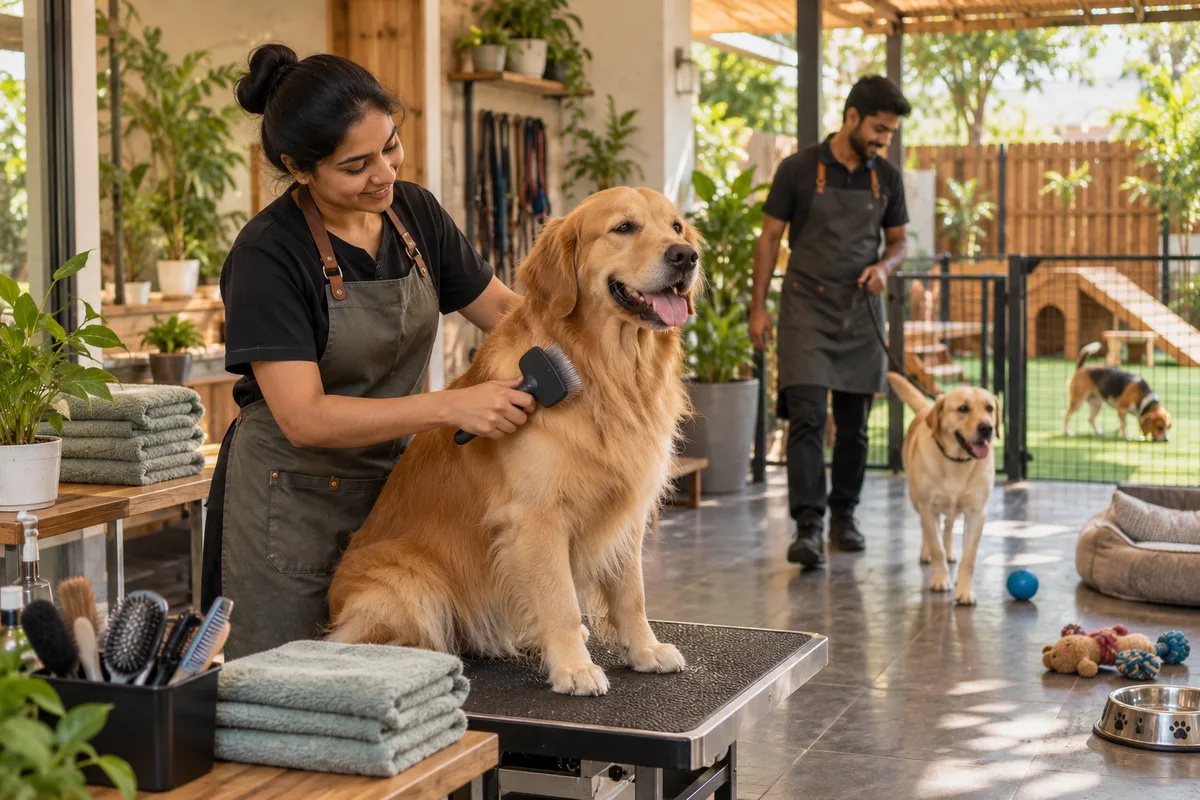
An owner can tell a stock dog from a client dog. Real finished-coat photos, with the owner's consent, show the quality of the work and the cleanliness of the salon.
“Mobile is where the visit happens”
Owners open the site on a phone, with a leash in the other hand. Large buttons, short text and a booking link that opens WhatsApp fit that moment.
“A price and process page cuts wrong enquiries”
Owners want to know how quotes are set and what a visit looks like. Explaining it on the site saves the groomer repeating it and filters the mismatches.
What we do
What we deliver for pet grooming services.
The work available for this need. We agree the deliverables and responsibilities for your engagement in writing.
A page structure for the site
A plan with home, services, breeds, areas, prices, about and contact, ordered by what an owner needs.
Result: A clear list of pages before any build.
Service and breed pages
Pages for each service and the breeds you handle, written with your groomers.
Result: Each page answers one search and one question.
A booking button on every page
A WhatsApp link with a prefilled message that asks for breed and coat.
Result: The booking message arrives with the right details.
A real photo gallery
A gallery of work, tagged by breed, using consented photos.
Result: The work is visible without leaving the site.
A contact and area page
Address or service area, hours and a map link, kept in step with the profile.
Result: Name, address and hours match everywhere.
A speed and phone check
A review of how the site loads and reads on a phone.
Result: The site works on the phones owners carry.
How the result is measured
- Page load time
- Bounce rate
- Enquiries from the website
Recorded as a baseline before work starts, so every later report has an honest comparison.
Searches your buyers type
A grooming site needs a page for each thing an owner looks for first.
- breed haircut pages
- One page per common breed, such as the poodle or shih tzu, with real photographs, the styles offered and the booking button.
- grooming services and process
- A page explaining baths, haircuts, de-matting and spa packages, and what happens at the visit, so wrong enquiries drop.
- mobile grooming service area
- A page listing the localities the van reaches and how to ask about a society not yet on the list.
- puppy first-groom page
- A page for new puppy owners on the first visit, the records asked for and what the groomer does to keep it calm.
- grooming photo gallery
- A gallery of real dogs groomed at the salon or van, with the owner's consent and the breed named.
- contact and directions
- An address, a map, hours and a message button, with the van schedule if it follows a fixed route.
Who it is for
This is written for these pet grooming services.
- Dog grooming salons
- Cat grooming
- Mobile grooming vans
- Spa and bath packages
- Breed-specific haircuts for poodles, shih tzus and others
- De-matting and shedding control
- Puppy first-groom packages
- Grooming inside pet stores and clinics
Before you decide
When this may not be the right fit.
- You have no photographs of your own work and would fill pages with stock images owners recognise
- Nobody can update prices and service areas, so a page that is wrong would lose the owner at the door
- You cannot reply to a site enquiry the same day, and a form with no answer sends the owner to another salon
Before you decide
Agree the work. Know how to judge it.
Website for pet grooming services: use these checks to prepare, choose the scope, and review what changes.
Bring the right evidence
List the pages that support a buying decision and the actions visitors must complete. Keep examples of failed forms, unclear product information, and questions your team answers repeatedly.
Make the scope clear
Agree the page list, content ownership, integrations, and who controls the domain and hosting. Include redirects and existing search traffic in a redesign brief, before changing addresses.
Check the work in use
Complete a real enquiry journey on a phone and a laptop. Check that the confirmation appears, the enquiry reaches the right person, and tracking records the action once.
Know when to change course
If visitors can enquire but the team does not follow up, start with the sales handover. A larger website will not resolve that delay.
These are discussion points, not a fixed package. GullySales confirms the deliverables, responsibilities, fee, and term in writing after reading your brief and speaking with you.
Before we start
What to have ready before the work starts.
The records, access and decisions this work needs from pet grooming services. Anything missing is noted in the written scope, with who will supply it.
- Domain name and hosting details
- The domain and hosting must be in your name. Bring the registrar login or the invoice that shows who bought it. If they sit with a former developer, the launch waits until you hold them. Also bring the email address that created the account, because renewal reminders and recovery links go there.
- Photographs of the salon, van and dogs
- A real gallery decides how the site feels. Bring what you have, original size, with owner consent noted. If it is thin, a shoot is added before design, since stock images weaken trust.
- A plain list of services and what each includes
- Write the baths, haircuts, de-matting and puppy packages as you sell them, with what each covers. Without it, the service pages repeat generic text and owners send wrong enquiries. Add what the owner must bring on the first visit, such as vaccination papers, since the page will state it plainly.
- A decision on online booking
- Choose between a WhatsApp booking button and a calendar. Consider who will manage a calendar through the working day. If undecided, the site uses WhatsApp, which is simpler to run.
- Opening hours, area and festival closures
- The contact and area page depends on facts that hold true. Bring your hours, the areas the van serves and known closures. Wrong details on the site send owners to a shut door.
How it works
How the website work runs
The work itself, in order. How an engagement starts, from your brief to a written scope, is set out on our method page.
- 1
Photograph the salon and the van first
Before any page is drawn, we collect real pictures: the entrance, the table, the dryers, the van and finished dogs, with owners' consent. You tell us which are fit to show. If the library is thin, we plan a shoot. The site is built around what the place looks like, not around stock images. We note the light in the room and the angle of the table, and we ask which corner you would not want shown, so the pictures do not embarrass the team.
- 2
Take the domain and hosting logins
We ask for access to the domain name and any hosting, and for the Business profile and WhatsApp number that the site will point to. You hold them in your name. If an earlier developer owns them, we begin by recovering them. Nothing is built on an address you do not control.
- 3
Draw the sitemap on the three questions
An owner arrives asking what you groom, how to book and what a visit involves. We lay out the pages so that the first screen answers all three, with a booking button on every page. You approve the map and strike pages for services you do not offer. We keep the page count small on purpose, since a short site with clear pages is easier for your team to keep accurate than a long one.
- 4
Write service and breed pages with your groomers
We interview the groomers for the service pages and for the breeds you handle best, and write from what they say. A price and process page explains what raises a quote, in the words you choose. You read the test site on your phone and correct anything that does not match the table.
- 5
Test the booking route on real phones
We open the test site on several phones and press the booking button, check that WhatsApp opens with the right message, and read the contact and area page. Your receptionist books a sample dog from start to finish. Speed and layout problems on a small screen are fixed before launch. We also test the contact page with a poor signal, because owners open it from the pavement outside the salon on a weak connection.
- 6
Launch and read the first enquiries
On your approval the site goes live and the old address points to it. We hand over the logins and show how to change photographs and hours yourself. Calls, messages and bookings that come from the site are compared with the figures taken before it existed.
Where this fits
Three pieces of sales work, in this order.
This work sits inside sales process design, at stage 1, prospecting and lead generation. The audit comes before it, and sales management keeps it running.
Step 1
Sales audit
Find where deals are being lost and what to fix first.
Start here if you cannot say where orders are lost.
Step 2 · you are here
Sales process design
One written way to sell, from first enquiry to repeat order.
Start here if every salesperson sells differently.
Step 3
Sales management
A target, a review routine and someone who owns the number.
Start here if the team has targets and no routine.
FAQ
Questions owners ask before they call.
Not here? More answers, or ask on WhatsApp.
Do we need a website if we use Instagram?
Should the site take online bookings?
Can we update it ourselves?
Do we need an online booking calendar?
Who writes the text on the pages, you or us?
What happens to our current page on a directory or social profile?
How much does it cost?
How long is the contract?
How soon will we see results?
Who will actually do the work?
More for pet grooming services
Related work to consider.
Closest to this: search and visibility
Also for pet grooming services
Or start from the overview: sales and marketing for pet grooming services.
Your next practical step
Tell us what you are trying to grow, and we will read it before we call.
Eight short steps, mostly taps. Skip anything you would rather answer on the call.