Caterers · Local SEO
Show up on Maps for the area your kitchen can actually deliver to.
Local SEO decides whether a family or an office nearby finds you when they search for a caterer in their area. GullySales sets the Business Profile category and menus, gets the kitchen address and service area right, and keeps the details matching across the listing sites.
Scope, fee, reporting and term are agreed in writing after we have read your brief and spoken to you.

What local SEO means
Local SEO is the work of making your business show up for searches that name your town or locality, such as a service plus an area name. GullySales sets up locality pages, local citations and map listings so nearby customers find you before a competitor across town.
Last updated 5 Oct 2026. Rules for this trade differ by state and professional body, and they change. We describe restrictions in general terms, so check the current position with your own council or adviser before you publish anything.
For caterers
Where it usually goes wrong, and what we would do.
“Your service area is a driving time, not a city”
Hot food travels an hour and no further, so the listing has to say where you can genuinely deliver.
“The kitchen address is not a showroom”
Nobody visits a catering kitchen except a corporate inspection, which is exactly the visitor the address has to satisfy.
“Your category is probably wrong”
Filed as a restaurant when you mainly run canteen contracts, and the enquiries that keep arriving prove it.
What we do
What we deliver for caterers.
The work available for this need. We agree the deliverables and responsibilities for your engagement in writing.
The profile category matched to the work you want
A primary category chosen between caterer, wedding service, canteen and food service, with secondary categories added for the rest of what you do.
Result: The enquiries arriving are the ones you can serve.
A service area set to your real delivery radius
The localities and towns you can reach with hot food in time, listed on the profile, with the kitchen address shown or hidden as you decide.
Result: You stop being called for functions three hours away.
Menus and per-plate ranges on the profile
Each menu added with its items and a price range in the services section, so a comparison can happen on your listing.
Result: Somebody can shortlist you from Maps alone.
Photographs of counters in service, not plated dishes
The buffet running, the service team at work, a crowd being fed and the kitchen itself, uploaded each season rather than left from years ago.
Result: The scale you work at is visible before anyone calls.
One set of details across Google, JustDial and WedMeGood
Business name, address, phone, capacity and cuisines made to match everywhere you are listed, including the wedding platforms.
Result: Google sees one business rather than three.
Maps reporting by search, call and message
The count of discovery searches, calls and messages from the listing, read against the baseline recorded at the start.
Result: You know whether Maps brings dates or only questions.
How the result is measured
- Map pack ranking
- Local search visibility
- Enquiries by locality
Recorded as a baseline before work starts, so every later report has an honest comparison.
What Google weighs here
How a family nearby finds a caterer for a function, and what to fix first.
- Caterer first
- Set Caterer as the main category. Add another only if that work is real and regular, such as a wedding service. Do not add banquet hall, restaurant or sweet shop to look bigger.
- The words families type
- Write the menus families ask for: pure veg, Jain, South Indian wedding, biryani, live counters. Use them in the description and services, each with the kind of function it suits, such as an engagement or a housewarming.
- Kitchen address against delivery area
- The pin shows where the kitchen is. Set the service area to the places you really reach, and write a page for each. A caterer cannot claim to be located in a city where there is no kitchen.
- WedMeGood, Justdial and hall lists
- Claim WedMeGood and Justdial and keep one name, number and menu description on both. Also ask the banquet halls you work in how their preferred caterer list is kept, and make sure your details are right on it.
- FSSAI licence on every listing
- Show the licence number on the website and wherever a platform asks. Corporate buyers and halls check it before they place you on a list. A licence in a different trade name from your signboard needs a note explaining it.
- Host reviews with the venue
- Ask the host a few days after the function, and ask them to name the venue and the kind of function. A review that mentions the hall tells another family you have already worked in that room.
Who it is for
This is written for these caterers.
- Wedding and function caterers
- Traditional vegetarian and Brahmin cooks for ceremonies
- Non-vegetarian and biryani specialists
- Corporate event and party caterers
- Office cafeteria and daily meal providers
- Industrial and factory canteen contractors
- School and hostel meal providers
- Live counter and snack specialists
- Home-based caterers for small gatherings
Not for
It is not the right fit if.
- Your kitchen is in a home with no listing address you are willing to publish, so a map profile would only confuse families.
- Your phone is not answered during the hours the profile shows, and a family would be sent to a missed call.
Before you decide
Agree the work. Know how to judge it.
Local SEO for caterers: use these checks to prepare, choose the scope, and review what changes.
Bring the right evidence
Confirm the real business address, service area, contact details, and who controls the business listings. Keep examples of calls that came from the wrong location or asked for a service you do not provide.
Make the scope clear
Choose the locations you actually serve and the information each needs. Agree who approves listing changes, responds to enquiries, and keeps opening hours accurate.
Check the work in use
Check the journey from a local search to a call or enquiry on a phone. The address, service area, and description should agree across your website and listings.
Know when to change course
Do not create an office claim for a place where you only serve customers remotely. Clear service coverage is more useful than a misleading local presence.
These are discussion points, not a fixed package. GullySales confirms the deliverables, responsibilities, fee, and term in writing after reading your brief and speaking with you.
How it works
How the local SEO work runs
The work itself, in order. How an engagement starts, from your brief to a written scope, is set out on our method page.
- 1
Branch selection and scope approval
Send your requirements brief, then discuss the locations and problems that matter most. GullySales puts the agreed work, fee, and term in writing before delivery begins.
- 2
Access and factual sign-off
You confirm account access and approve the branch information record. Missing ownership or verification requirements are identified before changes dependent on them proceed.
- 3
Search review and priority decision
We record the baseline and examine searches around the agreed locations. You review which profile corrections, pages, and listings take priority.
- 4
Content approval and publishing handoff
Your branch contact checks factual details and photographs. Approved profile changes and listing requests proceed, while page work follows the agreed website publishing arrangement.
- 5
Enquiry handoff and review
The person handling calls tests the contact route and records enquiry outcomes. Reporting frequency and the review arrangements are agreed in writing before work starts.
Where this fits
Three pieces of sales work, in this order.
This work sits inside sales process design, at stage 1, prospecting and lead generation. The audit comes before it, and sales management keeps it running.
Step 1
Sales audit
Find where deals are being lost and what to fix first.
Start here if you cannot say where orders are lost.
Step 2 · you are here
Sales process design
One written way to sell, from first enquiry to repeat order.
Start here if every salesperson sells differently.
Step 3
Sales management
A target, a review routine and someone who owns the number.
Start here if the team has targets and no routine.
FAQ
Questions owners ask before they call.
Not here? More answers, or ask on WhatsApp.
Our kitchen is in an industrial area nobody visits. Do we show it?
Can we appear in a city we deliver to but have no kitchen in?
Can we post photographs from a wedding we catered?
Can the tasting be booked from the profile?
How much does it cost?
How long is the contract?
How soon will we see results?
Who will actually do the work?
What do you need from us?
What if we are not happy with the work?
From the blog
Further reading for caterers.
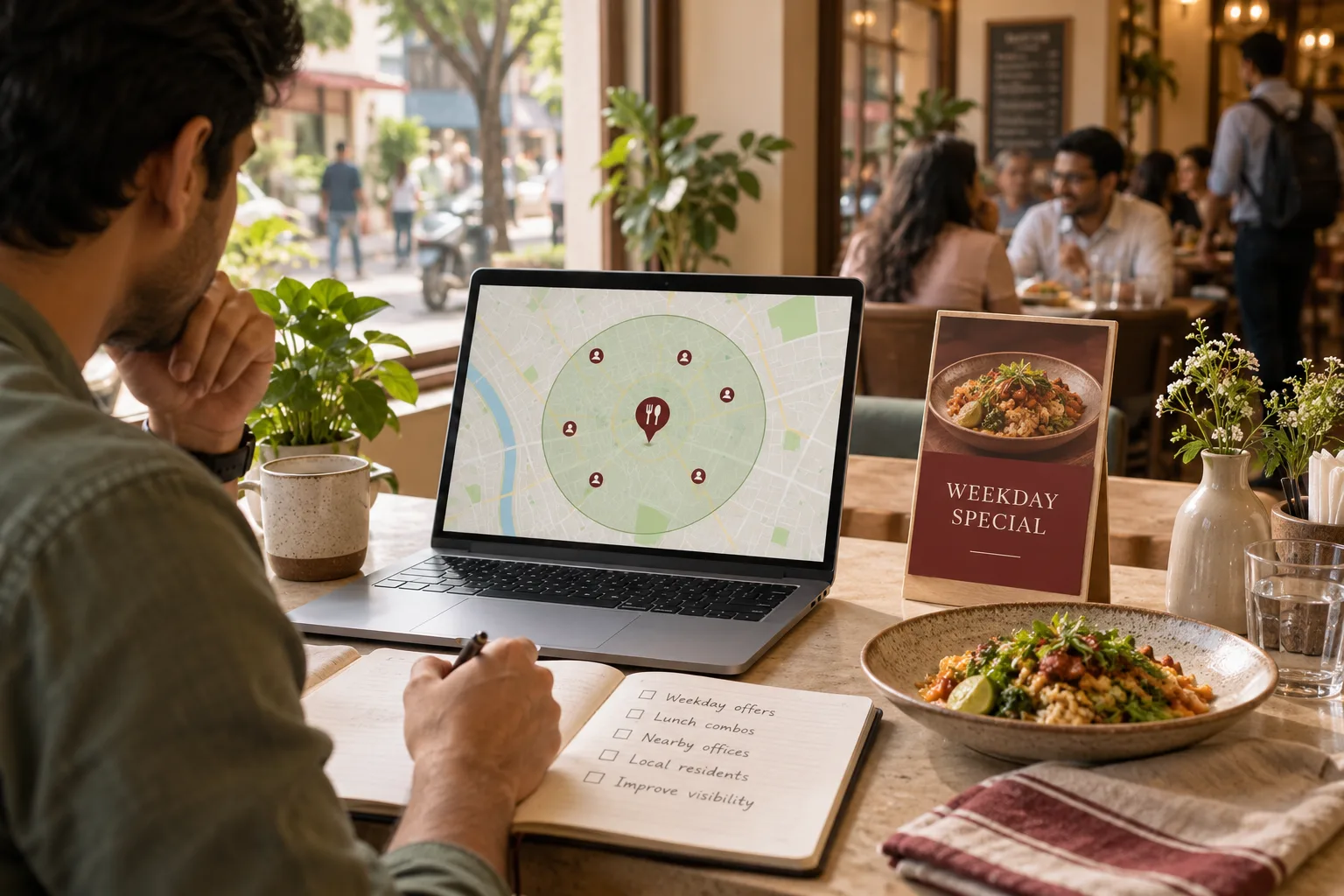 7 min read · 3 Jun 2025How to increase restaurant footfallDraw a circle round the few kilometres your diners come from, win the Maps search inside it, and give people in it a reason to visit on a weekday.
 5 min read · 6 Oct 2026What buyers check before they book a stay or a catererGuests, tenants and event families judge hotels, homestays, PGs, serviced apartments and caterers on the same checks. What each looks like.
 7 min read · 21 Sept 2026How to advertise to women entrepreneursNothing here comes from gender. It comes from how these businesses are financed, where they sell from and which hours the founder is free.
More for caterers
Related work to consider.
Closest to this: search and visibility
Also for caterers
Or start from the overview: sales and marketing for caterers.
Your next practical step
Tell us what you are trying to grow, and we will read it before we call.
Eight short steps, mostly taps. Skip anything you would rather answer on the call.