Travel agencies and tour operators · Exhibition stall and trade show backdrop design
Make your stall the one a family walks into, among forty destination photographs.
Exhibition stall design for a travel agency is the artwork on the backdrop, fascia, counter and floor of a stall at a travel fair, a wedding expo or a trade mart, drawn so a passing visitor reads who you are and what you sell. GullySales designs the surfaces to the stall plan and prepares files for your printer.
Scope, fee, reporting and term are agreed in writing after we have read your brief and spoken to you.
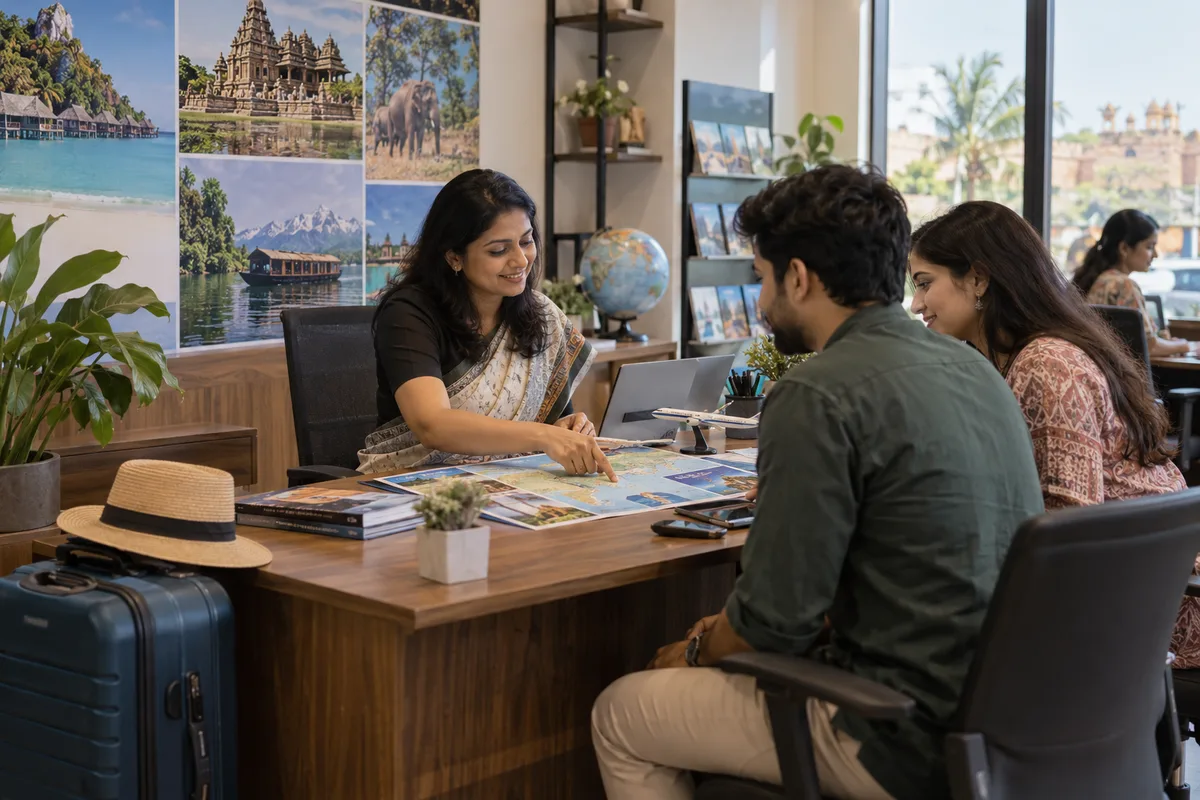
What exhibition stall and trade show backdrop design means
Exhibition stall graphic design is the artwork on a stall's backdrop, fascia, side panels, counter front and floor, drawn for how a visitor sees it from the aisle. GullySales designs the graphics to your stall build and the organiser's rules, and hands over print-ready files with a panel sheet. Writing, fabrication, printing and booking stay separate.
Also for travel agencies and tour operators
- PPC ads for travel agencies and tour operators
- Display advertising for travel agencies and tour operators
- SEO for travel agencies and tour operators
- Lead generation for travel agencies and tour operators
- Digital marketing for travel agencies and tour operators
- Reputation management for travel agencies and tour operators
- Local SEO for travel agencies and tour operators
- Social media marketing for travel agencies and tour operators
Sales and marketing for travel agencies and tour operators, the overview.
Last updated 14 Nov 2026.
For travel agencies and tour operators
Where it usually goes wrong, and what we would do.
“Every neighbouring stall also shows a beach”
A travel fair hall has tourism boards, hotel chains, airlines and agencies, and all of them hang large photographs of the same sunsets and mountains. A visitor walking the aisle cannot tell the stalls apart by scenery. What separates yours is the thing only you sell: a named departure, a pilgrimage route you run yourself, a honeymoon service with a real planner. The backdrop has to lead with that and let the photograph support it, not the other way round.
“Consumer fair and trade mart need different stalls”
At a consumer fair, a family in a hurry wants to see destinations and a reason to stop. At a trade mart, a visitor is another agent, a hotelier or a destination management company, and wants to see what you sell, whom you serve and how to place business with you. A backdrop that tries to speak to both ends up speaking to neither. The design starts by asking which visitor the show is for, then writes the hierarchy for that person.
“Photographs bring licence questions to the printer”
A destination image that looks fine on a screen can fail on a large print, and an image taken from a tourism board or a stock site may carry usage terms that do not cover a stall backdrop. Using an image you cannot clear is a risk that falls on your business. We flag which images need replacing, which need a licence, and which are your own, and we leave the rights decision with you and your adviser.
“The stall has to work with the counter and the crowd”
At a busy travel fair, the lower part of a backdrop is hidden by brochure racks, visitors and your own team. A line placed at waist height is read by nobody. The counter, where a planner sits with a tablet, is the surface a family reads while talking, so it carries the prompt to share dates or scan to chat on WhatsApp. The sight-line review decides what goes at eye level and what is left to the floor.
What we do
What we deliver for travel agencies and tour operators.
The work available for this need. We agree the deliverables and responsibilities for your engagement in writing.
Stall plan and sight-line review
We study the stall plan and the hall layout: which sides face an aisle, where visitors enter, where the counter and brochure racks stand, and what the next stall's wall will hide. We mark the areas a visitor will not see. This review decides where each message goes, before any artwork is drawn.
Result: You can see on the plan which surface is read first from the main aisle.
Backdrop and fascia concept
The main backdrop and the fascia are drawn first: your name, one clear message about what you sell, and the way to reach you, in the order a visitor reads them. A destination image supports the message and does not replace it. This is the concept you approve before the supporting surfaces are drawn.
Result: You approve one concept that shows the name, the message and the contact route in reading order.
Counter, side panel and floor graphics
The counter front carries the prompt to share dates or scan to chat; side panels carry the trips you want to talk about, such as a named departure calendar or a pilgrimage route. A floor graphic points visitors to the counter. Each surface has one job, so nothing is repeated for its own sake.
Result: Each surface on the stall has a stated job, and you can read it from the hierarchy plan.
Departure panel designed to be updated
A panel that lists the departures you want to sell at the show, designed so your team can change dates, trips and notes without redrawing the whole stall. Prices are left for your team to decide, because a printed price cannot be corrected on the day. Fixed text is kept apart from the parts that change.
Result: Your team can update the panel for the next show without a full redesign.
Image and rights list
A short list of every photograph on the stall: where it came from, who holds the rights, and whether it is a licensed image, your own or a supplied one. Images that print poorly at large size are flagged. We do not clear rights ourselves; your team and adviser confirm each licence before files go to print.
Result: Every image has a named source, and the ones that need a licence are marked.
Print-ready files and a proof check
Files are prepared panel by panel in the format your printer or fabricator specifies, with bleed, crop and colour references. We check the proof against the artwork before the print run, and we mark anything that prints differently from the screen. The fabricator holds responsibility for the structure; we hold the artwork.
Result: Your printer receives panel files to its own specification, and the proof matches the approved concept.
How the result is measured
- Visitors who stop and ask about the headline offer
- Enquiries that mention the stall or its backdrop
- Contact cards or scans collected at the stall
Recorded as a baseline before work starts, so every later report has an honest comparison.
Who it is for
This is written for these travel agencies and tour operators.
- Retail travel agencies selling domestic packages
- Tour operators running their own group departures
- International holiday and honeymoon specialists
- Pilgrimage and yatra tour organisers
- Air, rail and bus ticketing agents
- Corporate travel and MICE agencies
- Visa and travel documentation services
- School and college educational tour operators
- Local guides and sightseeing operators
Before you decide
Agree the work. Know how to judge it.
Exhibition stall and trade show backdrop design for travel agencies and tour operators: use these checks to prepare, choose the scope, and review what changes.
Bring the right evidence
Name the buyers you want to meet and the reason for them to speak with you. Bring a product or service story that can lead to a useful next conversation after the event.
Make the scope clear
Agree the event activity, demonstration material, enquiry capture, and follow-up responsibilities. Separate venue or sponsorship spend from production and sales preparation.
Check the work in use
Review the conversations that had a recorded need and agreed next step. Track them through proposals and orders instead of treating badge scans as qualified opportunities.
Know when to change course
If nobody can follow up after the event, reduce the activity to what the team can handle. A full contact list with no next action is not a sales pipeline.
These are discussion points, not a fixed package. GullySales confirms the deliverables, responsibilities, fee, and term in writing after reading your brief and speaking with you.
Before we start
What to have ready before the work starts.
The records, access and decisions this work needs from travel agencies and tour operators. Anything missing is noted in the written scope, with who will supply it.
- The stall plan and hall layout
- The organiser's plan shows the stall size, the open sides and the neighbouring stalls. Artwork drawn without it can place a message on a wall that a neighbour's structure hides. Send the plan as soon as you have it, and tell us if the stall changes, since a moved corner changes what a visitor sees first.
- The fabricator's structure drawing and print specification
- Your fabricator knows the frame, the panel sizes and how the printed material is fixed. Your printer knows the file format, bleed and colour setting it requires. We design to these specifications. If they arrive late, the files are redone, and a stall can reach the hall with panels that do not fit.
- The trips and departures you want to sell at this show
- Name the three or four trips you want to talk about, whether a pilgrimage route, a honeymoon service or a group departure, and say who the visitors are. If the list is missing, the stall tries to show everything and says nothing. The decision of what to lead with belongs to you, and we sharpen it.
- Your own photographs and licensed images
- Bring photographs of your own groups and trips, with the permission of the people in them, and a list of any image you plan to buy or take from a tourism board. Images that print poorly or carry unclear rights are the main cause of a stall being reprinted. We mark what is usable and what is not.
- The contact route a visitor should use
- Decide whether a visitor should scan to chat on WhatsApp, leave details at the counter or pick up a brochure, and name who will answer afterwards. A scan code that goes to an unattended number wastes the stall. We place the route you choose, and your team keeps the number and the account.
How it works
How the exhibition stall and trade show backdrop design work runs
The work itself, in order. How an engagement starts, from your brief to a written scope, is set out on our method page.
- 1
Read the show details and your brief
We start with the show: whether it is a consumer fair, a wedding expo, a pilgrimage fair or a trade mart for agents. We read your brief for the trips you want to sell at it and for the visitors you want to meet. We also note the hall's rules, such as height and what the organiser allows to hang.
- 2
Get the stall plan and structure drawing
We ask for the stall plan from the organiser and the structure drawing from your fabricator, with the open sides, the entry and the height. Without these, artwork is drawn for a stall that may not exist. We check where the counter will stand and which surfaces will be hidden by furniture.
- 3
Decide what the stall must say to a passing visitor
We write the hierarchy: what a visitor reads at the aisle, what they read on approach and what they read once they stop. The message at the aisle is short enough for someone walking, and the detail waits for the counter. We agree it with you before any artwork is drawn.
- 4
Draw the backdrop and fascia concept
We draw the backdrop and fascia with your name, the main message and the contact route, using your logo and your brand colours. A destination photograph is placed so that it supports the message. You approve one concept and mark any change before the supporting surfaces are designed.
- 5
Complete the counter, panels and floor, and prepare files
We design the counter front, side panels, the departure panel and any floor graphic, each with one job. Files are then prepared panel by panel in the format your printer asks for, with the image list beside them. You check the facts, dates and spellings on each panel before release.
- 6
Hand over, check the proof and read the show against your record
We hand over the files, check the printer's proof against the approved artwork and answer questions from the fabricator. After the show, we read the number of conversations your team recorded and the enquiries that came from it, against the figures you recorded before, and report plainly what the stall did and did not do.
Where this fits
Three pieces of sales work, in this order.
This work sits inside sales process design, at stage 1, prospecting and lead generation. The audit comes before it, and sales management keeps it running.
Step 1
Sales audit
Find where deals are being lost and what to fix first.
Start here if you cannot say where orders are lost.
Step 2 · you are here
Sales process design
One written way to sell, from first enquiry to repeat order.
Start here if every salesperson sells differently.
Step 3
Sales management
A target, a review routine and someone who owns the number.
Start here if the team has targets and no routine.
FAQ
Questions owners ask before they call.
Not here? More answers, or ask on WhatsApp.
Do you design only the backdrop or the whole stall?
Can we show prices on the backdrop?
Which photographs can we use?
Is a trade mart stall different from a consumer fair stall?
Will the stall bring us enquiries?
Do we need new artwork for every show?
How long is the contract?
How soon will we see results?
Who will actually do the work?
What do you need from us?
From the blog
Further reading for travel agencies and tour operators.

More for travel agencies and tour operators
Related work to consider.
Closest to this: paid and media
Also for travel agencies and tour operators
- SEO for travel agencies and tour operators
- Lead generation for travel agencies and tour operators
- Digital marketing for travel agencies and tour operators
- Reputation management for travel agencies and tour operators
- Local SEO for travel agencies and tour operators
- Social media marketing for travel agencies and tour operators
Or start from the overview: sales and marketing for travel agencies and tour operators.
Your next practical step
Tell us what you are trying to grow, and we will read it before we call.
Eight short steps, mostly taps. Skip anything you would rather answer on the call.