Battery manufacturers · Manufacturing
Be the battery the dealer stocks, the OEM approves and the customer asks for by name.
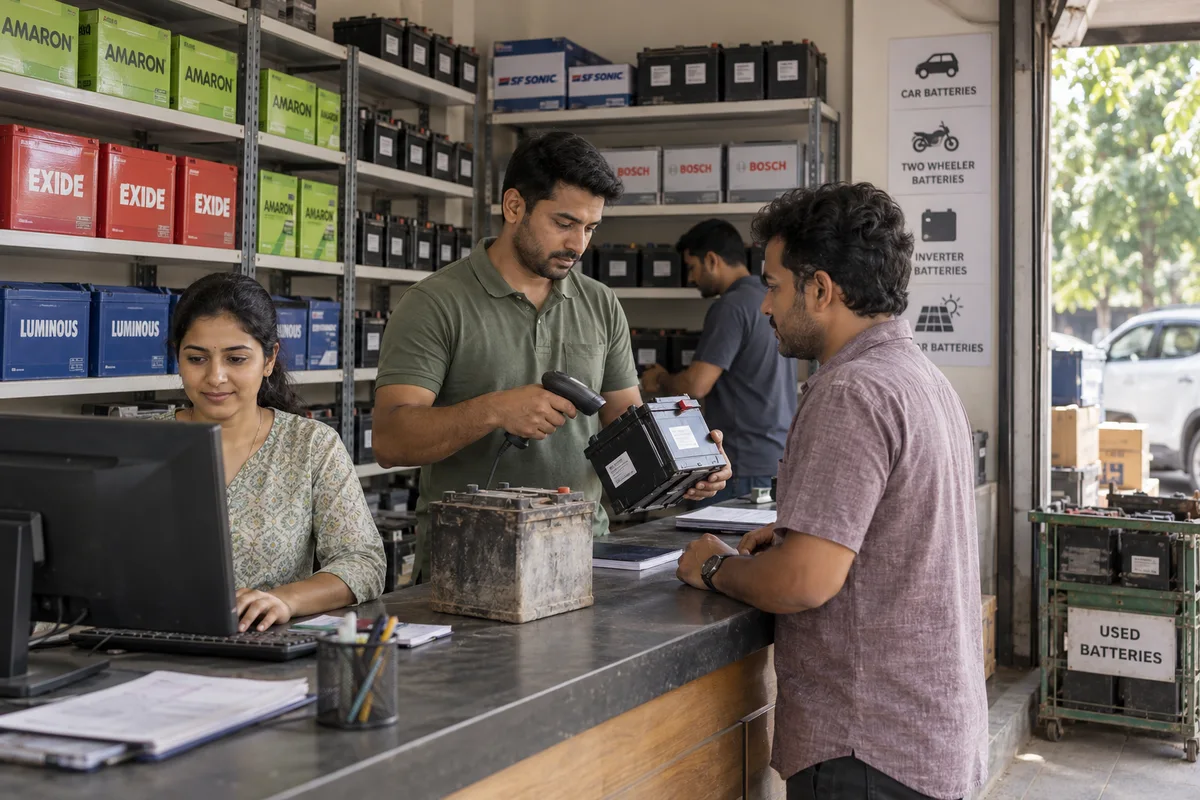
A battery shop owner in Hubballi gets a call from a customer whose inverter battery has died during a power cut. The shop recommends the brand that replaces a failed unit without argument and gives a fair rate for the old battery. Your brand is stocked, but it is not the one named.
Scope, fee, reporting and term are agreed in writing after we have read your brief and spoken to you.
In one paragraph
A battery manufacturer makes lead-acid, lithium-ion or other batteries and packs for vehicles, inverters, UPS, solar storage, telecom and industrial use. Marketing builds the brand with dealers, OEMs and fleet buyers. Sales turns those relationships into stocking orders, pack contracts and replacement business. GullySales writes the dealer programme and assembles the OEM approval pack.
Battery makers sell in three different worlds. The replacement market runs on dealers and old-battery exchange, vehicle and equipment OEMs run on approvals and volume contracts, and industrial buyers run on specifications and service. One website and one price list serve none of them well.
Last updated 18 Oct 2026.
How buyers decide
How battery manufacturers are chosen.
In the replacement market, the dealer decides, weighing margin, the old-battery exchange rate, how fast warranty claims are settled, and whether the maker sends stock on time in the season. A brand with an advertising name but a slow claim record loses the shop.
OEMs choose through trials and approvals. A two-wheeler, e-rickshaw or inverter maker tests samples, checks safety and cycle life against its own specification, audits the plant and negotiates a supply agreement. For lithium packs, the buyer also asks about the cell source and the battery management system.
Industrial and telecom buyers write a specification and compare approved vendors. Service response and an installed base they can visit count as much as price. Rules on batteries, recycling and safety differ by product and change, so check with your own compliance adviser.
The problem
What usually goes wrong for battery manufacturers.
What owners tell us on the first call, in their words.
“The dealer stocks three brands and sells the one with the better claim record”
A warranty replacement took weeks on our side, and the dealer tells customers about it.
“Our old-battery exchange scheme is not clear to anyone”
Dealers quote different exchange rates, and customers walk away when the rate is not explained at the counter.
“We have no way to reach OEMs without a personal contact”
The head of purchase at an e-rickshaw maker has never seen our test data, so we lose to the brand that was introduced.
“Fleet and industrial buyers want service, not a shop”
Telecom and warehouse buyers want a response plan and a visit, and our website sells to individuals.
“Season decides the year”
Orders spike before summer and monsoon, and stock, dealer schemes and calls are planned after the rush starts.
“Fake and refurbished batteries copy our label”
Customers buy a copy from a roadside shop, blame the brand when it fails, and the dealer finds out first.
What we do
What we do for battery manufacturers.
Everything included for battery manufacturers.
Dealer programme with claim clarity
A scheme, counter material and a written warranty and exchange process dealers can quote, with a log of each claim and its outcome.
Product and application pages
Pages by battery type and use, with capacity, cycle life, charging guidance and warranty terms, written for the buyer and the electrician.
OEM approval pack
Specification sheets, test summaries, safety documents and a plant visit plan, assembled for the purchase and engineering teams of target OEMs.
Fleet and industrial buyer path
A page and an enquiry route for telecom, warehouse and commercial buyers, with service coverage stated plainly.
Season calendar
A plan of dealer schemes, advertising and stock communication timed to the buying seasons for your product types.
Genuine product guidance
Pages and counter material that show how to identify a genuine battery and who to call about a suspected copy.
Sales-route sheet
Dealer secondary sales, OEM trials, enquiries and claims set down in one sheet, so you can see which route each rupee of sales came through.
How the result is measured
- Secondary sales by dealer, not only primary dispatch
- Warranty claims received and days to settle each
- OEM samples sent, trials started and approvals received
- Enquiries from telecom, warehouse and forklift buyers
- Old batteries taken back through the exchange scheme
- Stock held in the season against orders received
Recorded as a baseline before work starts, so every later report has an honest comparison.
Every service, written for battery manufacturers
Each has its own page: what it involves for battery manufacturers, what you get, and what it is measured on.
- Lead generationFind the dealers, OEMs and fleet buyers who will stock and specify your battery.
- SEOShow up when the electrician, fleet manager and OEM engineer search for a battery.
- Social media marketingUse social media to show dealers and electricians the battery behind the brand.
- Content marketingPublish what the electrician, dealer and purchase engineer need to read before they buy.
- Buyer personasKnow the shop owner, the purchase head and the fleet manager as separate buyers.
- CRMKeep dealers, OEM trials and warranty claims in one record the whole team can read.
- Follow-up systemsFollow up every dealer, sample and quotation until it becomes an order or a clear no.
- WhatsApp marketingRun dealer schemes, claim updates and stock news on the chat your dealers already use.
- Digital marketingPut one plan across search, social, WhatsApp and the website, route by route.
- WebsiteBuild a website that answers the dealer, the engineer and the fleet buyer in turn.
Worth a page and a campaign of their own
Inverter batteries through retail dealers · Two-wheeler and car battery replacement · E-rickshaw and low-speed EV battery supply · Lithium packs for energy storage · Industrial batteries for telecom and UPS · Forklift and traction batteries · Solar storage batteries through installers · OEM approvals for pack supply
Priority campaigns
Campaigns for what battery manufacturers most want to sell.
Each one planned around when your buyers decide, and measured against the baseline.
Pre-summer dealer scheme campaign
Scheme announcement through dealer meets, WhatsApp and counter material before the inverter season.
Exchange offer clarity campaign
A single, simple old-battery exchange explanation used at every counter and online.
OEM trial campaign
Targeted outreach with a sample and data pack to EV and inverter makers who need a new supplier.
Fleet and warehouse campaign
Content and search advertising for businesses that run forklifts, vehicles or backup power.
Solar storage installer campaign
Technical notes and partner terms for installers who recommend batteries with solar systems.
Beyond search
Where we reach buyers of battery manufacturers, beyond Google.
Search matters, but it is rarely the only way this industry's buyers find a supplier.
Battery shops and two-wheeler mechanics
Whoever fits the battery on a two-wheeler has the last word. Counter material and a claim process the mechanic can explain are what let your brand be named.
OEM purchase and engineering teams
A trial and approval pack for each OEM, with a note of the stage each one has reached, from sample to plant audit.
Telecom, forklift and warehouse buyers
These buyers ask about service response before price. They get an enquiry route and a plain statement of where your engineers can reach.
Solar installers
The installer picks the battery that suits the inverter on the roof. Partner terms and technical notes are what let the installer quote yours.
Distributors and service centres
They meet the customer after the sale, so they need a rule on who passes leads to whom.
Who it is for
This is written for these battery manufacturers.
- Automotive and two-wheeler battery makers selling through dealers
- Inverter and home UPS battery makers
- Tubular and industrial battery makers for telecom, forklifts and power backup
- E-rickshaw and low-speed EV battery makers
- Lithium-ion pack assemblers for EVs and energy storage
- Solar storage battery makers
- Battery makers supplying OEMs under their brand name
- Small battery and cell makers for consumer devices
Not for
It is not the right fit if.
- You want a guaranteed Google ranking or a guaranteed number of leads. Nobody honest can promise either.
- You need enquiries by next week and have nobody to answer them.
- You want posts and reach reported, not enquiries and orders.
How it works
From your first message to the first report.
No open-ended retainer. Every step gives you something in writing.
First
Your brief
You tell us what you need in a few short steps: your business, what you want, where enquiries come from and how they are handled.
After the brief
A conversation and a written scope
We read it, then talk with whoever handles your enquiries. If you want our help, the scope, the fee and the reporting come in writing, and nothing starts before you have read them.
Before work starts
Baseline recorded
The numbers this work is meant to move, such as enquiries, quotations, orders, visits or renewals, written down so every later report has an honest comparison.
After the baseline
The first fix goes live
The fix we agreed to start with is put in place and measured against the baseline, whether that is a reply, a follow-up, a page, a listing or the handover between marketing and sales.
As agreed
Report against the baseline
What moved, what did not, and what changes next, in plain words. How often you get it is set in writing before work starts.
At renewal
Renew on the numbers
The term ends and you decide whether to continue from the results. The length is agreed in writing before anything starts.
How the work runs for battery manufacturers
- 1
Split the sales by route
Dealer, OEM, fleet and installer sales separated, because dispatch figures do not show which route is carrying the year.
- 2
Clean up the dealer counter
Margin, scheme, exchange rate and claim steps checked against what dealers say customers are told.
- 3
Assemble the OEM and fleet packs
Specification sheets, test data and service coverage gathered from your engineering and service heads, one pack per buyer type.
- 4
Choose where to be seen
Dealer meets, direct OEM outreach and search advertising for fleet buyers, picked according to the route you want to grow.
- 5
Lay the season out
Schemes, stock messages and advertising set against summer and monsoon so one rush does not decide the year.
Why us
Why owners pick GullySales over an agency.
Marketing and sales, as one job
Most agencies stop at the enquiry. We also fix what happens after it: the reply, the follow-up, the quote and the CRM.
The person on the first call does the work
No account managers in between. You are never handed to someone you have not met.
A baseline before anything starts
Your numbers are written down on day one, so every later report compares against something honest.
The fee in writing, split three ways
Our time, your media spend and production on separate lines. You always see what goes to us.
No guarantees we cannot keep
The term is agreed in writing and never a default twelve months. We never promise a ranking or a lead count, because nobody controls those.
One office, and we say so
Nagarbhavi, Bengaluru. We work across India by call and WhatsApp and travel when a session needs to be in person.
#257, 3rd floor, Sri Nanjundeshwara Complex, Nagarbhavi 8th Block, Outer Ring Road. How we work.
Engagement options
Ways to work with us.
Pick the size of commitment that fits. Every option starts with your brief and a conversation.
Option 1
The conversation on its own
A call after you send your brief. It says honestly whether you need outside help, and many fixes are ones your own team can make.
Option 2
One fix, scoped
Start with the fix that matters most, such as reply time or follow-up. The fee is in writing before anything starts.
Option 3
An ongoing programme
We run the work, report against the baseline, and you renew on the numbers. The term and the reporting are agreed in writing first.
Option 4
Guidance for your own team or agency
We plan, brief and check the work of your in-house team or current agency, instead of replacing them.
Your brief
Tell us what you need, and we will read it before we call.
Eight short steps about your business, what you want and who decides. Most questions are a tap, and you can skip any you would rather answer on the call.
FAQ
Questions battery manufacturers ask before they call.
Not here? More answers, or ask on WhatsApp.
How do we get dealers to recommend our battery?
Can you introduce us to OEMs?
Should we sell lithium and lead-acid together?
What can we do about copies of our product?
How early should we plan for the season?
How much does it cost?
How long is the contract?
How soon will we see results?
Who will actually do the work?
What do you need from us?
Part of Manufacturing. See the other industries in the sector.
Your next practical step
Tell us what you are trying to grow, and we will read it before we call.
Eight short steps, mostly taps. Skip anything you would rather answer on the call.