Signage companies · Local SEO
Your workshop sits in a lane nobody visits, so list the areas.
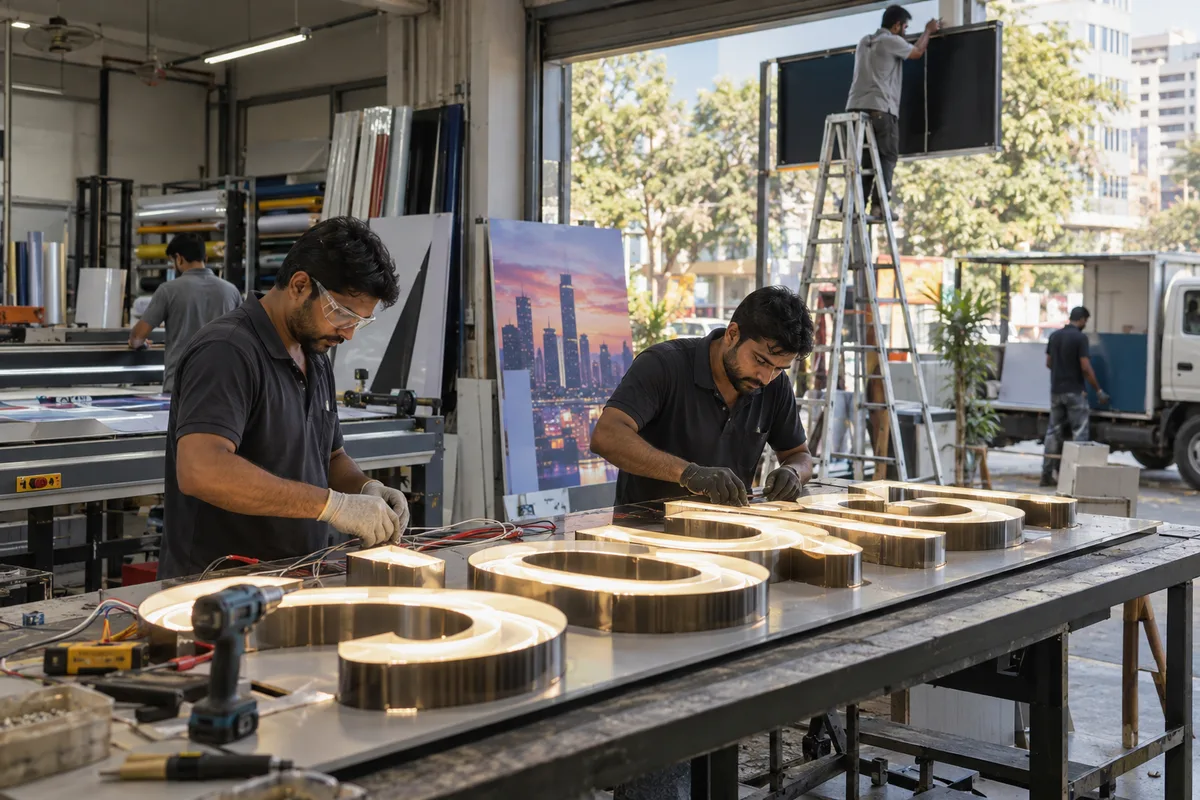
A sign maker's unit is in an industrial lane where no client will ever come, which changes how the listing has to be built. GullySales sets it up to serve an area, adds installed board photographs by locality, and writes a page for each market you work in.
Scope, fee, reporting and term are agreed in writing after we have read your brief and spoken to you.
What local SEO means
Local SEO is the work of making your business show up for searches that name your town or locality, such as a service plus an area name. GullySales sets up locality pages, local citations and map listings so nearby customers find you before a competitor across town.
Last updated 5 Oct 2026.
For signage companies
Where it usually goes wrong, and what we would do.
“The search happens where the board is needed”
A shop owner in a market five kilometres away is searching from their own counter. Your listing has to reach them, not sit in your estate.
“You already own the best local content and never publish it”
Every installed board is a photograph tied to a street. Most sign makers have thousands on a phone and none on a listing.
“Old flex photographs on a profile date you”
A listing whose last picture is a flex banner from two years ago tells a client exactly what you have been doing since then.
“Your unit is hard to find and that costs real time”
Clients who do come to see samples get lost in the lane. Clear directions and a picture of the gate save a phone call on every visit.
What we do
What we deliver for signage companies.
Every deliverable, what it covers for you, and the result it is there to produce. Nothing here is an extra.
A profile set up to serve an area
Service area, categories by sign type and genuine working hours, with the unit address shown or hidden depending on whether clients visit it.
Result: You appear where the boards are needed.
Installed board photographs uploaded
A batch each month with the locality named, including the lit versions, so the profile shows work from this year rather than from two ago.
Result: Anyone checking sees recent, real work.
A page for each market you install in
The commercial streets and markets your boards already stand in, named, with the work done there and the sign types those shops ask for.
Result: A search from that market has something to match.
Directions and a photograph of the gate
Landmarks, the lane name and a picture of the entrance on the profile and the site, for the clients who do come to see samples.
Result: Nobody rings you lost on the main road.
A review request sent after every handover
A short link sent with the switch-on photograph, so reviews arrive from finished jobs instead of only from failures.
Result: The profile stops being written by unhappy clients.
One name and number across every listing
A check across Maps, JustDial, IndiaMART and the site, so the firm name, the lane address, the working hours and the number all agree.
Result: Nothing about your firm contradicts anything else.
How the result is measured
- Map pack ranking
- Local search visibility
- Enquiries by locality
Recorded as a baseline before work starts, so every later report has an honest comparison.
What Google weighs here
How a shop owner or facility manager finds a signage maker nearby, and what to fix first.
- Primary category
- Choose Sign shop or Signage manufacturer for most of your work, and add Advertising agency, Flex printing service or Neon sign shop only if you do those jobs. A listing in the wrong category brings price checks.
- Board types as services
- List ACP letters, acrylic letters, LED glow sign boards, neon signs, flex, vinyl, vehicle branding and wayfinding as separate services. A search for a board type then reaches a line that names it.
- Installation photographs by market
- Add photographs of boards you have put up, by market or road, in daylight and lit at night. A shop owner on the same street wants to see a board like their own.
- Workshop gate and visiting hours
- If your unit is off a main road, photograph the gate and write the lane and the landmark. Say whether customers can come to see samples, since many prefer a site visit.
- Brand names and permissions
- Do not post a client's brand work without their agreement, and do not use a brand's logo as your own. Check the platform's current rules on names, and that each directory shows the same company name.
Who it is for
This is written for these signage companies.
- ACP and acrylic letter signboard makers
- LED and glow sign board manufacturers
- Neon and LED neon sign studios
- Corporate office and wayfinding signage companies
- Retail and franchise rollout signage vendors
- Outdoor hoarding and site branding companies
- Digital signage and display installers
- Flex, vinyl and vehicle branding printers
- Hospital and institutional signage specialists
Not for
It is not the right fit if.
- Your unit is in a lane with no stable address, and the listing would send visitors to the wrong gate.
- You install only for one brand's rollout and never accept walk-in shop owners.
- You do not install outside the factory's own town, so area pages for other markets would be untrue.
How it works
How the local SEO work runs
The work itself, in order. How an engagement starts, from your brief to a written scope, is set out on our method page.
- 1
Write down what is true
Each branch's real address, signboard name, phone, hours and owning Google account go into one record you sign off. Every later listing is copied from it.
- 2
Search as your buyer does
We search each branch on a phone from points around it, in your buyers' words, and note who appears with what reviews and photos.
- 3
Fix the profile first
Ownership first, then name, address, pin, phone, hours and business type. Google can suspend a profile with extra words in its name or an address that is not a real premises.
- 4
Build the branch pages and match the listings
Each real branch gets its own page, and the other listings are changed to agree with it. We write none for towns without a branch, because Google treats near-identical pages as doorway pages.
- 5
Ask, reply and measure
We agree with each branch who asks for reviews, when and how. Results are set against the baseline recorded before work began, and the branch that is behind gets the next round.
Where this fits
Three pieces of sales work, in this order.
This work sits inside sales process design, at stage 1, prospecting and lead generation. The audit comes before it, and sales management keeps it running.
Step 1
Sales audit
Find where deals are being lost and what to fix first.
Start here if you cannot say where orders are lost.
Step 2 · you are here
Sales process design
One written way to sell, from first enquiry to repeat order.
Start here if every salesperson sells differently.
Step 3
Sales management
A target, a review routine and someone who owns the number.
Start here if the team has targets and no routine.
FAQ
Questions owners ask before they call.
Not here? More answers, or ask on WhatsApp.
Our unit is in an industrial area. Should we show the address?
How often should we be adding photographs?
A client blames us when the corporation removes a board. Should the profile say anything?
Customers search signage near me but we are a factory. Should we have a showroom?
How much does it cost?
How long is the contract?
How soon will we see results?
Who will actually do the work?
What do you need from us?
What if we are not happy with the work?
From the blog
Further reading for signage companies.

More for signage companies
Everything else we would do for you.
Closest to this: search and visibility
Also for signage companies
Or start from the overview: sales and marketing for signage companies.
Your next practical step
Tell us what you are trying to grow, and we will read it before we call.
Eight short steps, mostly taps. Skip anything you would rather answer on the call.