Law firms · Conference marketing
A talk in the right room reaches the accountants and founders who refer legal work.
Conference marketing for a law firm is choosing which conferences, bar events and trade gatherings to attend or speak at, preparing a session that teaches a procedure, and recording the professional contacts made. GullySales prepares the shortlist, proposal and records, and every step is checked against the Bar Council's rules on advertising.
Scope, fee, reporting and term are agreed in writing after we have read your brief and spoken to you.
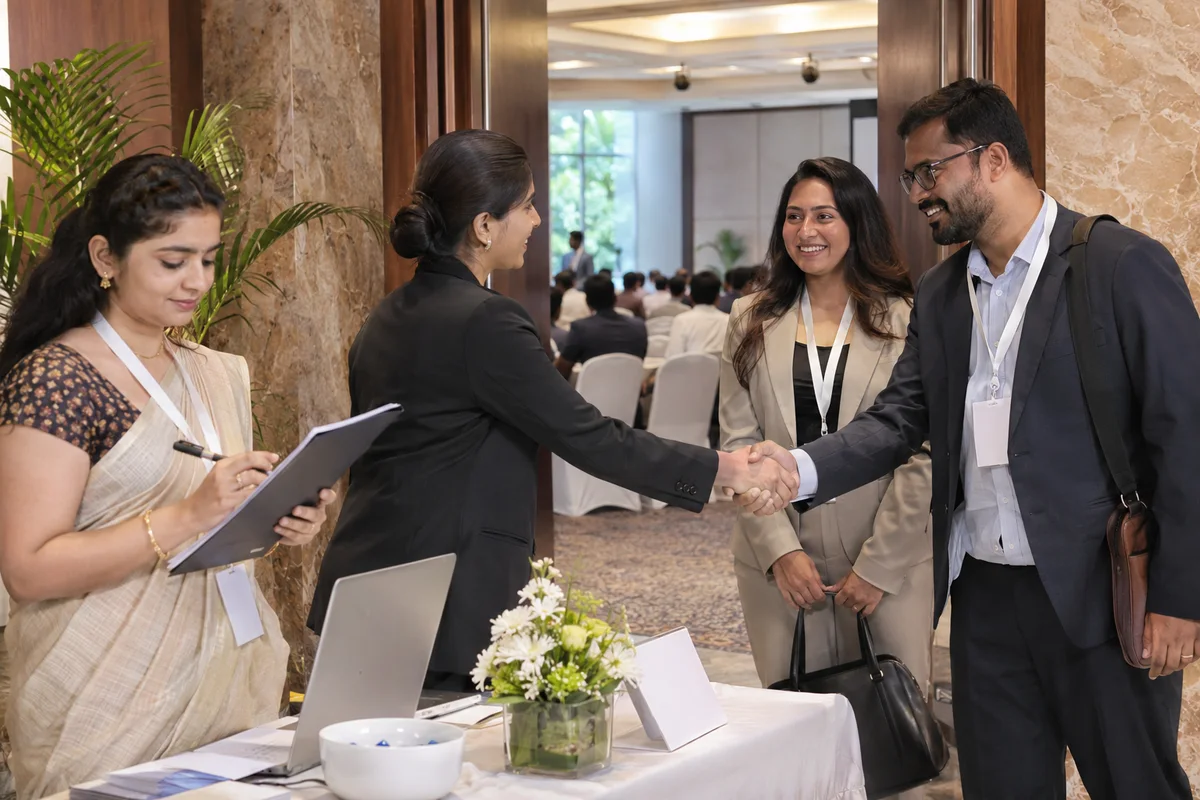
What conference marketing means
Conference marketing treats a conference as a source of buyers: which ones to attend, speak at or sponsor, the session proposal, meetings booked before the day, the table plan, lead capture and follow-up. GullySales prepares each of those with your team and records every conversation against the enquiry or order it led to.
Also for law firms
- Marketing strategy for law firms
- Buyer persona for law firms
- Digital marketing for law firms
- Buyer journey mapping for law firms
- Competitor marketing analysis for law firms
- Ideal customer profile development for law firms
- Founder-led sales advisory for law firms
- Fractional chief marketing officer for law firms
Sales and marketing for law firms, the overview.
Last updated 14 Nov 2026. Rules for this trade differ by state and professional body, and they change. We describe restrictions in general terms, so check the current position with your own council or adviser before you publish anything.
For law firms
Where it usually goes wrong, and what we would do.
“The room matters more than the badge”
A legal conference filled with other firms offers learning and possible co-counsel, but few people who will ever need representation. A meeting of chartered accountants, company secretaries, startup founders or a traders' association puts the firm where clients first describe their problems. Choose by who sits in the audience.
“A committee accepts a lesson, not a firm profile”
Programme committees pick sessions that teach their audience something. A proposal on what a founder should check before signing a shareholders' agreement, or how a flat owners' federation approaches a dispute, fits. A proposal describing your practice goes to the bottom of the pile.
“Sponsor packages may cross the advertising line”
A banner, a stall, a brochure in every delegate bag or a logo on the stage backdrop may count as advertising. Rules differ by state and change over time, so check each with your own council before agreeing to anything. A talk and a conversation at the tea break are the safer ways to be seen.
“A hallway conversation holds confidences”
A delegate describes a dispute over lunch, in a room full of strangers. The advocate listens, says nothing about the merits and suggests a proper consultation. What the firm records afterwards is who asked for a call, never the story. Private details are not written into a shared sheet.
What we do
What we deliver for law firms.
The work available for this need. We agree the deliverables and responsibilities for your engagement in writing.
Conference shortlist and fit note
A comparison of the conferences you are considering, using the programme, past speaker lists and the audience mix, with questions for the organiser. Each one is marked attend, speak or skip.
Result: A short list of events, each with a stated reason.
Check list for your own council
A written list of questions on badges, printed material, sponsor lines, speaker introductions and any listing of the firm in the programme, for your council to answer before you commit.
Result: A page of answers from your council kept with the booking.
Session proposal on a procedure
A title, abstract and speaker biography written to the call for proposals and its word limit. The advocate who will speak checks every statement of law and approves what is sent.
Result: A proposal approved by the speaker before submission.
Professional contacts to meet
A list of chartered accountants, company secretaries and other professionals attending, built from the public programme. Partners approve each name before any message goes out.
Result: A list of contacts that your partners have cleared.
Conversation record without client details
A simple form noting who you met, their role, the subject in general terms and any follow-up they asked for. It holds no facts about a person's dispute.
Result: A record of contacts that discloses nobody's matter.
Follow-up notes and cost record
Short thank-you notes to those who asked for contact, and a sheet of ticket, travel and time set against the referrals and consultations later traced to each event.
Result: A sheet that shows which events led to introductions.
How the result is measured
- Meetings accepted before the conference, against invitations sent
- Conversations recorded with a stated requirement
- Qualified opportunities accepted by sales
Recorded as a baseline before work starts, so every later report has an honest comparison.
Who it is for
This is written for these law firms.
- Litigation and dispute resolution practices
- Corporate and M&A law firms
- Family law practices
- Intellectual property law firms
- Real estate and property law practices
- Tax and compliance law practices
- Boutique single-practice-area firms
Before you decide
Agree the work. Know how to judge it.
Conference marketing for law firms: use these checks to prepare, choose the scope, and review what changes.
Bring the right evidence
Bring a recent won order and an enquiry that went nowhere. Trace how each buyer found you, what they asked, and who handled the next step. A channel list alone will not explain the difference.
Make the scope clear
Choose one offer and one buyer group first. Agree which part needs attention: being found, getting a useful enquiry, or turning an enquiry into an order. Separate recommendations from the work required to carry them out.
Check the work in use
A useful plan names the first change, its owner, the evidence behind it, and the number that will show whether it worked. Ask what has deliberately been left out and why.
Know when to change course
If your team cannot answer the enquiries it already receives, improve that handover before buying more traffic. If the offer itself is unclear, test it with buyers before adding channels.
These are discussion points, not a fixed package. GullySales confirms the deliverables, responsibilities, fee, and term in writing after reading your brief and speaking with you.
Before we start
What to have ready before the work starts.
The records, access and decisions this work needs from law firms. Anything missing is noted in the written scope, with who will supply it.
- Invitations and attendee lists you hold
- Past programmes, badges and emails show which events you were invited to and who attended. Gather what you have. Without them, we research events from public listings. If the firm has no records at all, tell us which bar associations and trade bodies you belong to, and we start from their calendars.
- The partner who will attend or speak
- A named advocate with time to prepare a session. If no partner is available, we plan to attend only. Give us also the dates you cannot travel, such as vacations of the court or a major hearing, so no event is proposed that collides with them.
- Your adviser's view on sponsorship
- Whether the firm may sponsor or exhibit is not ours to decide. Obtain a written view; without it, we propose attendance and speaking only. The view should cover speaking fees, a stall and a brochure separately, since each is judged on its own.
- A rule for visiting cards
- A short note on what the firm does with cards it collects. Write it with your adviser. Without it, no names are added to any mailing list. It should also say who may write to the person afterwards and in what words, so a courtesy note does not become a mailing.
- Travel and registration budget
- A figure for fees and travel. We cost the shortlist against it. Without a figure, we recommend events in your own city. Include the cost of a junior who stays behind to cover the office, so the figure is not understated.
How it works
How the conference marketing work runs
The work itself, in order. How an engagement starts, from your brief to a written scope, is set out on our method page.
- 1
Decide who you want to meet
We begin with the partners and a plain question: which people, such as in-house counsel, company secretaries, other advocates or accountants, would you like to know better? You name the roles and the cities. The answer decides which rooms are worth entering. A conference full of people you cannot serve is ruled out at once. We also ask which referrers the firm would like to meet in person, since a conference is the only place those people are gathered.
- 2
Look through last year's invitations and badges
We read the invitations, programmes and attendee lists the firm already holds, and note which events produced a useful introduction. You tell us from memory which ones were a waste of a day. From this we draw a shortlist of conferences and bar events, with the type of person each would put in front of you. We look at who sat on the panels, as the speakers show the level of professional the event draws.
- 3
Check the shortlist with your own council
For each event we list what attending, speaking or sponsoring would involve, and take the list to your adviser. Sponsor packages and exhibition stalls may cross the advertising line. Take the present rules to your own counsel. Events are removed or changed until your adviser accepts what remains. Your adviser also reads the speaker biography we supply, because a biography is the one place where a firm's description can drift into advertising.
- 4
Write a session proposal that teaches
For events that invite speakers, we draft a proposal on a procedure, such as how a particular filing works or what a company should check before a transaction. An advocate at your firm reviews the content. The proposal teaches and never describes the firm's record or services, which is what a programme committee accepts. We rehearse the opening of the session with the advocate and cut anything that reads as a profile of the firm, leaving the procedure and the documents in sight.
- 5
Prepare the meeting list and the notes sheet
Before the event, we prepare a list of professional contacts to meet and a sheet for recording conversations. The sheet holds names, roles and a next step, and no client details. You brief whoever attends on what not to discuss. A test entry confirms the sheet is easy to fill on a phone. The sheet has a column for follow-up, which is filled only if the other person asked to hear from you.
- 6
Review the contacts against the cost
After the event we count the useful conversations, the follow-up notes sent and any referrals that arrived, against the cost record and the earlier events you attended. You tell us which contacts have led to a meeting. We decide whether to attend again, speak again or drop the event.
Where this fits
Three pieces of sales work, in this order.
This work sits inside sales process design, at stage 0, foundation. The audit comes before it, and sales management keeps it running.
Step 1
Sales audit
Find where deals are being lost and what to fix first.
Start here if you cannot say where orders are lost.
Step 2 · you are here
Sales process design
One written way to sell, from first enquiry to repeat order.
Start here if every salesperson sells differently.
Step 3
Sales management
A target, a review routine and someone who owns the number.
Start here if the team has targets and no routine.
FAQ
Questions owners ask before they call.
Not here? More answers, or ask on WhatsApp.
Can our firm sponsor a conference?
Can we collect visiting cards and add the names to a mailing list?
Will a talk bring us clients?
May the firm exhibit at a stall?
What do we do with the visiting cards collected?
How much does it cost?
How long is the contract?
How soon will we see results?
Who will actually do the work?
What do you need from us?
From the blog
Further reading for law firms.
 6 min read · 18 Aug 2026How to get more law firm clients within the Bar Council's rulesAdvocates cannot advertise or solicit, yet law firms still grow through referrals, a factual website and a recorded response to enquiries.
 7 min read · 17 Mar 2026Marketing strategy for consultants and professional firmsProfessional firms are chosen on reputation and referral, not advertising, and several professions cannot advertise at all under their own body's rules.
 8 min read · 16 Dec 2025Website content checklist for professional firmsA referred client checks your site before calling, looking for named partners, services in plain words, fee signals and proof.
More for law firms
Related work to consider.
Closest to this: strategy and research
- Marketing strategy for law firms
- Buyer persona for law firms
- Digital marketing for law firms
- Buyer journey mapping for law firms
- Competitor marketing analysis for law firms
- Ideal customer profile development for law firms
- Founder-led sales advisory for law firms
- Fractional chief marketing officer for law firms
Also for law firms
Or start from the overview: sales and marketing for law firms.
Your next practical step
Tell us what you are trying to grow, and we will read it before we call.
Eight short steps, mostly taps. Skip anything you would rather answer on the call.