Plotted development companies · Lead generation
Bring in plot buyers who ask for your layout by area, size and approval.
Lead generation for a plotted development company means collecting enquiries from people who want land in your layout, not from anyone who clicked a plot photograph. GullySales works on the sources, the plot-size matching and the record of where each enquiry came from.
Scope, fee, reporting and term are agreed in writing after we have read your brief and spoken to you.
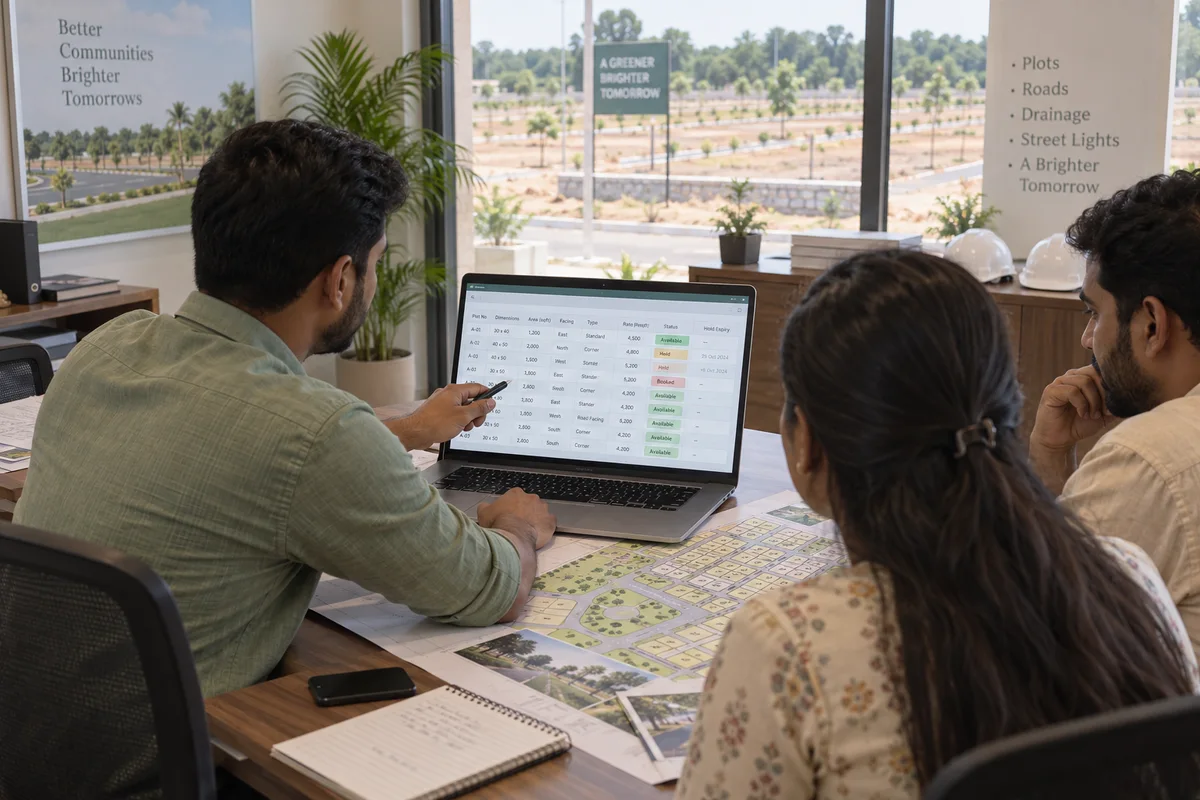
What lead generation means
Lead generation is the combined work of every channel that brings in a new enquiry, whether from search, adverts, referrals or a stall at an exhibition. GullySales runs these channels together and reports the number of enquiries each one produced, not the activity behind it.
Also for plotted development companies
- CRM for plotted development companies
- Follow-up systems for plotted development companies
- SEO for plotted development companies
- Local SEO for plotted development companies
- Social media marketing for plotted development companies
- Content marketing for plotted development companies
- Buyer personas for plotted development companies
- WhatsApp marketing for plotted development companies
Sales and marketing for plotted development companies, the overview.
Plan the next part of the work
Last updated 21 Nov 2026.
For plotted development companies
Where it usually goes wrong, and what we would do.
“A plot buyer searches by area and size, not by brand”
The buyer types a locality and a size, by size, and looks at what comes up. A page that names the locality, the sizes on offer and the approval type matches that search. A page that talks only about a lifestyle does not.
“Broker enquiries and direct enquiries are different leads”
A broker brings a buyer who may show the same buyer several layouts that day. A direct enquirer found you on purpose. Mixed in one list, the two get the same call, and the company never learns which source gives registered sale deeds.
“A curious Sunday visitor and a buyer with a budget look alike on a form”
Both fill the same short form. Asking for the plot size wanted, whether the buyer plans to build or hold, and how the purchase will be paid for separates them before a long drive is arranged.
“A layout that is nearly sold needs a different message”
When few plots remain, the enquiries that matter are for those exact plots. A general campaign keeps bringing buyers for sizes that no longer exist, and the sales team spends calls explaining what is gone.
What we do
What we deliver for plotted development companies.
The work available for this need. We agree the deliverables and responsibilities for your engagement in writing.
Layout enquiry page
A page per layout with the locality, plot sizes, approvals and a short enquiry form that asks for size wanted and purpose of buying.
Result: Each enquiry arrives with a size and a purpose written beside the phone number.
Source-tagged enquiry record
Every enquiry marked as search, advertisement, broker, existing buyer or walk-in, kept in one list.
Result: You can open the list and count enquiries by source.
Plot-size matching
Campaign copy and landing pages written for the sizes still unsold, and changed as plots are booked.
Result: No advertisement names a size that the plot list shows as sold.
Qualifying questions for the first call
A short script that asks about purpose, budget route and the person who will decide, written in plain words.
Result: The caller's notes show who is ready to visit and who is still looking.
Direct buyer list
A list of people who enquired or bought, held by the company and not only by brokers.
Result: The company owns a list that does not leave when a broker does.
How the result is measured
- Relevant enquiries by source
- Duplicate and unsuitable enquiries
- Time to the first response
- Accepted enquiries reaching an agreed next step
Recorded as a baseline before work starts, so every later report has an honest comparison.
What to capture or send
Record what each plot enquiry needs before anyone drives out to the site.
- Plot size wanted
- Taken in the buyer's own unit, such as square feet or cents, so the caller offers only plots still unsold in that size.
- Build now or hold as land
- A buyer who will build asks about road width and construction approval. An investor asks about boundary care. The answer picks the call script.
- Source of the enquiry
- Marked as search, advertisement, broker, existing buyer or walk-in when it is entered, so registered sale deeds can later be counted by source.
- How the purchase will be funded
- Own money, a bank loan or sale of other property. It tells the caller whether to send the map first or to arrange a visit.
- Plot number named by the buyer
- Check the live plot list before replying. Offering a sold plot costs more trust than saying plainly that it is gone and naming what is left.
Who it is for
This is written for these plotted development companies.
- Authority-approved residential layouts on city outskirts
- Companies converting agricultural land into plotted layouts under local rules
- Gated plotted communities with roads, parks and a clubhouse
- Joint development partners who develop a landowner's land and share the plots
- Small layouts of ten to forty plots in towns
- Commercial and industrial plots near highways
- Plots sold with a construction option on the same land
- Companies selling plots in tier-two towns to families living abroad
Before you decide
When this may not be the right fit.
- You have no live list of unsold plots, so every caller would give a wrong answer to the first question a buyer asks.
- Your approvals are still in process and cannot be shown yet, so enquiries would stop at the first doubt on the phone.
- Nobody is free to take a Sunday site visit, so more enquiries would only be left waiting.
Before you decide
Agree the work. Know how to judge it.
Lead generation for plotted development companies: use these checks to prepare, choose the scope, and review what changes.
Bring the right evidence
Define the organisations or buyers you can serve and the reasons they would consider a conversation. Bring examples of accepted and rejected prospects so the selection rule is visible.
Make the scope clear
Agree the research sources, contact approach, qualification rules, and handover. Clarify which meetings count as accepted and what happens to replies that are not ready to buy.
Check the work in use
Review why a prospect was selected and what was learned from the response. Count held, relevant conversations separately from contacts found, messages sent, or meetings booked.
Know when to change course
If the same objection appears repeatedly, adjust the offer or buyer group before increasing outreach. Respect a request to stop contact and keep the exclusion in the record.
These are discussion points, not a fixed package. GullySales confirms the deliverables, responsibilities, fee, and term in writing after reading your brief and speaking with you.
Before we start
What to have ready before the work starts.
The records, access and decisions this work needs from plotted development companies. Anything missing is noted in the written scope, with who will supply it.
- The enquiry register for every layout
- We need the book or sheet where callers and visitors are noted, even if names are partial. A photograph of each page is acceptable. Without it, source counts start from today and we cannot say which route brought buyers before we began.
- The current plot list with status
- A list showing plot number, size, facing and whether each plot is available, held or sold lets us match enquiries to real stock. It must be the list the office itself uses. If it is out of date, the matching guide could send a buyer to a plot already sold.
- Broker terms written on one page
- Note which brokers you work with, how they are credited and whether their buyers may be contacted directly. We do not set these terms. If they are unclear, broker buyers are recorded separately and left untouched until you decide.
- Approval wording cleared by your adviser
- Your own advocate or consultant must approve how approval and layout status are described. We cannot judge it. Until that wording arrives, the layout page says only that documents are available to view at the sales office.
- Names of the executives taking calls
- List who answers enquiries and on which days. A route that sends calls to a person who is away loses the buyer. Without names, enquiries go to one shared number, and we flag that this slows the first reply.
How it works
How the lead generation work runs
The work itself, in order. How an engagement starts, from your brief to a written scope, is set out on our method page.
- 1
Read the enquiry book for each layout
We begin with the register or sheet where your sales office has written down callers and visitors for the layout, and mark how each person heard of you: a hoarding, a broker, a neighbour, a portal, a post. You correct what we guess wrong. What exists afterwards is a count of enquiries by layout and source, recorded before we change any route.
- 2
Split broker enquiries from direct ones
We sit with the sales head and separate the people who arrived through a broker from those who came on their own, because the two are handled and paid differently. You tell us which brokers you wish to keep. Each group then gets its own entry on the record, so nobody is chased twice by different people.
- 3
Match plot sizes to the buyers who ask
We take the plot list with sizes, facings and status, and match it against what callers asked for, noting the sizes nobody enquires about. You decide which plots are shown first and which are held for later. The result is a short guide for the first call, so the executive offers a plot that exists.
- 4
Draft the first-call questions with the desk
We write four or five questions the executive asks at the start: when the buyer wants to build, whether a loan is being arranged, who else will decide and which locality they are comparing. The sales head tries them on a live call and strikes out any that sound like an interrogation. Callers are tagged by what they answer.
- 5
Prepare the layout page and the enquiry route
We build the page a buyer reaches from an advertisement or a message, showing the plot sizes, the approval wording your adviser has cleared and a form asking only what the first call needs. You read every line against the layout file. Nothing about status or approval appears without your say.
- 6
Send a test enquiry and read the first count
We put a test enquiry through every source and follow it to the executive's phone, then switch the routes on. Later we set calls, site visits booked and plots held on token against the count taken in the first step. You say which enquiries were genuine, and we adjust the sources without presuming any rise.
Where this fits
Three pieces of sales work, in this order.
This work sits inside sales process design, at stage 1, prospecting and lead generation. The audit comes before it, and sales management keeps it running.
Step 1
Sales audit
Find where deals are being lost and what to fix first.
Start here if you cannot say where orders are lost.
Step 2 · you are here
Sales process design
One written way to sell, from first enquiry to repeat order.
Start here if every salesperson sells differently.
Step 3
Sales management
A target, a review routine and someone who owns the number.
Start here if the team has targets and no routine.
FAQ
Questions owners ask before they call.
Not here? More answers, or ask on WhatsApp.
Should we spend on ads or on brokers?
What should the enquiry form ask?
Can we advertise plots in a layout that is still being approved?
Should the enquiry form ask for a budget?
Do we have to stop using brokers while this runs?
Can you promise a number of plot enquiries?
How long is the contract?
How soon will we see results?
Who will actually do the work?
What do you need from us?
More for plotted development companies
Related work to consider.
Closest to this: leads and follow-up
Also for plotted development companies
Or start from the overview: sales and marketing for plotted development companies.
Your next practical step
Tell us what you are trying to grow, and we will read it before we call.
Eight short steps, mostly taps. Skip anything you would rather answer on the call.