Notes for owners · Branding and communication
A brand story for a 20-year-old family business without sounding like a museum
How to write the story of a long-running family firm by starting from what customers wrongly believed before they met you, with a worked foundry example and a one-page template.
The GullySales team · Updated 17 Oct 2026 · 5 min read
On this page
A brand story for a family business that has been trading for twenty years works best when it starts with what customers wrongly thought before they met you, not with the year the shop opened. The wrong belief is the interesting part: it is specific, it is the reason people hesitate, and your history is the evidence that corrects it. Keep the founding year as one fact inside a sentence, and let the story be about the customer.
Why "Since 2004" does not carry a story
A date shows that you have survived. That counts for something with a buyer who fears being left stranded, but it does not tell anyone why they should choose you this month. Museum-style pages fail in a recognisable way: a photograph of the founder, a paragraph about humble beginnings, a list of expansions, and a closing line about values. Everything is true and none of it changes a decision.
The test is simple. Read your About page and ask what a stranger knows after it that they did not know before about how you will treat their order. If the answer is nothing, the page is a record, not a story.
Find the wrong belief
Ask your three longest-standing customers, and two people who left, the same question: "Before you dealt with us, what did you assume about us?" Write the answers as they are said. Common ones are "that you only do small jobs", "that an old firm will be slow", "that you cost more because you are established", or "that you are fine for local orders but not for a big contract".
Then ask what changed their mind. The change is the story. Your twenty years are only the reason it is believable.
A Gwalior printing press that people took for a card shop
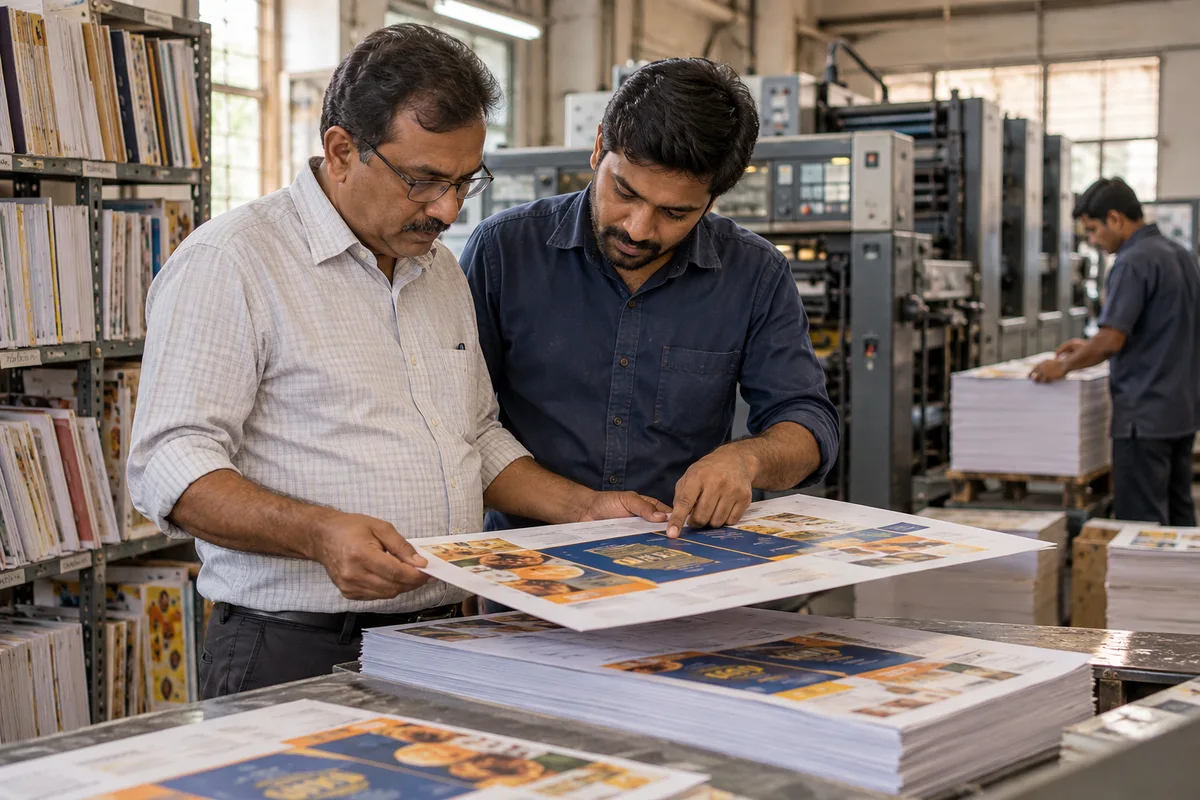
An invented example. A family-run offset press in Gwalior, begun by the father and now run by two brothers. Its About page is a timeline: the year of founding, the first machine, the second shed, a line about "quality and trust". Enquiries from companies needing catalogues and cartons stay thin, and most calls are for wedding cards.
The brothers ask their buyers, and the same belief comes up three times: "We thought you only did wedding cards." One buyer says the press proved the assumption wrong when it reprinted a carton with the colours matching the first run, without being reminded. The press had kept the approved proof.
The rewrite opens with the belief: "Most people meet us thinking we print wedding cards." The buyer's reprint is the proof. A photograph shows the shelf where approved proofs wait for repeat orders. The founding year drops into a sentence lower down, and the timeline shrinks to a box at the foot. Enquiries from companies do not jump, and the rewrite costs the brothers a day of a designer's time. One carton buyer rings in the following months, and the rest of the calls are still wedding cards, because the story has to be repeated on the Google profile and in quotations before it travels.
A one-page template
Fill this in before you write any prose:
| Prompt | Your answer |
|---|---|
| What did people assume before they met us? | |
| What did one named, consenting customer see that changed that? | |
| What do we do in practice that proves it (a habit, a record, a rule)? | |
| Who in the family answers for it today? | |
| What do we still not do well, and say so? |
The last row matters. A family firm that admits it does not take rush orders on Sundays sounds more believable than one that claims to do everything. Use customer examples only with the customer's permission, and describe them rather than inventing one.
Where the family belongs in it
Put the family where it changes something for the customer. If the second generation now handles dispatch, say what that means: who picks up the phone when a truck is late. If the founder still visits the floor, say what the founder checks. Skip the family tree, the childhood stories and any claim about values you cannot show in a behaviour.
Also be careful with age itself. "Twenty years of experience" invites the reply "Twenty years of doing it the old way?" Pair age with something current: a new process, a record you now keep, a customer who joined last year.
Where the story goes once it is written
The three-hundred-word version belongs on the About page and in the company profile. The one-sentence version goes into your WhatsApp business description, the first line of your Google profile and the opening of a quotation, so that a buyer meets the same words wherever they look. If it lives on one page only, nobody quotes it back. The same material feeds a corporate profile, which a purchase manager may forward internally, and a written brand story is the version to start from.
Checking the draft against a stranger
Give the draft to someone who has never dealt with you, ideally a person in the buyer's job, and ask them three things after one read. What do we do? What would I assume about us before this page? What would make me hesitate? If their answers match your wrong belief and your proof, the story works. If they remember the founder's name and the year but not what you do, the page is still a museum.
Cut anything they did not mention, except contact details and any statement your trade requires. The grandfather's photograph can stay as a small caption on the history box. It just should not lead.
One more habit helps. Write in the way the second-generation partner talks across a table, not the way the old brochure was written. If you would never say "we are committed to excellence" to a customer's face, do not put it in the story. Say what you did last Tuesday for a buyer who rang at six in the evening.
Write the wrong belief down this week
Call three customers and ask what they assumed about you. Write the answers in a notebook, pick the one that appears most often, and draft two sentences that correct it using something you can show. Keep the museum material as a footnote. The answers also feed the rest of your marketing, since the same wrong belief usually shows up in your quotations and your Google profile. If you want help turning them into a page, tell us what you need and send us what you have.
Related services