Notes for owners · Sales management
Export buyers who write once and go quiet: the follow-up that earns a second reply
What to send an overseas buyer who asked once and then went silent: a sample route, a short price for what the buyer asked about and one question, then a second note after a pause you choose in advance.
The GullySales team · Updated 17 Oct 2026 · 6 min read

On this page
The buyer wrote once, you sent your catalogue, and nothing came back. A silent buyer may not have said no. The same email probably went to a dozen suppliers, and your reply may have looked like the other eleven. Write once more with three things: a way to see a sample, a short price for exactly what was asked about, and one question the buyer can answer in a line. Then choose your pause, write the date in your calendar, and send a second note when it arrives. After that, stop.
Why the buyer went quiet
Picture a buyer in Sydney or Hamburg who asks five Indian suppliers the same question and reads all five replies in one sitting. The ones that answer the question get read to the end. The rest get archived.
Many first replies carry an eighty-page catalogue, rupee ex-factory prices for every quality, no lead time, and "kindly revert at the earliest". The buyer asked about one product. You sent homework.
Some buyers go quiet for reasons that have nothing to do with you. The project moved. The trade fair is next month and the decision waits for it. A customer has not paid. You cannot see any of that from India, so the follow-up has to make replying easy, even replying "not now".
Buyers of Rajasthan crafts may want samples before trusting a new maker. The follow-up starts that, not a reminder.
What the follow-up carries
A sample route. Post physical samples unasked only to a buyer who is real and specific: a company name, a website you can check, and a product or project named. Courier abroad costs real money. For everyone else, offer the sample and describe it.
A short price. Only for what was asked about, in the currency and terms the buyer uses, with the minimum order, the lead time and a validity date. Two qualities at most, so the choice needs no phone call.
One question. Not "please let us know your requirements". A single question with a short answer that tells you where the buyer stands. "Is the rug for a project with a fixed install date?" "Is this for your spring range or the one after?" If the answer comes, you have a conversation. If it cannot come in a line, the question is wrong.
Choose the pause before you send the first note
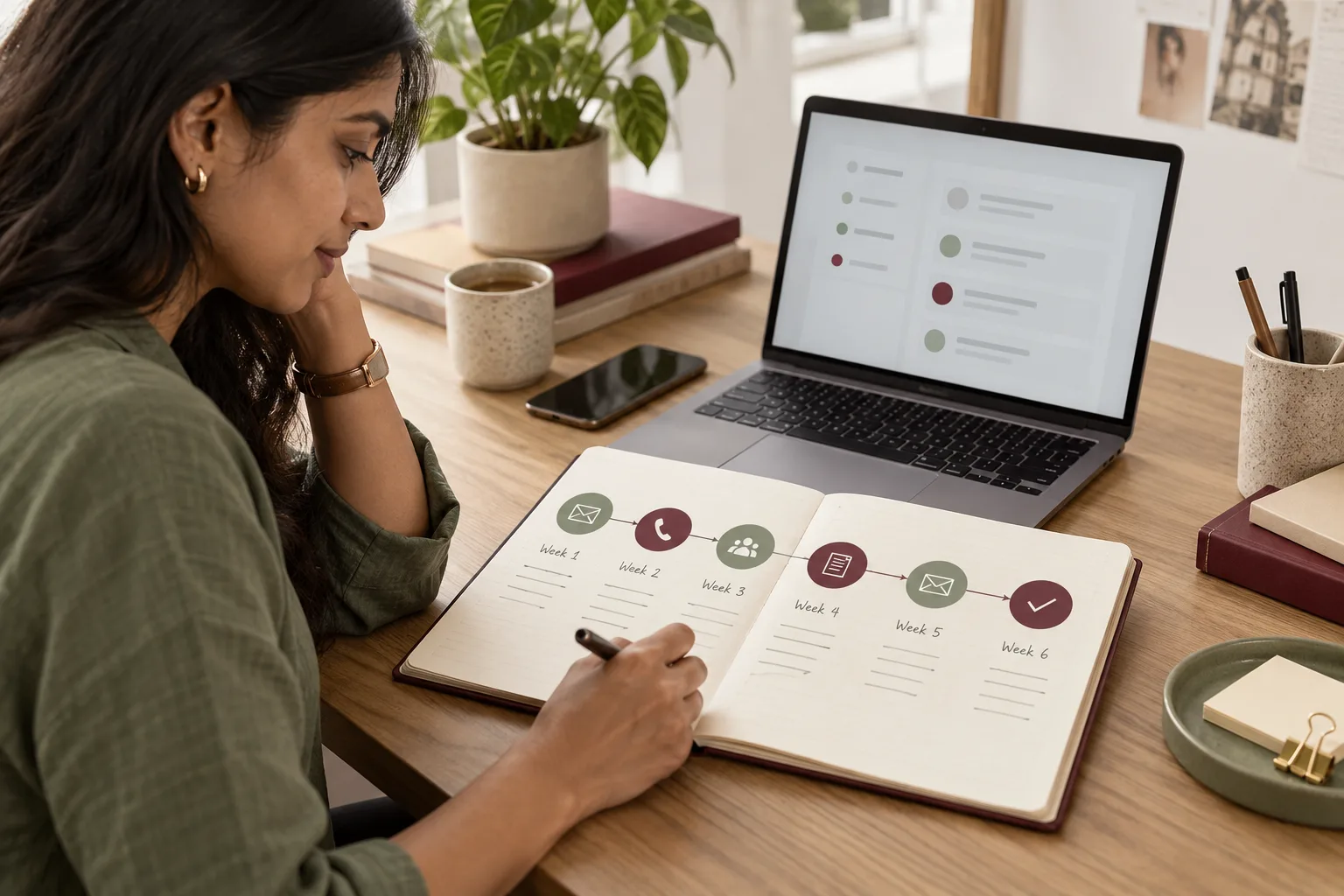
Decide when the second note goes before the first one leaves, and write the date down. Pick it in this order:
- If the buyer named a date or an event, such as a fair, a client meeting or a range review, wait until a few days after it.
- If you sent a physical sample, wait until the tracking shows it delivered, then allow enough working days for it to be shown to whoever decides.
- If neither applies, choose a fixed number of working days and keep to it. Ten is a start for a buyer who has not replied at all; adjust it after your first few.
Chasing three times in one week suggests you are short of work. Waiting until you remember suggests disorder.
The two notes, word for word
These are written for a Jaipur rug maker answering an interior designer. Change the product, keep the shape.
First follow-up. Dear (name), thank you for asking about a hand-knotted rug in muted greens, about 3 by 4 metres. I have attached photographs of two rugs we made in a similar palette, one in hand-spun wool and one in wool and silk. For 3 by 4 metres, the price is (price) in wool and (price) in wool and silk, delivered to (city), with a lead time of (weeks) from approval. I can post you a set of green yarn poms and a small corner sample of both qualities. Is the rug for a project with a fixed install date?
Second note, after the pause. Dear (name), the yarn poms reached you on (date). Attached is a photograph of the two greens you might pair, laid side by side in daylight. If the project has moved, tell me which month to write again. A strike-off before you decide? I can start one this week.
The second note brings something new and gives the buyer an easy way out. It does not say "just following up".
For example: a rug maker in Jaipur
Imagine a Jaipur maker of hand-knotted rugs and flat-weave dhurries, selling through two importers and wanting direct work with designers. The details are illustrative. An interior designer in Sydney emails asking for a custom rug in greens and "prices, please".
The unit's first reply is the full catalogue and a price per square foot for six qualities in rupees. Three days later it sends "Kindly revert". Two days after that, the same. Silence.
A family member takes over the export mail and sends the first follow-up above: two photographs, two prices delivered to Sydney, a lead time, the offer of poms and a corner sample, and the install-date question. The designer replies in one line asking for the poms. The unit sets the pause by the tracking and, when it has passed, sends the second note. The designer writes back that the client meeting has slipped and gives a new date. The unit writes again after that meeting, with the strike-off ready.
The first order is a single rug, and after courier and sample costs it barely covers itself. Whether a second order follows is not yet known.
When to stop writing
After the second note, stop unless the buyer replies. A third chase wears down the goodwill you built. Move the enquiry to a dormant list with three notes against it: what was asked for, what you sent, and the season the buyer buys for. Write again when that season comes round, with something new to show.
Skip the sample offer entirely when the enquiry is a one-line "send price list" from a free email address with no name, no company and no product. Reply politely with a short price and the one question, and see whether a real buyer answers.
How to reply the same day when the owner is travelling is in replying to export enquiries when the owner is away.
Reread the five that went quiet
Open your sent mail and find the last five export enquiries that went quiet. Against each, write the question you should have asked and the price you should have sent, in the buyer's currency. Season not over? Send the first follow-up today. If it has passed, the enquiry goes on the dormant list with the month to write again. If you want the notes, the pauses and that list kept for every buyer through missed and dormant lead recovery, tell us what you need.