Notes for owners · Industry playbooks
How a hospital builds brand awareness with targeted campaigns
A hospital does not need city-wide awareness, only to be the first name in its own catchment for the departments it wants to fill.
The GullySales team · Updated 15 Sept 2026 · 8 min read
Rules for this trade differ by state and professional body, and they change. Check the current position with your own council or adviser before you act on anything here.
On this page
A hospital does not need to be known across the city. It needs to be the first name a family says within its own catchment, and the default choice for the two or three departments it wants to fill. That is a targeted job: a defined radius, one department at a time, reached through the four groups who send patients. Those groups are families nearby, referring doctors, employers and apartment or resident communities. GullySales plans those campaigns, runs them, and reports the appointments they produce rather than the impressions.
What awareness actually means in healthcare
Two different things, and they are usually confused.
Emergency recall. When a child falls at nine at night, somebody says a name. That name is decided by proximity, by the boards people pass daily, and by whether a neighbour had a good experience. It is built slowly, locally, and almost entirely within a few kilometres.
Specialty reputation. When a family is told a knee replacement is needed, they ask who is good for it. That decision travels much further and is decided by the consultant's name, by referrals from other doctors, and by what can be verified online.
A campaign that mixes the two produces a pleasant hoarding and no appointments. Decide which one you are buying.
Start with the catchment, not the city
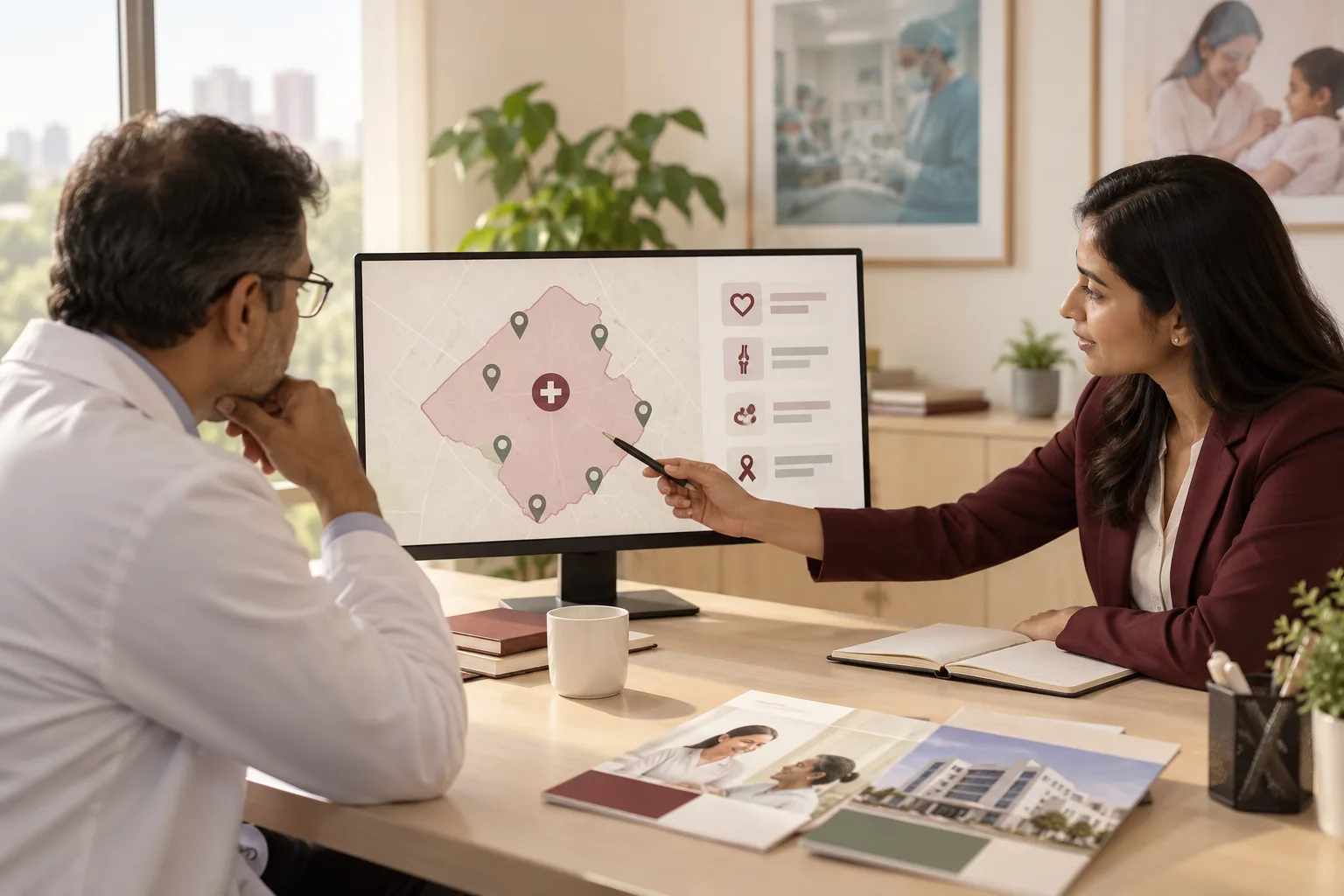
Draw the actual radius on a map: six to eight kilometres for general and emergency work, or twenty minutes in real traffic. Then list what is inside it. Apartment complexes with their association contacts. Schools. Factories and offices with more than fifty staff. Pharmacies. Clinics and single-doctor practices. Diagnostic centres. Senior citizens' associations and temples.
That list, with names and numbers, is a more valuable asset than any creative. Everything targeted is built on it.
For example, a hospital in Rajajinagar working an eight-kilometre catchment might find 90 apartment associations, 40 employers above fifty staff and 120 pharmacies inside it. Reaching those 250 contacts properly costs less than a month of hoardings and can be measured.
Target by department and by who decides
| Department | Who actually decides | Where to reach them | Campaign that fits |
|---|---|---|---|
| Emergency and trauma | The nearest bystander | Google Maps, boards, local recall | Correct profile, 24-hour listing, signage, ambulance tie-ups |
| Obstetrics | The expectant couple, advised by family | Search, obstetrician referrals, antenatal classes | Package page, hospital tour, antenatal programme |
| Orthopaedics | The patient, on a doctor's advice | Referring physicians, senior citizens' groups, search | Consultant-led camps, joint pain screening at associations |
| Paediatrics | The mother, on a neighbour's word | Schools, apartment groups, paediatric clinics | School health check-ups, vaccination reminders |
| Preventive health checks | Company HR or the admin head | Employers in the catchment, industry associations | Corporate package outreach, on-site camps |
| Dialysis and chronic care | The patient and the referring nephrologist | Diagnostic centres, physicians, search | Shift availability, transport help, doctor outreach |
The pattern is that almost nothing is decided by the patient alone. Campaigns that reach the person who advises the patient work better and cost less.
Referring doctors are a channel, and most hospitals neglect them
A large share of a hospital's specialty admissions come through general physicians, small clinics and diagnostic centres nearby. Those relationships are usually maintained by whichever consultant happens to know somebody.
Make it deliberate. Build the list of clinics and physicians inside the catchment. Have your consultants meet them, not a marketing executive. Send a proper discharge summary back to the referring doctor every single time, which is the single most appreciated thing a hospital can do and is often skipped. Hold a clinical meeting once a quarter where your consultants present a case. Record who referred whom, so you know which relationships are producing.
Employers and communities, one by one
For corporate health checks, the buyer is an HR or admin head with a budget and an annual cycle. Approach them three months before their renewal, with a package sheet that states every test included. It should also cover the time each employee will take, whether you will come on site, and how reports are delivered. An illustrative package might be quoted at ₹1,200 a head for a basic screening, and the HR head will compare it line by line with two others, so the inclusions matter more than the price.
For apartment associations, the offer is a camp plus something useful for the community: a first aid session for security staff, a talk on diabetes, an ambulance drill. Then a register, and follow-up calls.
What we do, and what gets reported
We have worked with hospitals including Chord Road Hospital. The work is consistent: define the catchment, build the contact list inside it, choose two departments with spare capacity, run a campaign for each with the right audience, keep every clinical claim out of the copy, and put one enquiry register behind all of it.
Reporting is on enquiries and appointments by department and by source, reply time, camp attendance converted to consultations, corporate packages signed, and referrals recorded by referring doctor. Impressions and reach are noted, not celebrated.
What to do next
Draw your catchment on a map this week and count what is inside it. Then pick the one department with the most spare capacity and ask who actually sends patients to it today. If nobody can answer that with names, the campaign to run is a list-building exercise, not an advertisement.
If you want that mapped with you, tell us what you need.
Industries