Notes for owners · Sales management
The demo, the visit and the reference call: what a machine buyer wants before ordering
How a machinery maker plans the three proofs a buyer asks for before a purchase order: a demo on the buyer's own material, a visit to a running installation, and a reference call with a user.
The GullySales team · Updated 17 Oct 2026 · 5 min read

On this page
- The demo: run the buyer's material, not yours
- The visit: a host plant you asked long before
- The reference call: two names, then step out
- The planning sheet for each serious enquiry
- For example: a Batala bending machine and a Meerut gym-equipment maker
- When one or two of the three will do
- Ring three hosts before the next shortlist
Your machine ran well at your works and the buyer's engineer nodded. Then the engineer asked to see one running in a plant like theirs. Nobody was ready to host the visit, it took weeks to arrange, and the order cooled. A machine buyer wants three proofs before ordering, and each answers a different fear. The demo shows the machine does the job on the buyer's material. The visit shows it keeps doing it in a real plant. The reference call lets the buyer hear what went wrong and how you handled it. Plan all three before the enquiry arrives.
The demo: run the buyer's material, not yours
Your own test pieces are the ones the machine was set up on. The buyer knows that. Ask for their material in advance, with the drawing and the quantity they run in a shift. Tubes with a thinner wall, a powder that bridges, a casting with a rougher surface: whatever the real problem is, it should be in the trial.
Run at production speed. A machine shown slowly proves only that it can be shown slowly. Show a changeover too, from one of the buyer's parts to another, because changeover time is what the production head will ask about. Then hand the controls to the buyer's operator for the last part of the run.
Write the readings down on one sheet: parts made, cycle time, rejects, power drawn if you can measure it. Ask the engineer to sign it. That sheet goes into the comparison and, later, into the capex note. Our note on how a machinery buyer moves from enquiry to purchase order covers where it ends up.
The visit: a host plant you asked long before
A visit to a running installation answers a question your works cannot. Does the machine hold up after a year of second shifts, run by an operator you never trained? The buyer wants to stand beside it, hear it, and talk to the person who runs it.
Hosts are a resource you can wear out. Keep a short list of customers who have agreed to host, with the machine, the industry, the distance from the main roads and the date of the last visit. Rest a host between visits. Ask permission for each visit, not once for ever, and tell the host who is coming and why.
On the day, arrange the gate pass and safety induction in advance. Then stand back. The host will say things you would not have said, about a breakdown or a slow spare. That is why the buyer came. Thank the host afterwards with something useful, such as a service check on the machine while your engineer is there.
The reference call: two names, then step out
Give two names, in the same industry and of similar size to the buyer, and let the buyer call them without you. Before passing a name on, ring the reference, ask if they are willing this time, and tell them what this buyer cares about. Do not tell them what to say.
The strongest reference is a customer who had a problem that you fixed properly. A buyer has heard enough praise. What the buyer wants to know is what happens when the hydraulic unit leaks in the middle of a season.
Proof of this kind has to be built before it is needed. Keep the host list, the willing references and the case notes, each with the customer's permission.
The planning sheet for each serious enquiry
Fill this in when an enquiry reaches the shortlist, not when the buyer asks.
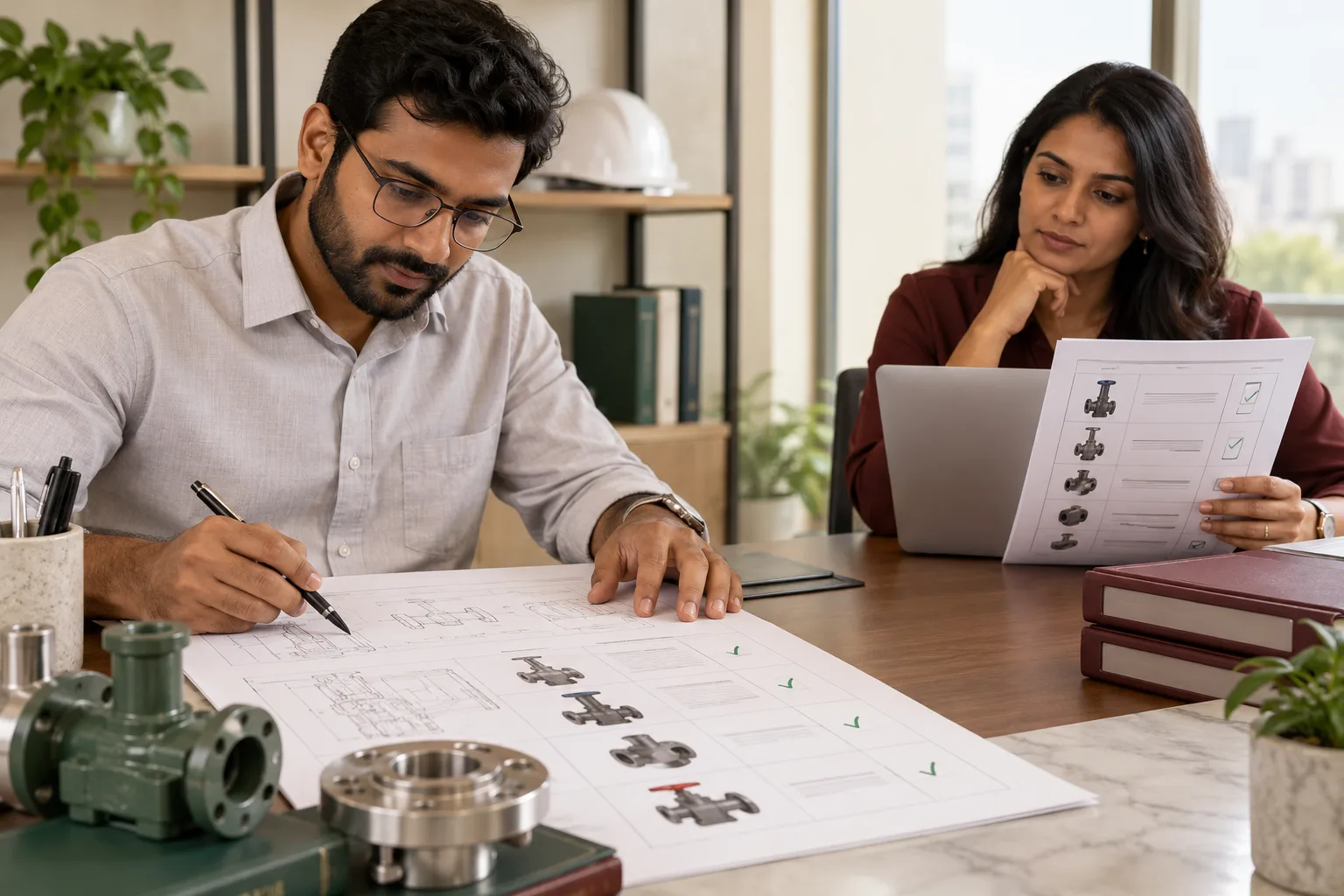
- Buyer's material requested, with drawing, wall thickness or grade, and shift quantity
- Trial date fixed, with the buyer's engineer and one operator invited
- Readings sheet printed: parts, cycle time, rejects, changeover time, power
- Two host plants identified in or near the buyer's industry, and the nearest one asked
- Gate pass, safety induction and travel arranged for the visit
- Two reference names chosen; each reference rung and willing
- One reference who had a problem that was fixed, if you have one
- Follow-up date set for the morning after the visit
For example: a Batala bending machine and a Meerut gym-equipment maker
Imagine a maker of hydraulic tube-bending machines in Batala quoting a gym-equipment maker in Meerut. The demo at Batala used the maker's own tubes, and the bends were clean. The buyer's engineer went home unconvinced, because their frames use a thinner wall that wrinkles on a tight radius. The engineer then asked to see a machine in a running plant. The maker had never asked any customer to host.
Recovering the order took three steps. The maker asked for a bundle of the buyer's actual tubes and ran them with a changed mandrel. The buyer's operator was at the controls, and both sides signed the readings. The owner rang a cycle-parts maker in Ludhiana who had run the same model for some years, asked permission, and arranged the visit with a gate pass ready. And the owner gave two reference names, one of them a customer whose hydraulic pack had failed early and was replaced on site. The buyer asked that customer most of the questions. In this invented case the Meerut firm ordered one machine, not the two it first discussed, and asked for the thin-wall mandrel to be tested again at commissioning.
When one or two of the three will do
For a standard machine of modest value, a long video of it running at a customer's plant and one reference call are enough. A full trial would cost you more than the margin.
Skip the demo for a buyer who has no budget approved and no date; ask the budget question first. Never send a buyer to a host whose machine is an older model or poorly kept. And if you have no installation in the buyer's industry yet, say so plainly, then offer a trial on the buyer's material at your works.
Ring three hosts before the next shortlist
Write down every customer who might host a visit, and ring the three most likely to agree before the next shortlist, not during it. A host list cannot be built in the week a buyer asks for it, and the industrial machinery and equipment section shows how other makers lay out their proof. For help building the proof behind your next quotation, including customer advocacy, tell us what you need.