Used car dealers · Follow up systems
Ring the buyer who drove the car on Sunday before another lot does.
Follow-up in a used car dealership is what happens after the visit: the buyer who drove the car and went home to think, the one waiting for a loan answer, the one who said the father would come along. GullySales builds the call list, the words for each case and the note that records why a sale did not happen.
Scope, fee, reporting and term are agreed in writing after we have read your brief and spoken to you.

What follow up systems means
A follow-up system is the set routine for calling, messaging or emailing an enquiry more than once, since most buyers do not decide on the first conversation. GullySales sets the number and timing of follow-ups so an undecided buyer keeps hearing from you until they decide either way.
Also for used car dealers
- Lead generation for used car dealers
- CRM for used car dealers
- Truck and commercial vehicle dealer lead-to-booking programme for used car dealers
- SEO for used car dealers
- Local SEO for used car dealers
- Pay per click advertising for used car dealers
- Social media marketing for used car dealers
- WhatsApp marketing for used car dealers
Sales and marketing for used car dealers, the overview.
Last updated 14 Nov 2026.
For used car dealers
Where it usually goes wrong, and what we would do.
“The car has been driven, so the buyer is the best lead on the lot”
A buyer who has driven your car is nearer to buying than any new enquiry. If nobody calls within a couple of days, another dealer's call is the one the buyer takes.
“The family decides after the visit”
The buyer who says the wife or father will come along is deciding at home. A message with the car's photographs and the date it can be held gives the buyer something to show them.
“A price drop is told to nobody”
A car that came down should reach everyone who walked away because of the price. Most lots tell nobody, and the buyer finds out from a rival.
What we do
What we deliver for used car dealers.
The work available for this need. We agree the deliverables and responsibilities for your engagement in writing.
A list of buyers who drove a car and did not buy
Everyone who test drove or visited and left without booking, taken from the register with the car, the date and what they said.
Result: The buyers nearest to a decision are on one page.
Wording for each reason a buyer goes quiet
Short, plain scripts for the buyer who needs to think, the one waiting for a loan, the one comparing a rival's car and the one who wants the family to see it.
Result: Staff say something that fits the buyer's reason instead of asking if the buyer has decided.
A car-held message with a date
A rule and a message for holding a car for a named buyer until a stated day, with the day written in the register.
Result: A hesitant buyer has a reason to come back, and so does the lot.
Price-drop messages to those who walked away on price
A list of buyers who left because of the price, matched to the cars whose price has changed, with a short message to each.
Result: The buyer hears about the new price from you, not from a rival.
Sold-car replies that offer a similar car
A message for the buyer whose car has sold, naming the day it went and offering the nearest two on the lot.
Result: A lost car becomes another visit.
One line on why each sale was lost
The reason in the buyer's own words, entered by whoever spoke to the buyer last.
Result: You learn which cars, prices and answers lose sales.
How the result is measured
- Follow-up completion rate
- Average number of follow-ups before close
- Enquiries closed after repeat follow-up
Recorded as a baseline before work starts, so every later report has an honest comparison.
Follow-up routine for dealers
What the lot does next for each kind of buyer who has gone quiet.
- Enquired, not yet answered
- The person who took the message calls the buyer the same day and sends photographs. If the buyer does not pick up, send a WhatsApp with the car and your hours, and note the attempt.
- Visited and test drove, no decision
- The salesman who showed the car rings the next day, asks what is holding the buyer back and writes the answer down. Offer a second drive or a visit with the family.
- Loan application pending
- Check with the lender before you ring, so you have a real status to give. Tell the buyer which document is missing and note the date promised for it.
- Said they would think about it
- Do not ask whether the buyer has decided. Ask which of the two or three cars the buyer liked and send that one, with any change in price. Write the date named for deciding.
- Car sold to someone else
- Tell the buyer the day the car goes and offer the nearest two on the lot. Ask whether the buyer still wants the same model or has changed the budget.
- Bought a car some years ago and may want to change
- From the register, ring owners of cars of the kind people change. Ask about the car and offer an exchange valuation, not a sales pitch.
Who it is for
This is written for these used car dealers.
- Independent used car dealers
- Multi-brand pre-owned showrooms
- Dealers specialising in one segment
- Franchise pre-owned outlets
- Online-first used car sellers
- Dealers who also broker and consign
Before you decide
When this may not be the right fit.
- Nobody records who drove which car, so a follow-up list would have no names to call
- The salesman who showed the car has left and no one wrote down what the buyer said
Before you decide
Agree the work. Know how to judge it.
Follow-up systems for used car dealers: use these checks to prepare, choose the scope, and review what changes.
Bring the right evidence
Trace recent enquiries from arrival to the last recorded action. Include a won enquiry, an unsuitable one, and one that went quiet, with personal details removed for the initial discussion.
Make the scope clear
Agree who accepts each enquiry, what makes it qualified, and how ownership changes. Include a rule for missed replies and a clear reason for closing an enquiry.
Check the work in use
Pick an enquiry at random and ask the team to find its owner, latest conversation, and next action. Check that the record agrees with what actually happened.
Know when to change course
If no one has capacity to respond, assign that responsibility before buying more leads. Automation can support the owner, but it cannot replace an unresolved handover.
These are discussion points, not a fixed package. GullySales confirms the deliverables, responsibilities, fee, and term in writing after reading your brief and speaking with you.
Before we start
What to have ready before the work starts.
The records, access and decisions this work needs from used car dealers. Anything missing is noted in the written scope, with who will supply it.
- The test-drive sheet or gate register
- We need the record of who drove which car, even on paper. Photographs of pages are acceptable. Without it, the list of warm buyers is built from memory and misses the quiet ones.
- The enquiry book with the car asked about
- Follow-up depends on the car, so the book must show which car each buyer wanted. Missing entries are noted rather than guessed. If the car is not recorded, the message cannot name it.
- A rule on holding a car
- You decide whether the dealership holds a car for a buyer, for how long and with what token. We write the message to match. If undecided, the message says the car is available and invites a quick call.
- Salespeople willing to log the reason
- Each salesperson must add the reason a sale was lost after the last call. It takes a line. Without it, the review has no data and the same losses repeat.
How it works
How the follow up systems work runs
The work itself, in order. How an engagement starts, from your brief to a written scope, is set out on our method page.
- 1
List the buyers who drove and did not buy
We go through the test-drive sheet, the gate register and the enquiry book for the last stretch and list the buyers who drove a car and went home. A salesperson adds what each said. You decide who is worth a call. The result is a list of warm buyers with the car, the date and the reason they gave.
- 2
Sort the reasons buyers went quiet
We group the reasons into price, finance, family decision, another car, condition doubt and no reason. The salespeople help us recognise them. You tell us which reasons the dealership can fix. The step ends with a short sheet of reasons, each paired with what a salesperson may honestly say next. The sheet also marks which reasons arrive together, such as a family decision that hides a finance doubt, so a salesperson asks the right second question.
- 3
Write the car-held message
For a buyer who needs time we write a message saying the dealership will hold the car until a date you set, and what happens afterwards. The salesperson tests it on a real case. You decide whether holding is allowed at all. The result is a polite message that makes the date plain.
- 4
Set the price-drop and sold-car messages
We write a short message for buyers who walked away on price when a price changes, and a reply for the buyer who asks about a car that has since sold, offering a similar car from stock. You approve both. The step ends with messages tied to the stock sheet so they go out only when true. A salesperson checks the stock sheet before each message, so no buyer hears about a car that is no longer on the lot.
- 5
Log the reason each sale was lost
We add a single line to the enquiry sheet where the salesperson records why a sale did not happen, and read the lines together. You see which reasons repeat and what could change. We compare enquiries, visits and sales against the opening record and do not promise a conversion rate.
Where this fits
Three pieces of sales work, in this order.
This work sits inside sales process design, at stage 2, qualification. The audit comes before it, and sales management keeps it running.
Step 1
Sales audit
Find where deals are being lost and what to fix first.
Start here if you cannot say where orders are lost.
Step 2 · you are here
Sales process design
One written way to sell, from first enquiry to repeat order.
Start here if every salesperson sells differently.
Step 3
Sales management
A target, a review routine and someone who owns the number.
Start here if the team has targets and no routine.
FAQ
Questions owners ask before they call.
Not here? More answers, or ask on WhatsApp.
How many times do we follow up a buyer who has gone quiet?
Who should call, the salesman or the owner?
Do we message a buyer about a car that has now sold?
A buyer says they are also looking at a rival's car. What do we do?
Who should make the first follow-up call, the owner or the salesperson?
How much does it cost?
How long is the contract?
How soon will we see results?
Who will actually do the work?
What do you need from us?
From the blog
Further reading for used car dealers.
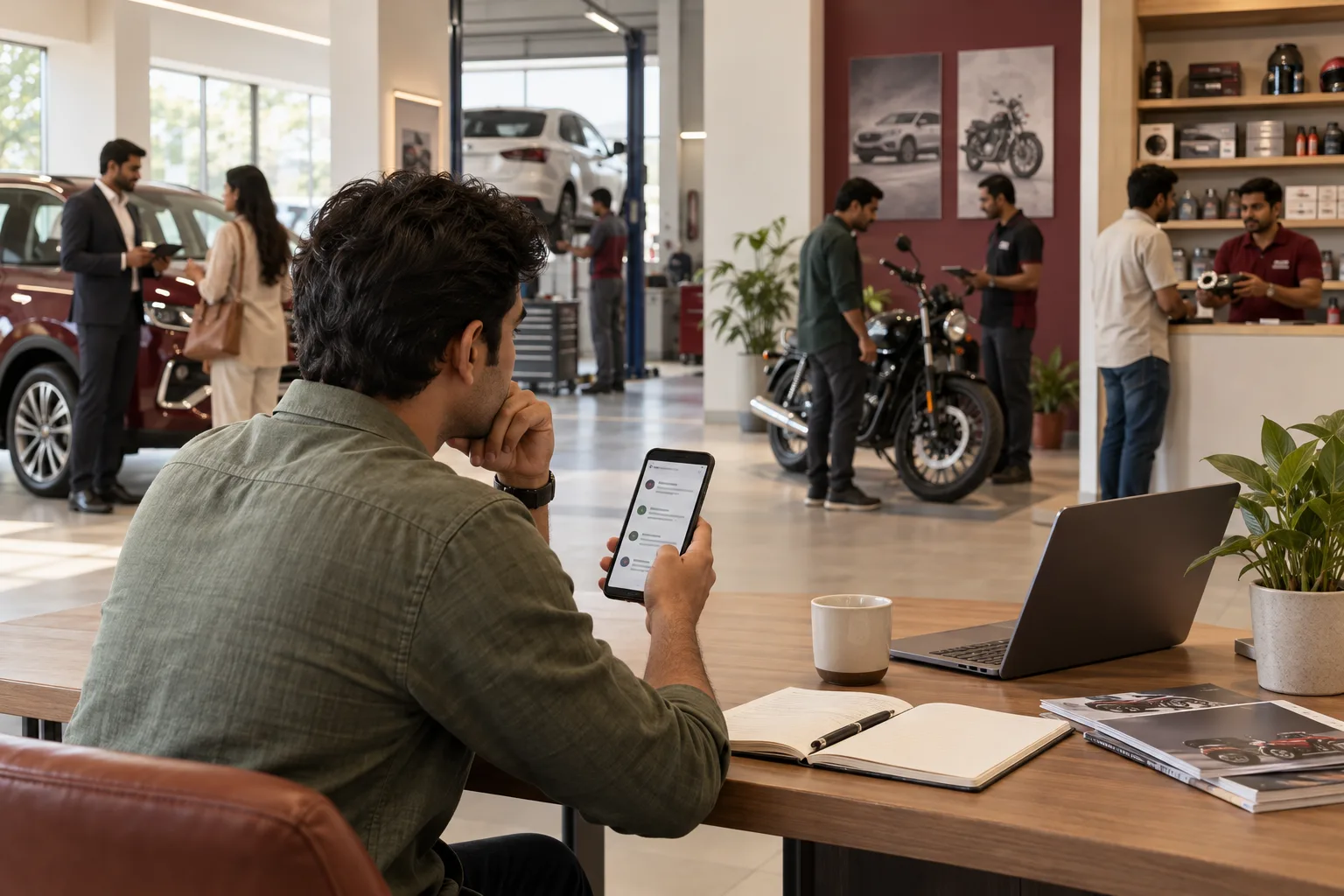 6 min read · 6 Oct 2026How buyers choose a showroom, workshop or parts counterCar, bike, repair and parts buyers send one enquiry to several sellers and pick the first clear answer. See what each buyer checks and where you lose them.
 7 min read · 19 Feb 2026How used car dealers should answer portal enquiriesThe same portal enquiry reaches three dealers. The one who replies first with photographs, ownership details and an EMI figure gets the test drive.
 5 min read · 6 Oct 2026How used car dealers move ageing stockA used car that sits unsold costs you every day. Find out why it is not selling, fix the cause before cutting the price, and reach buyers who asked.
More for used car dealers
Related work to consider.
Closest to this: leads and follow-up
Also for used car dealers
Or start from the overview: sales and marketing for used car dealers.
Your next practical step
Tell us what you are trying to grow, and we will read it before we call.
Eight short steps, mostly taps. Skip anything you would rather answer on the call.