Used car dealers · Video marketing
Walk round the car on camera and show the buyer what the photographs leave out.
Video marketing for a used car dealer means short walk-around films of each car and short talks by the person who sells them, which answer the doubt a buyer has about condition before driving over. GullySales plans the shots around the cars you hold and puts each video where the buyer already looks.
Scope, fee, reporting and term are agreed in writing after we have read your brief and spoken to you.

What video marketing means
Video marketing is using short videos, such as a product demonstration or a customer walkthrough, to explain your business on social media, your website and Google listings. GullySales scripts, shoots and edits these videos around the questions buyers ask before they visit or call.
Last updated 14 Nov 2026.
For used car dealers
Where it usually goes wrong, and what we would do.
“A walk-around shows what a photograph hides”
Panel gaps, the underside, the engine bay and the odometer are what buyers ask about. A video that shows them, flaws included, makes the car believable before the visit.
“Nobody films the paperwork”
The RC, the insurance and the service book decide trust, and few dealers show them on camera. A short video of the file for each car answers the question buyers keep asking.
“A film of the whole yard answers no buyer”
A long shot of the lot with music is pleasant and says nothing about any car. One car, one video and one reason to visit is what a buyer watches.
What we do
What we deliver for used car dealers.
The work available for this need. We agree the deliverables and responsibilities for your engagement in writing.
A walk-around for every car, shot the same way
A fixed order of shots: outside, inside, the odometer, the engine bay and the flaws, so every car is filmed the same way by anyone on the lot.
Result: A buyer compares your cars without guessing what was left out.
A short video of the file for each car
The RC, insurance and service book shown on camera with the owner's name and address covered, and the number of owners said aloud.
Result: The question about history is answered before it is asked.
A film of how you check a car before it goes on sale
What you inspect and in what order, said by the person who does it, with a sample condition note on screen.
Result: A sceptical buyer sees the check, not a promise.
A talk from the person buyers meet
A short piece to camera from the owner or senior salesman on what to look for in a used car and who should not buy from the dealership.
Result: The buyer meets the dealer before driving over.
Videos cut for each platform and placed on the car's page
The same walk-around cut for a reel, a status and the stock page, with subtitles and the call or WhatsApp link at the end.
Result: The video is where the buyer is looking.
Videos tied to enquiries
A note in the register of enquiries that mention a video, set against the baseline taken before filming began.
Result: You count messages and visits, not views.
How the result is measured
- Views
- Watch time
- Enquiries traced to video
Recorded as a baseline before work starts, so every later report has an honest comparison.
Videos worth making
The videos a used car buyer actually watches, and what each should show.
- The walk-around of one car
- Film the car outside, then inside, then the odometer and the engine bay, and show every scratch. Put it on the car's page and in the listing. The action wanted is a visit or a call.
- The file on camera
- Show the RC, the insurance, the service book and the key, and say how many owners the car has had. Cover the owner's name and address. The action wanted is a message asking to see the car.
- How we check a car before it goes on sale
- Show what you inspect, in the order you do it, in the language buyers speak, and name no certifying body unless it inspected the car. The action wanted is a call.
- The salesman or the owner talking
- A short piece from the person buyers meet, saying what to look for in a used car and who should not buy from the dealership. A buyer trusts a dealer who says no.
- A handover, with permission
- Film the delivery only if the buyer agrees before you start, and keep the plate and papers out of frame. Ask the buyer to say in their own words how the visit went.
- What not to film
- Do not film a car you have not inspected, use a clip of another car or cut out the flaws. Do not show a customer's face or documents without permission.
Who it is for
This is written for these used car dealers.
- Independent used car dealers
- Multi-brand pre-owned showrooms
- Dealers specialising in one segment
- Franchise pre-owned outlets
- Online-first used car sellers
- Dealers who also broker and consign
Before you decide
When this may not be the right fit.
- No one has the time to film each car on its arrival, so the videos would cover only a few cars and miss the slow ones
- You plan to film a customer taking delivery without asking beforehand, which you must not do
Before you decide
Agree the work. Know how to judge it.
Video marketing for used car dealers: use these checks to prepare, choose the scope, and review what changes.
Bring the right evidence
Identify the product, process, or buyer question the images or film must explain. Gather reference material and confirm permission for people, premises, and client work that may appear.
Make the scope clear
Agree the shot list, formats, usage rights, and approval stages before production. Separate filming or photography from editing, animation, and later adaptations.
Check the work in use
Check the finished asset in the place it will be used: a mobile page, presentation, advert, or product listing. Look at crop, captions, sound, and whether the important detail remains clear.
Know when to change course
Do not present an illustration or generated scene as evidence of client work. If a claim needs a real product demonstration, obtain that evidence before using the asset to support it.
These are discussion points, not a fixed package. GullySales confirms the deliverables, responsibilities, fee, and term in writing after reading your brief and speaking with you.
Before we start
What to have ready before the work starts.
The records, access and decisions this work needs from used car dealers. Anything missing is noted in the written scope, with who will supply it.
- A phone with a clean lens
- A recent phone, a cloth for the lens and a cheap stand or a steady hand are all we need. If the phone is old or the storage full, we say so before filming. Poor sound or shake makes a film worse than a photograph.
- A salesperson willing to be on camera
- The person buyers meet should talk on the film, if they agree. A knowledgeable salesperson is better than a stranger. If nobody agrees, the films are voiceless walk-arounds with captions, and trust is built more slowly.
- The service file for each filmed car
- To film the papers we need the registration, insurance and service record in hand. Missing documents are not filmed, and the car's page says what is available on request.
- A clean, well-lit corner of the lot
- Films need a quiet patch with daylight and little traffic. Cars should be washed. If the lot is crowded, we film early in the morning or after closing.
- A rule on music and signboards in frame
- Other brands' signboards and licensed songs cause trouble. We need your decision on what may appear. Without it, we film with natural sound and keep neighbours' boards out of frame.
How it works
How the video marketing work runs
The work itself, in order. How an engagement starts, from your brief to a written scope, is set out on our method page.
- 1
Watch a salesperson show one car
We stand beside a salesperson as a real buyer is shown a car, and write down what is pointed at, what is opened and what the buyer asks. You tell us which cars matter this month. The step ends with a list of the points a walk-around film must cover, taken from the lot rather than from a template.
- 2
Fix a walk-around order and shoot a trial car
We agree one fixed order, from the front to the engine bay, the interior, the boot and the underside, and film a single car with a phone. The salesperson and the supervisor watch it and say what is missing. You approve the format. The result is a sample film and a card showing the order.
- 3
Film the papers for one car
A buyer worries about the file, so we film the registration, insurance and service record for a car, with the numbers hidden where needed. You decide what may be shown. The step ends with a short film that tells a buyer the papers exist and are in order.
- 4
Film how a car is checked before sale
With your mechanic or supervisor we film the checks a car gets on arrival: the test drive, the lift inspection, the electrical checks and the cleaning. The person who does the work speaks. You approve what is claimed. The result is a film about your method that names no results.
- 5
Cut each film for each platform and attach it
We cut the walk-around for Instagram, YouTube and the car's own page, and add the film to the stock sheet so it follows the car to Marketplace and WhatsApp. A salesperson checks that a sold car's film is hidden. The step ends with films placed beside the cars they show.
- 6
Read films against enquiries per car
We note which cars had films and compare the enquiries and visits they drew with cars that had none, using the enquiry sheet. You see whether buyers who watched came better informed. We report counts and say where a few cars are too few to judge.
Where this fits
Three pieces of sales work, in this order.
This work sits inside sales process design, at stage 0, foundation. The audit comes before it, and sales management keeps it running.
Step 1
Sales audit
Find where deals are being lost and what to fix first.
Start here if you cannot say where orders are lost.
Step 2 · you are here
Sales process design
One written way to sell, from first enquiry to repeat order.
Start here if every salesperson sells differently.
Step 3
Sales management
A target, a review routine and someone who owns the number.
Start here if the team has targets and no routine.
FAQ
Questions owners ask before they call.
Not here? More answers, or ask on WhatsApp.
Can we film with a phone?
How long should a car video be?
Can we film a customer taking delivery of a new car?
Is the music in a video a problem?
How long should each walk-around film be?
How much does it cost?
How long is the contract?
Who will actually do the work?
What do you need from us?
What if we are not happy with the work?
From the blog
Further reading for used car dealers.
 5 min read · 6 Oct 2026How used car dealers move ageing stockA used car that sits unsold costs you every day. Find out why it is not selling, fix the cause before cutting the price, and reach buyers who asked.
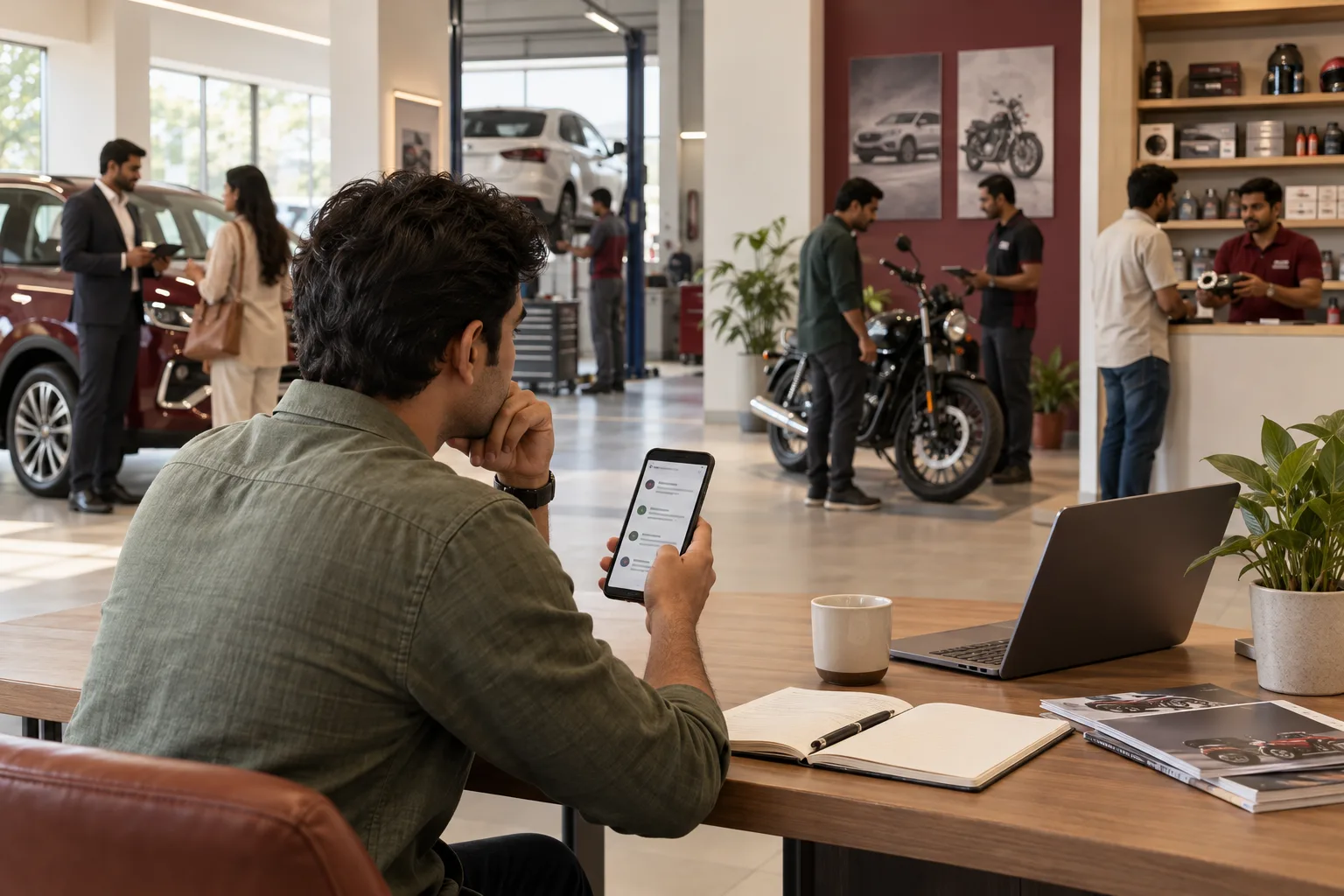 6 min read · 6 Oct 2026How buyers choose a showroom, workshop or parts counterCar, bike, repair and parts buyers send one enquiry to several sellers and pick the first clear answer. See what each buyer checks and where you lose them.
 7 min read · 19 Feb 2026How used car dealers should answer portal enquiriesThe same portal enquiry reaches three dealers. The one who replies first with photographs, ownership details and an EMI figure gets the test drive.
More for used car dealers
Related work to consider.
Closest to this: content and social
Also for used car dealers
Or start from the overview: sales and marketing for used car dealers.
Your next practical step
Tell us what you are trying to grow, and we will read it before we call.
Eight short steps, mostly taps. Skip anything you would rather answer on the call.