E-commerce · Kitchen & Dining
Everyone asks if it works on induction, and half our listings do not say.
A cook who buys cookware online cannot lift it, so they read for the things that say how it will behave. Is the base thick enough to avoid scorching, is the coating what the listing says it is, will the handle stay cool, does it fit a gas stove or an induction plate. A listing that skips any of these gets a question or a return.
Scope, fee, reporting and term are agreed in writing after we have read your brief and spoken to you.
In one paragraph
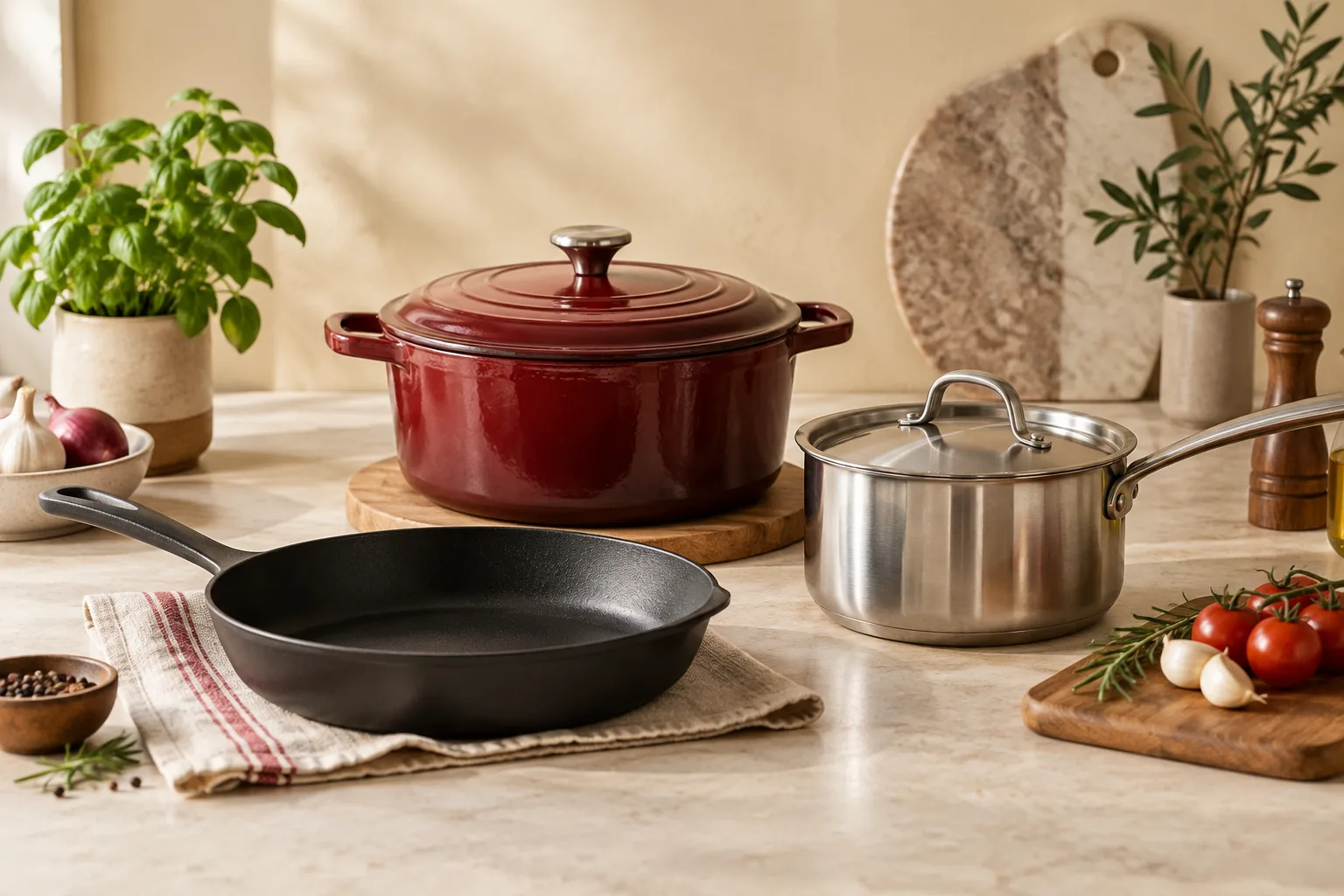
Cookware e-commerce is the online sale of pressure cookers, kadais, tawas, frying pans, saucepans and handis in steel, aluminium, cast iron, non-stick and clay, bought to be used on a particular stove. GullySales works on how your listings state the base, the coating and the size, and how a buyer is helped to choose between near-identical pans.
Prices cluster tightly, and the marketplace page fills with sets that differ by a lid. The seller who shows the cut-away of the base and says what the coating is wins the click.
Last updated 7 Oct 2026.
Who it is for
This is written for you if you sell cookware online.
- Non-stick and hard-anodised cookware brands on Amazon and Flipkart
- Cast iron, kansa, brass and clay pot makers selling to health-minded cooks
- Pressure cooker brands competing on capacity and induction compatibility
- Steel cookware makers selling three-ply and tri-ply pans through their own store
Not for
It is not the right fit if.
- A seller who cannot say what the coating or material actually is
- Anyone selling a thin pan as heavy-duty because the photograph can be made to look that way
How buyers choose
What decides the sale of cookware.
Base and heat source
Flat induction base, gas friendly, or both. The buyer looks for a diagram of the base and the words induction compatible, and a missing line is read as not compatible.
Material and coating
Hard-anodised, tri-ply stainless steel, cast iron, ceramic and PTFE non-stick are compared by what they take: metal spoons, high heat, dishwashers. Cast iron buyers want seasoning instructions.
Capacity and the lid
Pressure cookers are bought by litres and by the number of people. For pans it is diameter and depth, and whether a glass lid or a steel lid comes with it.
Handles and weight
Riveted or welded, cool-touch or not, and how heavy a full pan is. Elderly buyers and buyers with small hands read reviews for this.
Where sales are lost
What usually goes wrong when you sell cookware online.
In the words sellers use on the first call.
“Our non-stick pans get bad reviews after three months”
Many of those reviews describe use the pan was not meant for, such as high heat or metal spoons. The care instructions sit on a card in the box instead of in front of the buyer.
“Buyers bought the induction pan for a gas stove, or the reverse”
A pan that does not work on the buyer's hob comes back at your cost, with a note about misleading information.
“We sell a set, and buyers want only the kadai”
Customers search for the one pan, find a six-piece set at a high price, and leave. The single piece is on the listing, buried behind variants.
The scope
The work we would propose for cookware.
Measured on purchases, conversion rate, cost to win a customer, average order value and repeat purchases. Anything here that needs a platform or tool we have not used with you is confirmed with you before it goes in the scope.
- Hob compatibility on every listingA clear line and a base diagram for gas, induction and oven use, repeated in the title, the first image and the bullet points.
- A cutaway and a cooking videoA short video showing the base thickness, the coating and an egg or dosa cooked without oil, instead of a stock photograph of a pan.
- Pages for each way cookware is searchedGuides and collection pages for tri-ply versus non-stick, the right size of cooker for a family of four, and how to season a cast iron tawa.
- Reviews that mention careAsking buyers who cooked with the pan for a few weeks to share how it holds up, and replying to critical reviews with the care steps.
Lids, handles and spares
A page for replacement lids, handles and gaskets by model, which brings back the buyer whose pan is fine but part is missing.
What we do
What you get for cookware.
Each deliverable and what it is there to change.
A base and compatibility diagram
One graphic per product line showing which hobs it works on and what the base is made of, placed as the second image.
A care and seasoning card for the page and the box
Heat levels, which utensils to use, how to clean and, for cast iron, how to season. It answers the review before it is written.
A cooker and kadai size chooser
A short table matching litres or diameter to the number of people and the dishes cooked.
A single-piece page for each set item
A page for the kadai, the tawa and the saucepan that is in the set, so a buyer can order one without scrolling past the set price.
How the result is measured
- Purchases
- Conversion rate
- Average order value
- Return rate
- Returns for wrong hob or wrong size
- Reviews mentioning coating or handles
Recorded as a baseline before work starts, so every later report has an honest comparison.
How it works
From your first message to the first piece of work.
No open-ended retainer. Every step gives you something in writing.
First
Your brief
You tell us what you need in a few short steps: your business, what you want, where enquiries come from and how they are handled.
After the brief
A conversation and a written scope
We read it, then talk with whoever handles your enquiries. If you want our help, the scope, the fee and the reporting come in writing, and nothing starts before you have read them.
Before work starts
Baseline recorded
The numbers this work is meant to move, such as enquiries, quotations, orders, visits or renewals, written down so every later report has an honest comparison.
After the baseline
The first fix goes live
The fix we agreed to start with is put in place and measured against the baseline, whether that is a reply, a follow-up, a page, a listing or the handover between marketing and sales.
As agreed
Report against the baseline
What moved, what did not, and what changes next, in plain words. How often you get it is set in writing before work starts.
At renewal
Renew on the numbers
The term ends and you decide whether to continue from the results. The length is agreed in writing before anything starts.
What we need from you
What to have ready before we talk.
None of it has to be tidy. We read what you have.
- Your current listings for cookers, pans and sets, and the one you most want to sell
- Reviews that mention coating, handles or heat
- Returns for wrong hob or wrong size
- Competitor pans your buyers compare you with
- Any test or certificate documents you want shown, and what they cover
Selling in India and abroad
Selling cookware beyond your own market.
Where you sell decides sizes, units, seasons and returns. We work from Bengaluru and have no overseas office, so for a new country we start from your own sales and the platforms you already use.
Hobs abroad
Glass-top, ceramic and induction cookers are common in many overseas homes. A pan that says induction compatible and gives the base diameter is easier to buy for an Indian family abroad.
Pressure cookers and local rules
Pressure cookers are sold under their own safety rules in other countries, and some marketplaces restrict them. Check this with your adviser and the marketplace before listing.
FAQ
Questions about selling cookware online.
Not here? More answers, or ask on WhatsApp.
How do I show a non-stick pan is safe without making health claims?
Should the listing say induction compatible even if it works only sometimes?
Is it worth selling cast iron online?
How much does it cost?
How long is the contract?
How soon will we see results?
Who will actually do the work?
What do you need from us?
What if we are not happy with the work?
More in Kitchen & Dining
Sellers of cookware also need
Also selling from a shop, a workshop or a warehouse? See the page for household products brands.
This page is part of the e-commerce section. The D2C brands page covers the arithmetic of acquisition cost and the second order for any brand.
Why us
Why owners pick GullySales over an agency.
Marketing and sales, as one job
Most agencies stop at the enquiry. We also fix what happens after it: the reply, the follow-up, the quote and the CRM.
The person on the first call does the work
No account managers in between. You are never handed to someone you have not met.
A baseline before anything starts
Your numbers are written down on day one, so every later report compares against something honest.
The fee in writing, split three ways
Our time, your media spend and production on separate lines. You always see what goes to us.
No guarantees we cannot keep
The term is agreed in writing and never a default twelve months. We never promise a ranking or a lead count, because nobody controls those.
One office, and we say so
Nagarbhavi, Bengaluru. We work across India by call and WhatsApp and travel when a session needs to be in person.
#257, 3rd floor, Sri Nanjundeshwara Complex, Nagarbhavi 8th Block, Outer Ring Road. How we work.
Engagement options
Ways to work with us.
Pick the size of commitment that fits. Every option starts with your brief and a conversation.
Option 1
The conversation on its own
A call after you send your brief. It says honestly whether you need outside help, and many fixes are ones your own team can make.
Option 2
One fix, scoped
Start with the fix that matters most, such as reply time or follow-up. The fee is in writing before anything starts.
Option 3
An ongoing programme
We run the work, report against the baseline, and you renew on the numbers. The term and the reporting are agreed in writing first.
Option 4
Guidance for your own team or agency
We plan, brief and check the work of your in-house team or current agency, instead of replacing them.
Your brief
Tell us what you need, and we will read it before we call.
Eight short steps about your business, what you want and who decides. Most questions are a tap, and you can skip any you would rather answer on the call.
Your next practical step
Tell us what you are trying to grow, and we will read it before we call.
Eight short steps, mostly taps. Skip anything you would rather answer on the call.