Educational institutions · Case study document design
A programme story approved by your board deserves a page a parent can read at a glance.
Case study document design for an educational institution is the layout that turns an approved account of a programme, a partnership or a student project into a finished page or PDF. GullySales designs around the text and permissions you already hold, sets the hierarchy, supplies print and screen files, and hands over an editable master.
Scope, fee, reporting and term are agreed in writing after we have read your brief and spoken to you.

What case study document design means
Case study document design is the layout and artwork that turn an approved customer story into a finished page or PDF a buyer can read and pass on. GullySales designs the document around your approved text, sets the hierarchy, supplies the files and hands over an editable master so the next story fits the same frame.
Also for educational institutions
- Social media marketing for educational institutions
- Content marketing for educational institutions
- Corporate announcement writing for educational institutions
- Social media cover and banner design for educational institutions
- Brochure design for educational institutions
- Press release distribution for educational institutions
- SEO for educational institutions
- PPC ads for educational institutions
Sales and marketing for educational institutions, the overview.
Last updated 14 Nov 2026. Rules for this trade differ by state and professional body, and they change. We describe restrictions in general terms, so check the current position with your own council or adviser before you publish anything.
For educational institutions
Where it usually goes wrong, and what we would do.
“A school story is about a programme, not a sale”
A case study in a school or college is an account of a programme that was run, such as a science fair, a reading initiative, a partnership with a local company or a new bridge course. It is read by a prospective parent, a trustee, a funder or an inspector. The design has to tell what was done and what was observed, without reading like an advertisement for results.
“No outcome claims the institution cannot support”
An account that says a programme raised marks or placed students in jobs is making a claim, and rules on such claims differ by place and by authority. Your own adviser or board decides what may be stated. Our design gives the evidence, the dates and the source a visible place, and leaves out any outcome line you have not approved in writing.
“A student or a family in the story needs consent”
If a pupil's work, name or photograph appears, written guardian consent is needed for that use, and a former student needs to agree as well. The design plans for stories that can be told without a face: the project, the classroom, the artefact, a quote attributed in a way the person has approved.
“Stories scattered across newsletters and slide decks”
The institution has accounts of its work in an annual report, a newsletter, a presentation to trustees and a post on social media, none of which can be forwarded to a prospective parent as a tidy single page. A designed document in a fixed frame turns separate pieces into a set that reads as the institution's record of its own work.
What we do
What we deliver for educational institutions.
The work available for this need. We agree the deliverables and responsibilities for your engagement in writing.
A layout plan before any artwork
A short plan, with a rough sketch, showing what goes where: the heading, the situation, the work done, the confirmed observations, the quote and the caption. You see the reading order and the length that suits a page or a spread before the artwork begins.
Result: You approve the order of sections on one sheet before design starts.
The designed case study document
The finished page or short document, laid out with the approved text, the crest, headings, subheadings and images. It is built for a reader who has a minute: the first thing seen says what the programme was, the second what was done, the third what the institution observed and records.
Result: Every approved text block appears, and nothing is added that you did not supply.
Image and caption treatment
Photographs, student work scans and drawings placed with captions that say what is shown, and credits where needed. Images of pupils appear only where written guardian consent is on record. Where there is none, the layout uses the artefact, the room or a drawing.
Result: Each image has a caption and a note of its consent or source.
Quote and fact strip styling
A styled panel for an approved quotation and a strip for plain facts such as the programme name, the class or batch, the partner and the dates. Figures are set only as you supply them, with a source line, so a reader can see where each came from.
Result: Every figure and quote in the document is traceable to a supplied source.
A reusable master for the next story
An editable template in the same frame, with placeholders for each section, so the next programme account is dropped into a known layout. A staff member can use it without a designer, and a set of stories keeps looking like one set.
Result: A second story can be placed in the master by staff on their own.
Print and screen files with a handover list
A print file set to your printer's specification, a light PDF for the website and for sending by message, and a list of fonts, images and their sources. Fee or date information is not placed in the file unless you ask for it, so it does not go stale.
Result: The PDF opens on a phone and the print file is accepted by the printer.
How the result is measured
- Case studies in the same visual family
- Sales conversations where a story was sent as a file
- Downloads of each case study from the page
Recorded as a baseline before work starts, so every later report has an honest comparison.
Who it is for
This is written for these educational institutions.
- Pre-schools and play schools
- CBSE and ICSE schools
- State board schools
- Coaching institutes for competitive exams
- Degree colleges
- Vocational and skill-training institutes
- Ed-tech linked hybrid learning centres
- Multi-branch tutorial chains
Before you decide
Agree the work. Know how to judge it.
Case study document design for educational institutions: use these checks to prepare, choose the scope, and review what changes.
Bring the right evidence
Bring questions from sales calls and examples of objections that delay a decision. Choose a subject expert who can check the substance, and identify evidence that can be published.
Make the scope clear
Agree the reader, buying question, format, and distribution route for each piece. Set the approval process and distinguish new research from rewriting material you already have.
Check the work in use
Ask a colleague to use the draft in a real buyer conversation. It should answer the question, support its claims, and make the next step clear without requiring a sales pitch to explain it.
Know when to change course
If the same unanswered question appears in several articles, improve the strongest page before commissioning another. More words are not a substitute for missing evidence.
These are discussion points, not a fixed package. GullySales confirms the deliverables, responsibilities, fee, and term in writing after reading your brief and speaking with you.
Before we start
What to have ready before the work starts.
The records, access and decisions this work needs from educational institutions. Anything missing is noted in the written scope, with who will supply it.
- The approved account in final text
- Provide the finished text of the story, with the date it was approved and the name of the person who approved it. Draft text changes length, and a page designed around a draft has to be rebuilt. If parts are still being checked, mark them so we can leave room.
- Consent from every person shown or named
- For pupils, written guardian consent for this use; for former students and staff, their own agreement; for a partner organisation, its approval of how it is described. Without these, names and faces come out and the layout relies on the work itself.
- Source for each figure and quote
- If the story gives a count, a date or a quotation, tell us where it came from: a register, a report, a signed note. Figures with no source are left out of the fact strip. A number that cannot be traced is a risk to the institution, not a benefit.
- Images of the work and the setting
- Send original photographs or scans of the artefact, the classroom and the project, at full size. Phone copies sent through a messaging app are compressed and print poorly. Tell us which images carry consent and which show only objects and places.
- Board or authority rules on what may be stated
- Some boards and authorities limit how an institution describes itself or its results. Ask your own adviser what applies and give us any written guidance. We follow it. If nothing is provided, we leave claims out of headlines and keep the document descriptive.
How it works
How the case study document design work runs
The work itself, in order. How an engagement starts, from your brief to a written scope, is set out on our method page.
- 1
Receive the approved account and its permissions
We start from the text the institution has already approved, with the name of the approver and the permissions on record: consent for any pupil, a letter from any partner organisation, the board's clearance if one is needed. We do not interview or write. Where a permission is missing, that part is marked and set aside.
- 2
Decide who reads this story
A story shown to a prospective parent is read differently from one sent to a trustee or an inspector. We ask which reader matters now and what that reader asks. The answer decides the length, the order of sections and which facts sit in the fact strip near the top.
- 3
Plan the layout on one page
We sketch the layout with the real text length, showing headings, the fact strip, image positions and where the quotation falls. You see how much the page can hold. If the account is too long, we mark candidates for cutting and you decide, since the words belong to the institution.
- 4
Design with the crest and colours
The document is designed with the institution's own crest, colours and typefaces, so it sits beside the prospectus and the annual report. We choose emphasis carefully: numbers are not made to look bigger than the evidence behind them, and a sentence is not set as a headline claim unless you approved it as one.
- 5
Check every fact against the source
Each date, name, figure and quote is read against the source material you supplied. We return differences for a decision and do not correct silently. The document is marked final only after the approver and, where relevant, the partner or the family have seen the finished layout and agreed.
- 6
Release the files and read the use
We deliver the print and screen files and the master. Before the work began, you noted the number of times the admissions desk or the principal's office is asked for examples of the institution's work. Afterwards, the same record shows whether the document was sent, opened and asked about.
Where this fits
Three pieces of sales work, in this order.
This work sits inside sales process design, at stage 4, presentation and proposal. The audit comes before it, and sales management keeps it running.
Step 1
Sales audit
Find where deals are being lost and what to fix first.
Start here if you cannot say where orders are lost.
Step 2 · you are here
Sales process design
One written way to sell, from first enquiry to repeat order.
Start here if every salesperson sells differently.
Step 3
Sales management
A target, a review routine and someone who owns the number.
Start here if the team has targets and no routine.
FAQ
Questions owners ask before they call.
Not here? More answers, or ask on WhatsApp.
Is a case study suitable for a school at all?
Can a student's name and photograph appear?
Do you write or edit the story?
Can we say a programme improved results or placements?
Will the document match our prospectus?
How do we know the document is being used?
How much does it cost?
How long is the contract?
Who will actually do the work?
What do you need from us?
From the blog
Further reading for educational institutions.
 5 min read · 6 Oct 2026How families and companies choose between institutesA parent, a student, a candidate and an HR head each pick an institute differently. Who decides, what each checks and what admissions should have ready.
 8 min read · 21 Sept 2026How to advertise to studentsThe student chooses and the parent pays, so you run two campaigns at once. Under eighteen, platforms also limit how you can target them.
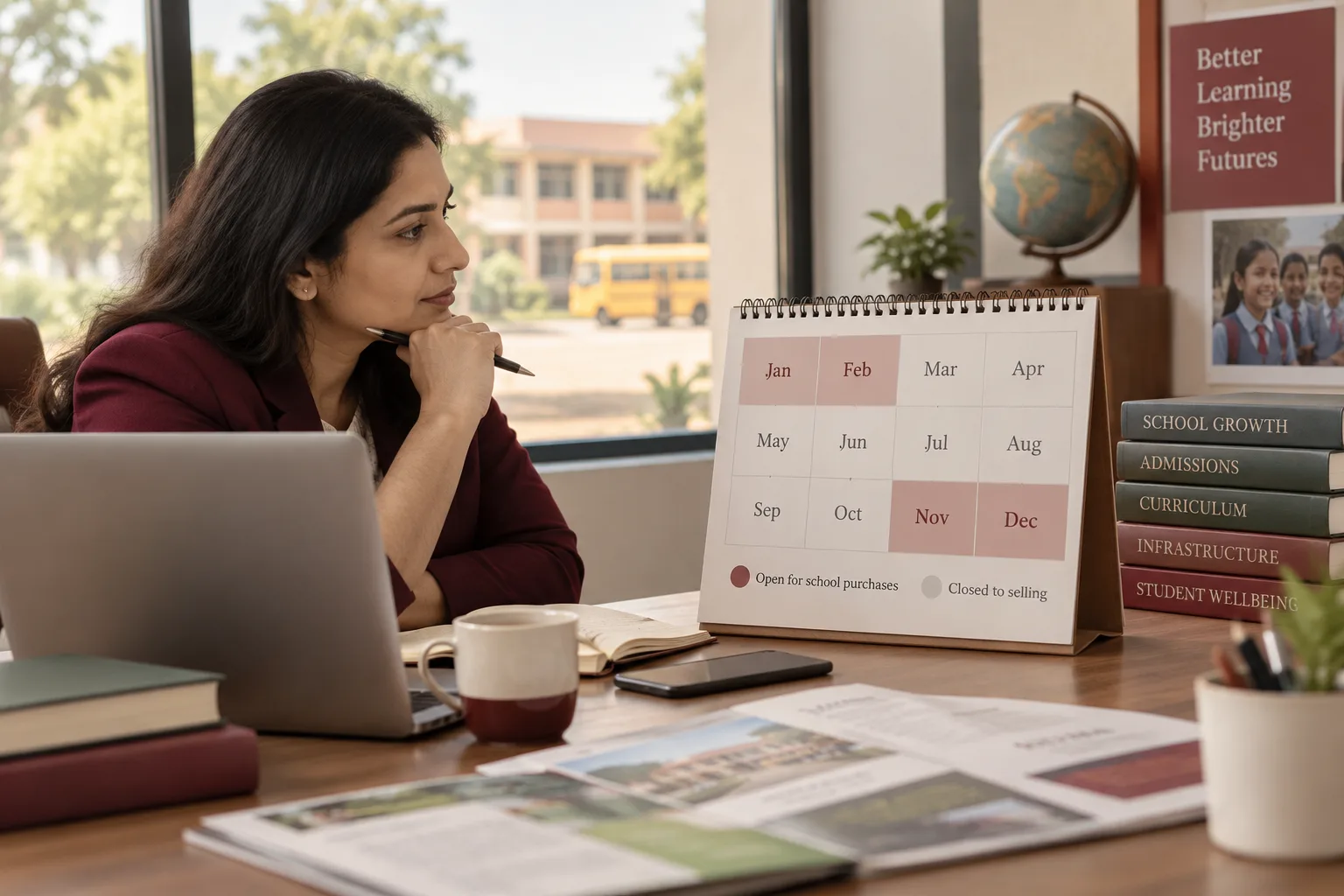 7 min read · 21 Sept 2026How to advertise to school ownersA school buys in a four-month window and is closed to selling the other eight. Miss November to February and you have missed the year.
More for educational institutions
Related work to consider.
Closest to this: content and social
- Social media marketing for educational institutions
- Content marketing for educational institutions
- Corporate announcement writing for educational institutions
- Social media cover and banner design for educational institutions
- Brochure design for educational institutions
- Press release distribution for educational institutions
Also for educational institutions
Or start from the overview: sales and marketing for educational institutions.
Your next practical step
Tell us what you are trying to grow, and we will read it before we call.
Eight short steps, mostly taps. Skip anything you would rather answer on the call.