Alteration shops · Local SEO
Show up on the map when a customer needs a tailor within walking distance.
Local SEO for an alteration shop is winning the three map results for people searching for a tailor or alteration shop near them. GullySales works on your listing, the jobs it names, the photographs and the reviews that sit beside your shop on the map.
Scope, fee, reporting and term are agreed in writing after we have read your brief and spoken to you.
What local SEO means
Local SEO is the work of making your business show up for searches that name your town or locality, such as a service plus an area name. GullySales sets up locality pages, local citations and map listings so nearby customers find you before a competitor across town.
Last updated 14 Nov 2026.
For alteration shops
Where it usually goes wrong, and what we would do.
“The search is for the nearest shop that is open”
A person holding a garment will not travel far. They open Maps, see three shops and choose on distance, hours and a glance at the stars. A shop showing closed at the hour of the search loses the tap.
“Job names decide which search you match”
A listing that says only tailor appears for tailor searches. A listing that names blouse fitting, trouser hemming, zip replacement and uniform alteration appears when the customer types the fault, which is how these searches are phrased. The listing then matches the exact word the person typed.
“Photos answer what a board cannot”
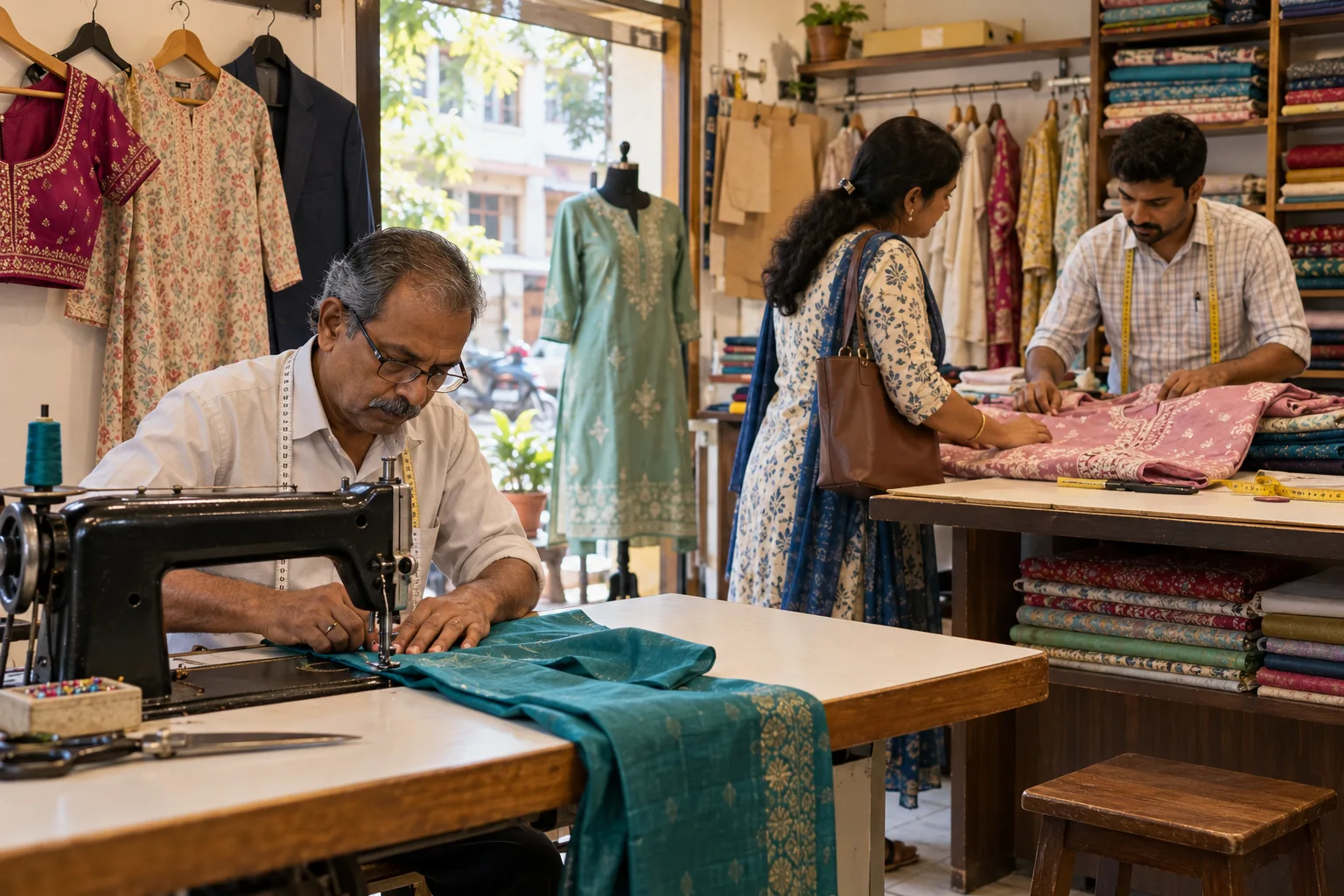
A shop front says little. A rail of finished garments, the fitting corner and the master at work tell a stranger that the shop is real and the work careful. Customers also judge from photos whether the shop looks too crowded to meet a date.
“A showroom nearby sends searchers your way”
When a person asks the salesperson for an alteration shop, they then check the name on Maps. A listing with reviews that mention fitting and on-time pickup confirms the recommendation the showroom made. A bare listing leaves the customer unsure and the recommendation unused.
What we do
What we deliver for alteration shops.
The work available for this need. We agree the deliverables and responsibilities for your engagement in writing.
A listing that names every job
Services entered on the profile for hemming, taking in, letting out, zip changes, blouse fitting and uniform work, with a short description in plain words.
Result: Each job appears by name on the listing.
Hours that match the wedding week
Opening hours, special hours for festival days and a late slot entered correctly, including the days the shop shuts.
Result: The listing shows open when the shop is open.
Finished-work photographs
Daylight photographs of the shop front, the fitting corner and finished garments, added to the profile and refreshed through the year.
Result: A set of recent photographs on the profile.
A review request at the counter
A card or a saved WhatsApp message handed over when the customer collects the garment and checks the fit.
Result: Recent reviews written by people who collected a garment.
Replies to every review
Written replies that answer a complaint about a date or a price plainly and thank the customer who praised the fit.
Result: Each review on the profile has an answer from the shop.
How the result is measured
- Map pack ranking
- Local search visibility
- Enquiries by locality
Recorded as a baseline before work starts, so every later report has an honest comparison.
Searches your buyers type
The map result is chosen by walking distance, so the listing must name every job you do.
A showroom nearby can send searchers your way. Name the jobs, show the work and keep the hours true.
- tailor near me for alteration
- A listing with alterations named as a service, correct hours and a call button.
- blouse fitting near [locality]
- A locality line and photos of finished blouses on the mannequin.
- lehenga alteration open on Sunday
- Hours that match the wedding week, including Sundays if you work them.
- suit alteration for interview
- A service entry for men's wear with a note on what can be done at short notice, without a promised time.
- tailor with pickup and drop
- A listing note saying whether you collect, and the societies served.
Who it is for
This is written for these alteration shops.
- Saree blouse and lehenga alterations for weddings
- Men's suit and trouser fitting
- School and college uniform alterations
- Zip, lining and button repair
- Ethnic wear refitting for festivals
- Maternity and nursing wear alterations
- Showroom and boutique alteration partners
- Pickup and drop alteration services for apartments
Before you decide
When this may not be the right fit.
- Your hours change every week, and the listing would be wrong most days
- You do not take pickup and cannot serve beyond walking distance, so a service area listing adds little
- You have no way to ask a customer for a review at the counter
Before you decide
Agree the work. Know how to judge it.
Local SEO for alteration shops: use these checks to prepare, choose the scope, and review what changes.
Bring the right evidence
Confirm the real business address, service area, contact details, and who controls the business listings. Keep examples of calls that came from the wrong location or asked for a service you do not provide.
Make the scope clear
Choose the locations you actually serve and the information each needs. Agree who approves listing changes, responds to enquiries, and keeps opening hours accurate.
Check the work in use
Check the journey from a local search to a call or enquiry on a phone. The address, service area, and description should agree across your website and listings.
Know when to change course
Do not create an office claim for a place where you only serve customers remotely. Clear service coverage is more useful than a misleading local presence.
These are discussion points, not a fixed package. GullySales confirms the deliverables, responsibilities, fee, and term in writing after reading your brief and speaking with you.
Before we start
What to have ready before the work starts.
The records, access and decisions this work needs from alteration shops. Anything missing is noted in the written scope, with who will supply it.
- The Google account that owns the listing
- We need the login or the owner role on the listing. Some shops find it was set up by a former helper or a printing shop. Without ownership we cannot edit hours or reply to reviews, and the plan stops until access is regained through the platform's own steps.
- Hours for ordinary days and wedding weeks
- A written list of when the shop is open, including the late evenings before big dates and any closed day. Rough notes are fine. If hours are missing, the listing may show closed while you are working, and a nearby rival gets the call that should have been yours.
- Photographs of the shopfront and the counter
- Two or three photographs a customer could use to find the door: the board from the road, the entrance and the counter. Phone pictures in daylight are fine. Without them, the listing shows only what others uploaded, which may be wrong or out of date. Take them in daylight from across the road.
- A list of customers who may be asked
- Names of regulars who would not mind a review request, handed to us as a short list or as a rule your helper follows. Without it we cannot plan the review ask, and the shop relies on whoever happens to post a review without being prompted. A list of five is enough.
- Your decision on pickup and drop
- Whether the shop collects garments from apartments, and from which areas. A yes or no is enough for now. If you have not decided, we leave pickup off the listing, since a promise on the map that the shop cannot keep only draws complaints. Tell us if the answer changes with the area.
How it works
How the local SEO work runs
The work itself, in order. How an engagement starts, from your brief to a written scope, is set out on our method page.
- 1
Choose the shop door that is listed
If you have one counter, this is simple. If you have a second, a stall in a mall or a pickup point, we ask which of them customers visit and which is only a drop. You decide which locations get a listing, and we note the rest as pickup only on the sheet.
- 2
Claim the listing and fix the facts
We ask for owner access and read every field: name, address, hours, phone and the jobs listed. You confirm the opening hours, including the rush before weddings and festivals. We correct what is wrong only after you have signed off on each fact, one at a time. A wrong hour sends walk-ins elsewhere.
- 3
Search the way a rushed customer does
We search for a tailor, an alteration shop and a blouse fitting near your door, from the street and from the nearest showroom. We note which shops appear, what they show and what you lack. Together we pick the three fixes that matter first for your shop. We keep the findings to one page.
- 4
Name every job, add finished-work photos
We write the job names the listing will carry and caption each photograph of finished work. You supply the photographs and tell us which are safe to show. Anything that shows a customer's face or a garment still waiting for a wedding stays out of the listing. Captions use the words customers say.
- 5
Put a review ask at the counter
We write a short line your helper says when a garment is collected, and a small card carrying the review link. You decide who asks and who answers each review. We test the link from a phone at the counter before the first card is handed out. The card costs almost nothing to print.
- 6
Read calls and directions against the start
We compare the calls, direction requests and messages from the listing with the figures noted before we began. You see what changed and which job names brought customers in, and you decide what to add before the next festival. No map position is promised. If a job name brought nobody, we say so and drop it.
Where this fits
Three pieces of sales work, in this order.
This work sits inside sales process design, at stage 1, prospecting and lead generation. The audit comes before it, and sales management keeps it running.
Step 1
Sales audit
Find where deals are being lost and what to fix first.
Start here if you cannot say where orders are lost.
Step 2 · you are here
Sales process design
One written way to sell, from first enquiry to repeat order.
Start here if every salesperson sells differently.
Step 3
Sales management
A target, a review routine and someone who owns the number.
Start here if the team has targets and no routine.
FAQ
Questions owners ask before they call.
Not here? More answers, or ask on WhatsApp.
Why does a shop with worse work rank above mine?
Can I list pickup and drop on the profile?
What if someone leaves an unfair review?
Should the listing show prices?
Should the listing show my shop on a mall floor or the street?
What happens if two shops share my address?
How long is the contract?
How soon will we see results?
Who will actually do the work?
What do you need from us?
More for alteration shops
Related work to consider.
Closest to this: search and visibility
Also for alteration shops
Or start from the overview: sales and marketing for alteration shops.
Your next practical step
Tell us what you are trying to grow, and we will read it before we call.
Eight short steps, mostly taps. Skip anything you would rather answer on the call.