International tour operators · Website
Build a site that shows your office, your team and every trip with its real price lines.
A website for an international tour operator is where a cautious traveller checks that you are real, reads the itinerary and decides to call. GullySales plans and builds the pages for trips, visas, trust and enquiries, and makes no promise about traffic or bookings.
Scope, fee, reporting and term are agreed in writing after we have read your brief and spoken to you.
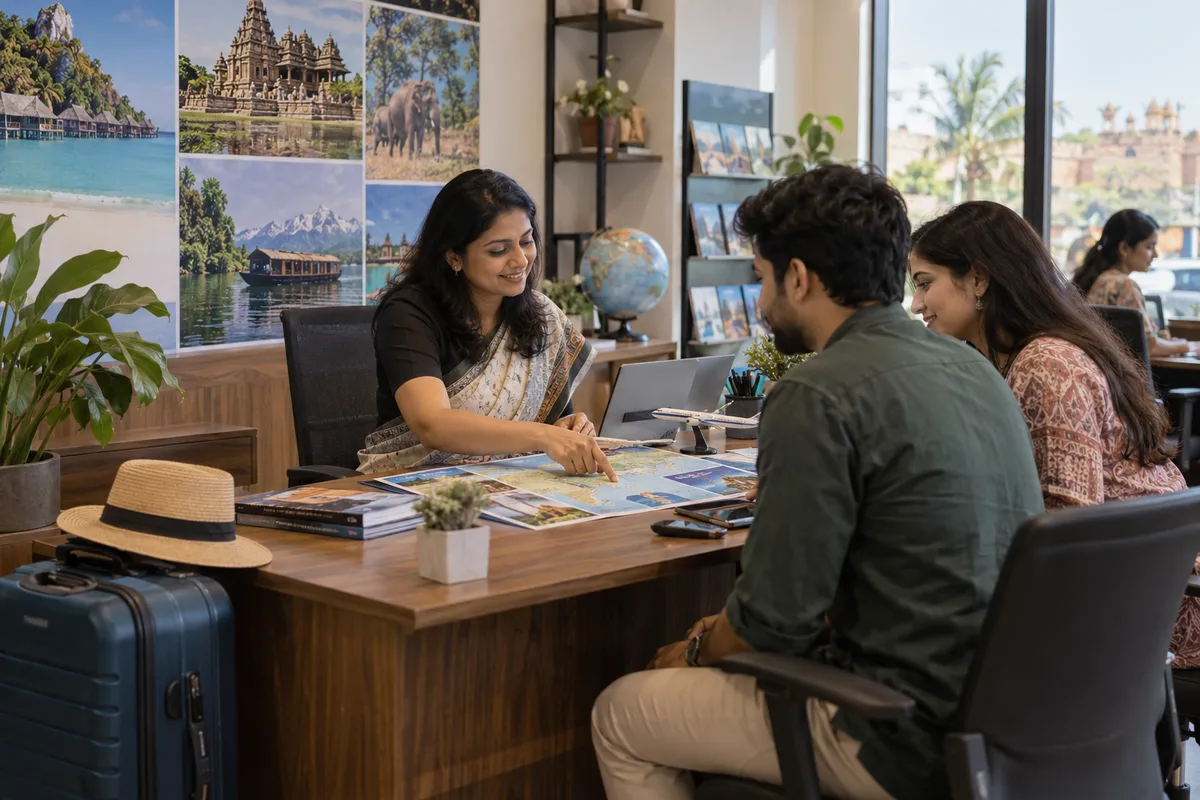
What website means
A website is the page a customer lands on after searching, clicking an advert or scanning a code, and it decides whether they call or leave. GullySales builds and maintains sites that load quickly, explain the offer plainly and make the enquiry form or phone number easy to find.
Also for international tour operators
- SEO for international tour operators
- Local SEO for international tour operators
- Lead generation for international tour operators
- Social media marketing for international tour operators
- Content marketing for international tour operators
- Buyer personas for international tour operators
- CRM for international tour operators
- Follow-up systems for international tour operators
Sales and marketing for international tour operators, the overview.
Last updated 18 Oct 2026.
For international tour operators
Where it usually goes wrong, and what we would do.
“The site is a trust test before it is a catalogue”
A traveller hands over a passport to a name they met online. They look for an address, named staff, past groups and a plain statement of what happens when a flight is cancelled. A site of only beach photographs fails that test.
“Price lines belong on the page”
If a package shows one total, the buyer compares it against a portal's flight-and-hotel figure and loses sight of the meals, transfers and tour manager. Naming each included line, and each exclusion, protects your price.
“Visitors arrive on a phone”
A visitor from Instagram or WhatsApp sees a narrow screen. A heavy page with tiny type and a form of ten fields is abandoned. Calling and messaging buttons should be easy to reach with a thumb.
What we do
What we deliver for international tour operators.
Every deliverable, what it covers for you, and the result it is there to produce. Nothing here is an extra.
A trust page
Office address, map, staff names, past group photographs with permission, registrations held and a cancellation explanation.
Result: One page holds the proof a cautious buyer looks for.
Destination and departure pages
Pages with dates, itinerary, inclusions, exclusions, tour manager and seats left for each trip you sell.
Result: A visitor can tell what is included and whether a departure is confirmed.
A visa and documents section
Guides for each destination, with a last-checked date, linked from every trip page.
Result: Visa answers sit beside the trips they affect.
A phone-first enquiry design
Tap-to-call and WhatsApp buttons and a short form with few fields.
Result: A visitor can enquire in a few taps.
Basic site health and tracking
Speed, page titles, analytics and a record of which page produced each enquiry.
Result: You can see which pages bring calls.
How the result is measured
- Page load time
- Bounce rate
- Enquiries from the website
Recorded as a baseline before work starts, so every later report has an honest comparison.
Who it is for
This is written for these international tour operators.
- Group tour operators with tour managers for Europe, Japan and Southeast Asia
- Honeymoon and private package specialists for Bali, Maldives, Dubai and Thailand
- Family holiday operators selling Singapore, Malaysia and Dubai
- Senior citizen group travel operators
- Operators for cruise add-ons and Alaska or Scandinavia trips
- Corporate incentive and MICE operators abroad
- School and college international educational tour operators
- Operators selling Australia, New Zealand and USA packages for families
- Pilgrimage and heritage operators for Nepal, Sri Lanka and Bhutan
How it works
How the website work runs
The work itself, in order. How an engagement starts, from your brief to a written scope, is set out on our method page.
- 1
Confirm structure and content
We agree the site's pages and content needs before design begins, drawing on website strategy where it exists.
- 2
Design the site
Every page is designed against your brand identity and checked for how it should convert a visitor.
- 3
Build and test
The site is developed and tested across devices and browsers before anything goes live.
- 4
Load real content
Actual copy, images and information about your business replace placeholder content before launch.
- 5
Launch and hand over access
The site goes live with domain, hosting and content management access clearly handed to you.
Where this fits
Three pieces of sales work, in this order.
This work sits inside sales process design, at stage 1, prospecting and lead generation. The audit comes before it, and sales management keeps it running.
Step 1
Sales audit
Find where deals are being lost and what to fix first.
Start here if you cannot say where orders are lost.
Step 2 · you are here
Sales process design
One written way to sell, from first enquiry to repeat order.
Start here if every salesperson sells differently.
Step 3
Sales management
A target, a review routine and someone who owns the number.
Start here if the team has targets and no routine.
FAQ
Questions owners ask before they call.
Not here? More answers, or ask on WhatsApp.
Do we need a booking engine on the website?
Can we show prices on the site?
Who updates the site after launch?
How long is the contract?
How soon will we see results?
Who will actually do the work?
What do you need from us?
What if we are not happy with the work?
More for international tour operators
Everything else we would do for you.
Closest to this: search and visibility
Also for international tour operators
Or start from the overview: sales and marketing for international tour operators.
Your next practical step
Tell us what you are trying to grow, and we will read it before we call.
Eight short steps, mostly taps. Skip anything you would rather answer on the call.