3D printing service bureaus · Website
Build a site that explains what you print and takes the file in one step.
A website for a 3D printing bureau is the place where a designer checks what you print, how you quote and how to send a file. GullySales plans the pages, the upload step and the proof so the site answers the questions before they are asked on a call.
Scope, fee, reporting and term are agreed in writing after we have read your brief and spoken to you.
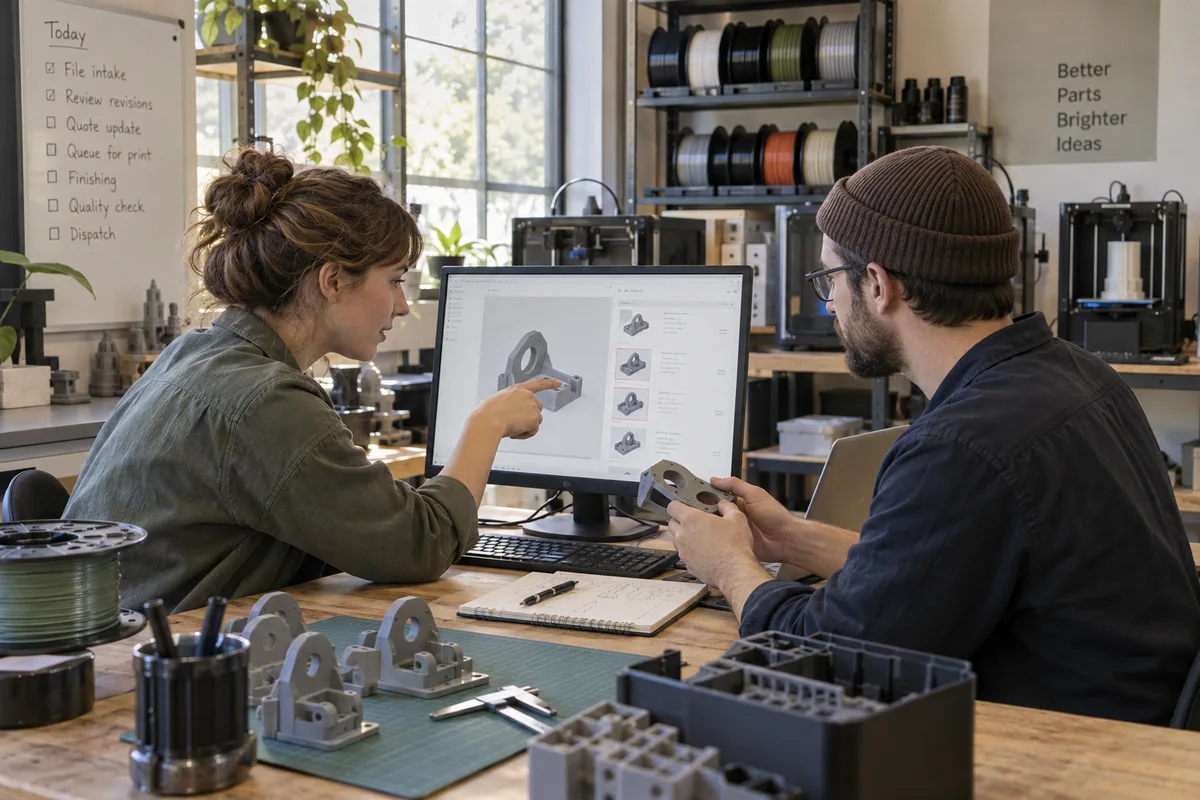
What website means
A website is the page a customer lands on after searching, clicking an advert or scanning a code, and it decides whether they call or leave. GullySales builds and maintains sites that load quickly, explain the offer plainly and make the enquiry form or phone number easy to find.
Also for 3D printing service bureaus
Sales and marketing for 3D printing service bureaus, the overview.
Last updated 14 Nov 2026.
For 3D printing service bureaus
Where it usually goes wrong, and what we would do.
“The home page cannot hold every process”
Resin, FDM, powder and metal each serve different people. A single page with a paragraph on each leaves everyone half informed. Give each process its own page and link them from a clear menu.
“File upload is the make-or-break step”
A large STL fails on a poor phone connection or a clumsy form. If the upload breaks, the designer goes to the bureau whose WhatsApp number worked. Test the route on a phone.
“Specifications build trust faster than adjectives”
Build volume, layer height range, materials, finishes and accepted formats let an engineer judge the fit. Words like high quality and precise do not.
“A site with no people feels like a drop box”
Show the workshop, the machines and the technician who reviews files. A buyer sending an expensive prototype wants to know a person is reading it.
What we do
What we deliver for 3D printing service bureaus.
The work available for this need. We agree the deliverables and responsibilities for your engagement in writing.
Page structure by process and use
A site map with a page for each process, each material family and each major buyer type.
Result: A visitor finds the page for their job in one click.
File upload and enquiry form
A simple form that takes the file, material, quantity and date, with a fallback to chat.
Result: Enquiries arrive complete and in one place.
Specification tables
Clear, accurate tables of what each machine and material offers, checked by your technician.
Result: An engineer can judge fit without a call.
Gallery with captions
Photographs of finished parts, each with material, process and use.
Result: The gallery proves the work and supports search.
Technical foundation
Mobile layout, speed, secure pages and basic search settings checked and fixed.
Result: Problems are listed and re-tested after the fix.
How the result is measured
- Page load time
- Bounce rate
- Enquiries from the website
Recorded as a baseline before work starts, so every later report has an honest comparison.
Searches your buyers type
What a visitor expects to find on the page before sending a file.
- upload STL for quote
- An upload form on its own page, asking for file, material, quantity and date. Make the accepted file types and size limit clear beside the button.
- 3D printing materials and finishes
- A specification table with each material, its colour options, finish and the largest part per process, kept to what you stock.
- 3D printing minimum order and lead time
- A short explanation of how a quote is set and what affects the date. Do not state a fixed delivery figure on the page unless you can meet it.
- 3D printed parts gallery India
- A gallery with captions that name the process, the material and the use of each part, shot in daylight against a plain background.
- 3D printing bureau contact and location
- A contact page with the workshop address, collection hours and a map, or a clear note that work is by courier only.
Who it is for
This is written for these 3D printing service bureaus.
- Product designers and industrial design studios in Bengaluru, Pune and Chennai
- Start-ups testing a hardware product before tooling
- Engineering and polytechnic colleges with final-year project deadlines
- Architects and interior studios ordering scale models
- Dental labs and clinics that print surgical guides and models
- Jewellery makers who need resin patterns for casting
- Small factories that need jigs, fixtures and spare parts for old machines
- Auto and electronics suppliers that need low-volume plastic parts
- Film, cosplay and prop makers who print large pieces in sections
- Hobbyists and drone and robotics clubs
Before you decide
When this may not be the right fit.
- You have no one to open and quote an uploaded file the same day, and an upload form would only collect files that wait.
- Your materials and machines are about to change, so a specification table would be out of date as soon as it is written.
- You have no photographs of finished parts, and a site without them gives the buyer nothing to judge you by.
Before you decide
Agree the work. Know how to judge it.
Website for 3D printing bureaus: use these checks to prepare, choose the scope, and review what changes.
Bring the right evidence
List the pages that support a buying decision and the actions visitors must complete. Keep examples of failed forms, unclear product information, and questions your team answers repeatedly.
Make the scope clear
Agree the page list, content ownership, integrations, and who controls the domain and hosting. Include redirects and existing search traffic in a redesign brief, before changing addresses.
Check the work in use
Complete a real enquiry journey on a phone and a laptop. Check that the confirmation appears, the enquiry reaches the right person, and tracking records the action once.
Know when to change course
If visitors can enquire but the team does not follow up, start with the sales handover. A larger website will not resolve that delay.
These are discussion points, not a fixed package. GullySales confirms the deliverables, responsibilities, fee, and term in writing after reading your brief and speaking with you.
Before we start
What to have ready before the work starts.
The records, access and decisions this work needs from 3D printing service bureaus. Anything missing is noted in the written scope, with who will supply it.
- Domain and hosting logins
- Launch stops until the domain and host are under your control. Bring the registrar and hosting logins, or introduce whoever keeps them. A former agency that holds them must hand them back before anything else. A short note of who holds them is enough.
- Machine specification sheets
- Specification tables must come from the makers' sheets and your own checks. Bring them for each machine, with build size and materials. Without them, tables show only what you can confirm by hand. Photocopies of the brochures help too.
- Original photographs of finished parts
- Pages need clear photographs, not screenshots. Bring originals with the process and material noted. If few exist, a photo session is planned and the gallery waits. Name the material in the file name.
- A list of file types your team accepts
- The upload form must accept what you can use. List the formats and size limits. If you are unsure, we start with common formats and adjust after test uploads. Any format you cannot print should also be stated. If a customer sends an unusual format, tell us which one.
- Someone to approve every page
- Pages go live only after a person from the bureau reads them. Name that person and give them time. If approvals queue behind print runs, the launch moves, and we do not publish unread pages. Delay in approval delays the launch.
How it works
How the website work runs
The work itself, in order. How an engagement starts, from your brief to a written scope, is set out on our method page.
- 1
List every process and material you sell
You and your lead technician write down each process, material and build size the bureau offers, and mark what you want more of. We turn this into a page plan, so the structure follows the machines instead of a single catalogue page. The plan is kept on one sheet so it can be revised.
- 2
Collect logins, photographs and specification sheets
We need the domain and hosting logins, original photographs of finished parts, and the specification of each machine. We record how the current site loads and which pages are visited, so later changes are measured against something written down. Anything missing goes on a list, so no one fills the gap with a guess. We also ask which pages on the old site still receive visits from search.
- 3
Approve the sitemap and a sample process page
We draw the pages and routes, from process pages to the upload step, and design one sample page. You and your estimator read it as a designer would. The plan and the sample are signed off before building begins. Altering the plan now costs little, so read the sample closely.
- 4
Test the upload step with real files
The form takes the file, the material, the quantity and the use. We test it with the file types and sizes your customers send, and your estimator checks what arrives. Anything that blocks a large file or hides an error is fixed before launch. A confirmation reaches the sender so they know the file arrived. Large files are tried in more than one browser.
- 5
Fill the pages with captions, tables and people
We write specification tables, caption each photograph with the material and use, and add a page about the people who run the machines. You correct any figure. Nothing is published until a technician has read the technical pages. Each page has a person from the bureau who has read it.
- 6
Compare uploads with the starting figures
After launch, we set the files and enquiries that came through the site against the figures noted before the rebuild. You see which pages bring file-ready buyers, and decide what to extend. That comparison tells you which pages get extended next.
Where this fits
Three pieces of sales work, in this order.
This work sits inside sales process design, at stage 1, prospecting and lead generation. The audit comes before it, and sales management keeps it running.
Step 1
Sales audit
Find where deals are being lost and what to fix first.
Start here if you cannot say where orders are lost.
Step 2 · you are here
Sales process design
One written way to sell, from first enquiry to repeat order.
Start here if every salesperson sells differently.
Step 3
Sales management
A target, a review routine and someone who owns the number.
Start here if the team has targets and no routine.
FAQ
Questions owners ask before they call.
Not here? More answers, or ask on WhatsApp.
Do we need an online instant quote?
How many pages should the site have?
Can we show prices?
What must our upload form accept?
Do we need an instant online quote?
Which pages come first on the site?
How long is the contract?
How soon will we see results?
Who will actually do the work?
What do you need from us?
More for 3D printing service bureaus
Related work to consider.
Closest to this: search and visibility
Also for 3D printing service bureaus
Or start from the overview: sales and marketing for 3D printing service bureaus.
Your next practical step
Tell us what you are trying to grow, and we will read it before we call.
Eight short steps, mostly taps. Skip anything you would rather answer on the call.