FMCG and beverage brands · Retailer marketing
Give the kirana a reason to stock your pack and a message it can repeat at the counter.
Retailer marketing for a packaged drink, cleaner or personal care brand is what the shop owner receives, is told and is reminded of after the distributor's van has left. GullySales prepares the retailer kit, the scheme in plain words, a WhatsApp list and a feedback record, and sets out who sends each.
Scope, fee, reporting and term are agreed in writing after we have read your brief and spoken to you.
What retailer marketing means
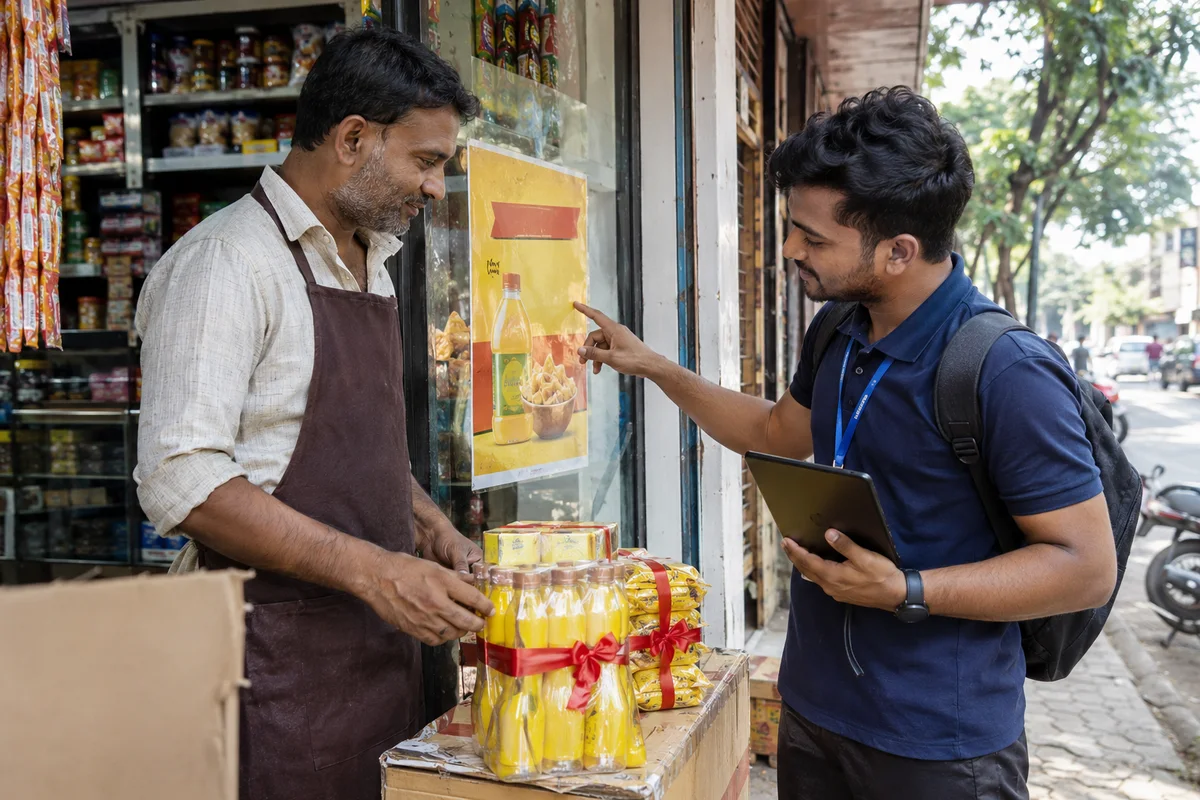
Retailer marketing gives the shops that sell your product a reason and a means to stock it, show it and name it to buyers. GullySales prepares the retailer kit, the scheme wording, the WhatsApp broadcast group, the feedback record and the reordering prompts, and sets out who sends what.
Also for FMCG and beverage brands
- Point-of-sale marketing for FMCG and beverage brands
- SEO for FMCG and beverage brands
- Social media marketing for FMCG and beverage brands
- Influencer marketing for FMCG and beverage brands
- Digital marketing for FMCG and beverage brands
- Branding for FMCG and beverage brands
- Content marketing for FMCG and beverage brands
- Lead generation for FMCG and beverage brands
Sales and marketing for FMCG and beverage brands, the overview.
Last updated 14 Nov 2026. Rules for this trade differ by state and professional body, and they change. We describe restrictions in general terms, so check the current position with your own council or adviser before you publish anything.
For FMCG and beverage brands
Where it usually goes wrong, and what we would do.
“The scheme reaches the shop as a rumour”
The salesperson mentions a discount on the case, the distributor quotes a different one, and the shopkeeper trusts neither. A one-page note in the shop's own language, with dates, that the salesperson and the distributor have both seen, ends the argument at the counter.
“The chilled shelf is decided by the shopkeeper, not the brand”
A retailer gives the cooler to the pack that sells without effort and pays the same at the end of the month. The shopkeeper needs a reason, such as steady pull from customers, a margin they can state and a salesperson who comes on the day promised.
“Small shops have no time to read”
A retailer with a queue of customers will not read a long circular. A single picture price list and a short voice or text message is read. Anything longer is left under the counter with the last distributor's bill.
“Feedback stays in the salesperson's head”
The shopkeeper says the sachet is too dear, the bottle leaks and a rival gives more margin. If this is not written down it dies on the beat. A simple record read with the order desk turns shop talk into changes to the next scheme.
What we do
What we deliver for FMCG and beverage brands.
The work available for this need. We agree the deliverables and responsibilities for your engagement in writing.
Retailer kit
The price list as your firm issues it, a one-page product sheet and a display guide in the language the shop reads. Your product owner signs off the sheet before it goes out.
Result: One kit every field representative leaves behind.
Scheme in plain words
Each scheme written as a short message and a note with start and end dates. Your sales head supplies the terms; we do not design the scheme.
Result: Ask a retailer and a distributor about one scheme and hear the same answer.
Retailer WhatsApp list
A broadcast list for retailers who agreed to hear from you, with a joining message that states what they will get. Anyone who asks to leave is removed.
Result: A list of consenting retailers with a joining record.
Retailer feedback record
A sheet or form for what each shop says about price, margin, pack size, stock and rival brands, read with the order desk.
Result: Feedback grouped by topic, with an owner for each item.
Reorder prompts
A short message at the point a shop is likely to run low, sent from the list and passed to the distributor's salesperson for the order.
Result: A reorder traced from message to distributor invoice.
How the result is measured
- Retailers who joined the broadcast group, against retailers invited
- Retailers carrying the current price list
- Retailer feedback logged, by topic
Recorded as a baseline before work starts, so every later report has an honest comparison.
Who it is for
This is written for these FMCG and beverage brands.
- Packaged drinking water and 20-litre can brands
- Regional soft drink, soda and goli soda bottlers
- Juice, fruit drink and nectar brands
- Energy, sports and electrolyte drink brands
- Packaged tea and coffee powder brands
- Flavoured milk, buttermilk and lassi brands
- Home care brands: detergent, dishwash, floor cleaner and phenyl
- Personal care and pooja brands: soap, hair oil and agarbatti
Before you decide
Agree the work. Know how to judge it.
Retailer marketing for FMCG and beverage brands: use these checks to prepare, choose the scope, and review what changes.
Bring the right evidence
Map existing partners, their territories, and the customers they serve. Review active selling and repeat orders separately from the number of partners signed up.
Make the scope clear
Agree partner fit, territory rules, onboarding, and support responsibilities. Clarify how direct enquiries and partner enquiries are assigned before starting recruitment.
Check the work in use
Follow a partner enquiry through to an order and the next purchase. Check whether the partner has the product knowledge and material needed to sell without repeated intervention.
Know when to change course
If current partners cannot sell because supply or support is weak, resolve that before recruiting more. A bigger network can spread the same problem further.
These are discussion points, not a fixed package. GullySales confirms the deliverables, responsibilities, fee, and term in writing after reading your brief and speaking with you.
Before we start
What to have ready before the work starts.
The records, access and decisions this work needs from FMCG and beverage brands. Anything missing is noted in the written scope, with who will supply it.
- A day on a beat with your salesperson
- Choose a salesperson whose beat reflects the average, and tell the salesperson beforehand. We need to see the real conversation at the counter. If no beat can be spared, we work from your sales officers' accounts and the kit is less certain. Tell the salesperson what we are there to do, so the shopkeepers see a colleague and not an inspector.
- The outlet list with shop types
- List your outlets and mark each as a kirana, paan shop, wholesale counter or another type you use. The kit differs by type. If the list has no types, we sort a sample on the beat day and ask you to extend it. We also need to know which shops hold a cooler of yours and which share one with a rival, because the kit differs.
- The scheme circular and claim rules
- Bring the current scheme circular and the rule for how retailers receive their benefit. The scheme is written from it. If the circular is vague, the plain-words version waits until your accounts person confirms the rule. Include dates when the benefit starts and ends, since a shopkeeper will ask on the last day whether it still applies.
- Retailer numbers with agreement to message
- Provide numbers of retailers who agreed to receive messages, or let officers collect the agreement on the beat. The group is built only from them. Without agreement the list starts small. Keep a note of the date each agreement was given and by whom, so the list can be checked later against what was said at the counter.
- A place to keep retailer feedback
- Choose the sheet or app where salespeople record what shopkeepers say. A notepad is not enough, because feedback that stays in a head helps nobody. If no place exists, we give you a simple sheet to start with. Whoever reads the sheet should be named, because a record nobody reads is the same as a head full of unrecorded remarks.
How it works
How the retailer marketing work runs
The work itself, in order. How an engagement starts, from your brief to a written scope, is set out on our method page.
- 1
Ride a beat with the van salesperson
We spend a day on a real beat with one of your van salespeople, watching what is said at each shop, what is handed over and what the shopkeeper asks. You tell the salesperson that we are coming. This day shows how a scheme reaches a shop now, and where it turns into a rumour. We also ask the salesperson which shops always have time to talk and which never do, because the kit must work for the second kind without anyone explaining it.
- 2
List what each shop type really needs
From the beat day and your outlet list, we sort shops into kinds such as a chilled-shelf kirana, a paan shop and a wholesale counter. For each we note what the owner reads, what they ignore and what they want from a brand. You correct the list where we have misjudged a shop. A chilled-shelf kirana cares about margin and the cooler; a wholesale counter cares about credit and carton price; a paan shop has a few inches of counter and little patience. Each kind gets its own short list of what the kit must carry and what it must leave out.
- 3
Write the scheme in plain words
We turn your scheme circular into a few lines a shopkeeper understands in a glance: what to buy, what they get, when it ends. Your sales head confirms the numbers are right, and your accounts person confirms the claim can be paid. Anything unclear is rewritten until it stands alone. We read the result aloud to a sales officer who has not seen the circular, and if the officer cannot repeat the benefit back, we rewrite it again before it is printed.
- 4
Print the kit and start the list
The retailer kit is printed in the size that fits a counter drawer, and the retailers who agree are added to a message group. You choose who sends each item, the officer, the distributor's salesperson or our team. We write down the split so no message is sent twice. The first scheme message goes out only after the printed kit has reached the shop, so the shopkeeper sees the card and the message together and links them.
- 5
Try it on one beat and adjust
The kit and the first scheme are tried on one beat. The salesperson logs shopkeeper feedback in the feedback record, and we review reorders and kept displays against the figures taken on the beat day. You decide whether it goes to the other beats. We also note which shopkeepers asked for more material, since those shops are the first to receive the next kit.
- 6
Set reorder prompts and read the feedback
From the feedback, we write the short prompts that remind a shop to reorder, and decide who sends them. Your sales head reads the record with us and picks the three complaints to fix first. The prompts then run on the beats where reorders are slipping. The prompts name the pack and the last order date in the shop's own record, so the message reads as a reminder from a supplier who knows the counter, not a circular.
Where this fits
Three pieces of sales work, in this order.
This work sits inside sales process design, at stage 0, foundation. The audit comes before it, and sales management keeps it running.
Step 1
Sales audit
Find where deals are being lost and what to fix first.
Start here if you cannot say where orders are lost.
Step 2 · you are here
Sales process design
One written way to sell, from first enquiry to repeat order.
Start here if every salesperson sells differently.
Step 3
Sales management
A target, a review routine and someone who owns the number.
Start here if the team has targets and no routine.
FAQ
Questions owners ask before they call.
Not here? More answers, or ask on WhatsApp.
Can retailers be told the shelf price?
Do you contact the retailers directly?
Who sends the retailer messages, the brand or the distributor?
What if a retailer wants a different scheme from the one on offer?
How long is the contract?
How soon will we see results?
Who will actually do the work?
What do you need from us?
What if we are not happy with the work?
From the blog
Further reading for FMCG and beverage brands.
 5 min read · 6 Oct 2026How food brands win the trade and the shopperA food or household brand is chosen twice, by the distributor or retailer who stocks it and by the shopper who picks it up. What each buyer checks.
 6 min read · 6 Oct 2026How beverage brands check summer loading against sell-throughA distributor's invoice shows what you pushed in, not what reached shops. How a beverage brand compares summer loading with sell-through.
More for FMCG and beverage brands
Related work to consider.
Closest to this: channels and partners
Also for FMCG and beverage brands
Or start from the overview: sales and marketing for FMCG and beverage brands.
Your next practical step
Tell us what you are trying to grow, and we will read it before we call.
Eight short steps, mostly taps. Skip anything you would rather answer on the call.