FMCG and beverage brands · Point-of-sale marketing
Win the last second at the counter, where a shopper points at a bottle or a bar.
Point-of-sale marketing for a drinks, home care or personal care brand is the strip, wobbler, price card and cooler branding that stands next to the pack in a small shop. GullySales cuts the material to real shelf and counter space and checks that it is up, and that dead scheme material is taken down.
Scope, fee, reporting and term are agreed in writing after we have read your brief and spoken to you.
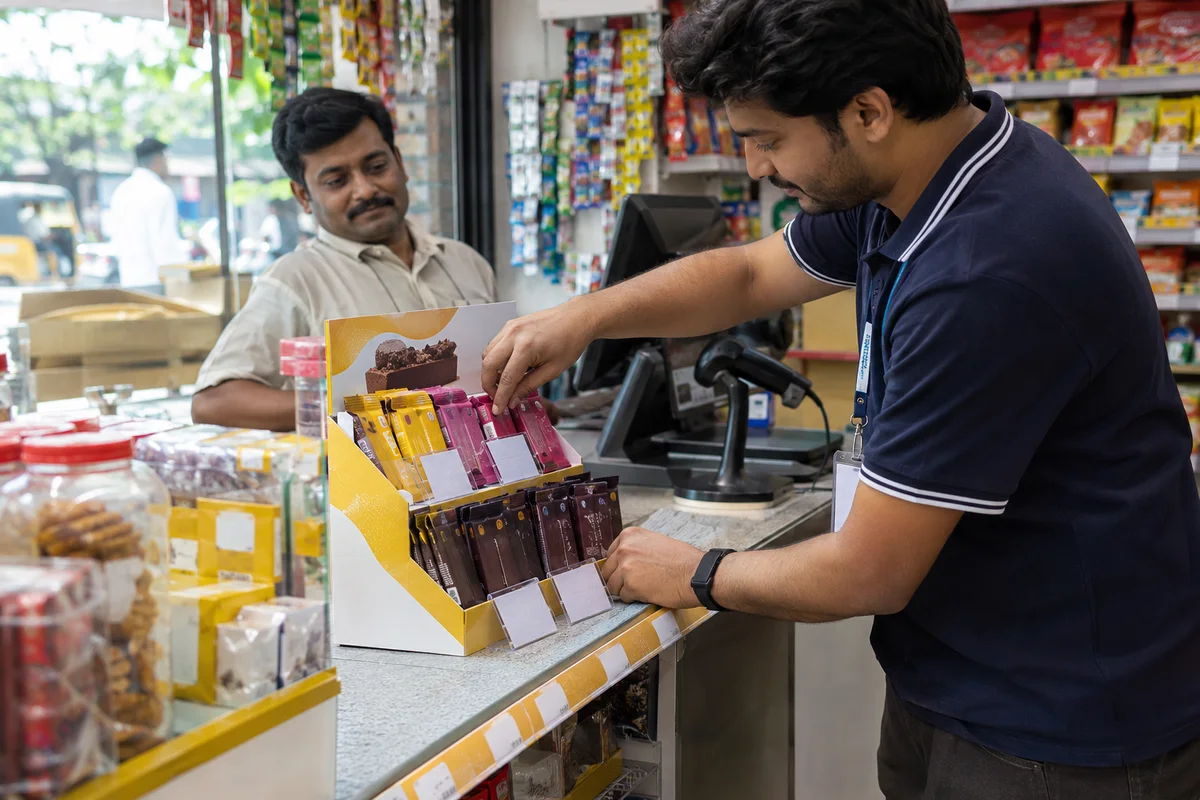
What point-of-sale marketing means
Point-of-sale marketing is the printed and physical material at the counter and shelf that decides the last choice between brands. GullySales designs it to fit real shop space, adds a QR code to your WhatsApp catalogue or warranty page, checks that it is put up, and gets outdated scheme material removed.
Also for FMCG and beverage brands
- Retailer marketing for FMCG and beverage brands
- SEO for FMCG and beverage brands
- Social media marketing for FMCG and beverage brands
- Influencer marketing for FMCG and beverage brands
- Digital marketing for FMCG and beverage brands
- Branding for FMCG and beverage brands
- Content marketing for FMCG and beverage brands
- Lead generation for FMCG and beverage brands
Sales and marketing for FMCG and beverage brands, the overview.
Last updated 14 Nov 2026. Rules for this trade differ by state and professional body, and they change. We describe restrictions in general terms, so check the current position with your own council or adviser before you publish anything.
For FMCG and beverage brands
Where it usually goes wrong, and what we would do.
“A kirana counter has no room for a standee”
The shop is a few feet wide and the shelf edge is already crowded with rival strips. Material cut to a printer's default size ends up folded behind the counter. Measuring a sample of real shops decides what the beat salesperson can actually fix to a shelf.
“The cooler sticker is the best sign in the shop”
A branded chiller door, a price strip and a shelf talker at eye level are the nearest thing a drinks brand has to a billboard. They work only if the cooler is clean, the pack is visible and the price shown matches the scheme the shopkeeper was told.
“Last season's scheme stays on the wall”
A summer combo card is still pasted beside the new price after the scheme closed, and the shopper asks for the old rate. The shopkeeper loses a customer or the distributor receives a claim. Removal has to be planned with the same care as putting up.
“Claims on a pack card are the brand's responsibility”
Words about health, energy or purity on a card carry advertising rules that differ by product. Wording is taken from the approved label and checked with your own adviser, and the card does not add any claim the label lacks.
What we do
What we deliver for FMCG and beverage brands.
The work available for this need. We agree the deliverables and responsibilities for your engagement in writing.
Outlet-type material list
A list of which pieces suit a small shop, a wholesaler, a canteen, a modern trade store and a cart, agreed with you before design starts.
Result: A list the sales head has approved.
Size sheet from real shops
Measurements and photographs of sample shelves, counters and coolers from your beat, used to cut every piece to size.
Result: Artwork that fits the shops where it is meant to go.
Artwork with approved wording
Print-ready files with the product name, pack size and scheme line, using only wording from your label and written scheme note.
Result: Every price and scheme line matches the note.
QR code to the retailer order line or a consumer page
A code that opens your WhatsApp order line or a product page under your own account, tested on a phone before print.
Result: The code opens the intended page on a handset.
Placement record and withdrawal list
Dispatch recorded by shop and distributor, a photo check after putting up and a dated list for material to be removed when a scheme ends.
Result: A shop-by-shop record of what is up and what has come down.
How the result is measured
- Outlets with each piece put up, separate from pieces dispatched
- Material in the right place and readable at the counter
- Outdated scheme material still showing after its end date
Recorded as a baseline before work starts, so every later report has an honest comparison.
Who it is for
This is written for these FMCG and beverage brands.
- Packaged drinking water and 20-litre can brands
- Regional soft drink, soda and goli soda bottlers
- Juice, fruit drink and nectar brands
- Energy, sports and electrolyte drink brands
- Packaged tea and coffee powder brands
- Flavoured milk, buttermilk and lassi brands
- Home care brands: detergent, dishwash, floor cleaner and phenyl
- Personal care and pooja brands: soap, hair oil and agarbatti
Before you decide
Agree the work. Know how to judge it.
Point-of-sale marketing for FMCG and beverage brands: use these checks to prepare, choose the scope, and review what changes.
Bring the right evidence
Map existing partners, their territories, and the customers they serve. Review active selling and repeat orders separately from the number of partners signed up.
Make the scope clear
Agree partner fit, territory rules, onboarding, and support responsibilities. Clarify how direct enquiries and partner enquiries are assigned before starting recruitment.
Check the work in use
Follow a partner enquiry through to an order and the next purchase. Check whether the partner has the product knowledge and material needed to sell without repeated intervention.
Know when to change course
If current partners cannot sell because supply or support is weak, resolve that before recruiting more. A bigger network can spread the same problem further.
These are discussion points, not a fixed package. GullySales confirms the deliverables, responsibilities, fee, and term in writing after reading your brief and speaking with you.
Before we start
What to have ready before the work starts.
The records, access and decisions this work needs from FMCG and beverage brands. Anything missing is noted in the written scope, with who will supply it.
- The pack and the scheme the material carries
- Tell us the exact pack and the scheme dates. Material is cut to them. If the scheme is not final, we hold the artwork, because a printed card with the wrong offer has to be pulled from every shop. Say also which shop types are out of scope this time, so we do not cut material for them.
- Shops we may measure
- Name some shops where the owner allows us to measure and photograph. The size sheet comes from them. If no shop agrees, we use measurements from your salespeople, and the material list is shorter and more cautious. We would rather have six real shops than a dozen guesses, and the size sheet is marked with how many shops each measurement came from.
- Label and claim approval from quality
- Have your quality person ready to approve each line on a card against the label. Nothing about health or effect is added by anyone else. If approval is slow, the wording is reduced to the pack name, size and scheme. Their approval is recorded against each piece, so a later query about a line on a card has an answer.
- Someone to fix the material in shops
- Decide who goes to each shop to fix the strip, wobbler or cooler sticker, and who pays for it. Material that reaches a godown and is never fixed does nothing. When no one is named, we start with a few shops we can reach ourselves. Name a backup for shops where the first person cannot go, because a card in a carton is not on the wall.
- The old scheme material to be removed
- Tell us which earlier cards and posters are still up. They must come down for the new ones to be seen. If the list is unknown, the first store visit records what is up and builds the withdrawal list from the photographs. Photographs of the wall as it stands today are enough, and we cross-check them with the visit sheet.
How it works
How the point-of-sale marketing work runs
The work itself, in order. How an engagement starts, from your brief to a written scope, is set out on our method page.
- 1
Pick the shops and the pack
With your sales head, we choose which outlet types and which pack the material is for: a chilled-shelf kirana for a bottled drink, a general store for a floor cleaner, a counter for a bar of soap. You decide the scheme it carries. Everything after follows from this choice. We also ask which shops already carry a rival's strip or sticker, since those need a different piece from shops with bare walls.
- 2
Measure the real counters and walls
We visit a handful of shops and measure the space on the counter, the glass of the cooler and the wall beside it, and photograph what is already there. You confirm the shops. The sizes we record are the limits the artwork must fit, and a standee that does not fit is dropped. We note, too, which wall the shopkeeper actually uses for schemes, because a space the shopkeeper has given up is unlikely to be handed back.
- 3
Approve wording and the code destination
We draft the text on each piece, and your quality person approves every claim against the label. Any code printed on a card is pointed at a retailer order line or a consumer page, and you choose which. A card that says more than the pack is not approved. The reader of the card is a shopper standing at arm's length, so we cut the wording to the pack name, the size and the scheme line, and nothing further.
- 4
Proof, print and send to the field
A printed proof is held against a real shelf before the full run. After you approve, the material goes to the distributor or the salesperson with a note of who fixes it in each shop, and what to do with the old material it replaces. We keep a list of how many pieces went to each distributor, so a shortfall in one town can be traced to a dispatch and not guessed at.
- 5
Visit shops to see what is up
A salesperson or our team photographs the material in place and ticks the placement record. Missing or damaged pieces are replaced. We then compare sales in those shops with those recorded before, and with shops that received nothing. Shops where the owner refused or removed the material are recorded with the reason, because that reason tells you whether the piece, the placement or the scheme was the problem.
- 6
Take down finished scheme material
When a scheme ends, the withdrawal list tells the salesperson which cards and strips to remove from which shops. You approve the list. Old wording left on a wall misleads a shopper, so removal is treated as part of the plan, not an afterthought. The distributor's salesperson signs the list once the cards are down, and the signed list is what the next scheme's material is measured against.
Where this fits
Three pieces of sales work, in this order.
This work sits inside sales process design, at stage 0, foundation. The audit comes before it, and sales management keeps it running.
Step 1
Sales audit
Find where deals are being lost and what to fix first.
Start here if you cannot say where orders are lost.
Step 2 · you are here
Sales process design
One written way to sell, from first enquiry to repeat order.
Start here if every salesperson sells differently.
Step 3
Sales management
A target, a review routine and someone who owns the number.
Start here if the team has targets and no routine.
FAQ
Questions owners ask before they call.
Not here? More answers, or ask on WhatsApp.
Who pays for the printing and the fixing?
Can the card say the drink is good for health?
Should the shopkeeper be paid to display our material?
What if the QR code on a card stops working?
How much does it cost?
How long is the contract?
How soon will we see results?
Who will actually do the work?
What do you need from us?
From the blog
Further reading for FMCG and beverage brands.
 5 min read · 6 Oct 2026How food brands win the trade and the shopperA food or household brand is chosen twice, by the distributor or retailer who stocks it and by the shopper who picks it up. What each buyer checks.
 6 min read · 6 Oct 2026How beverage brands check summer loading against sell-throughA distributor's invoice shows what you pushed in, not what reached shops. How a beverage brand compares summer loading with sell-through.
More for FMCG and beverage brands
Related work to consider.
Closest to this: channels and partners
Also for FMCG and beverage brands
Or start from the overview: sales and marketing for FMCG and beverage brands.
Your next practical step
Tell us what you are trying to grow, and we will read it before we call.
Eight short steps, mostly taps. Skip anything you would rather answer on the call.