Point-of-sale marketing · Channel and partners
The customer is at the counter, and your brand is not what they are looking at.
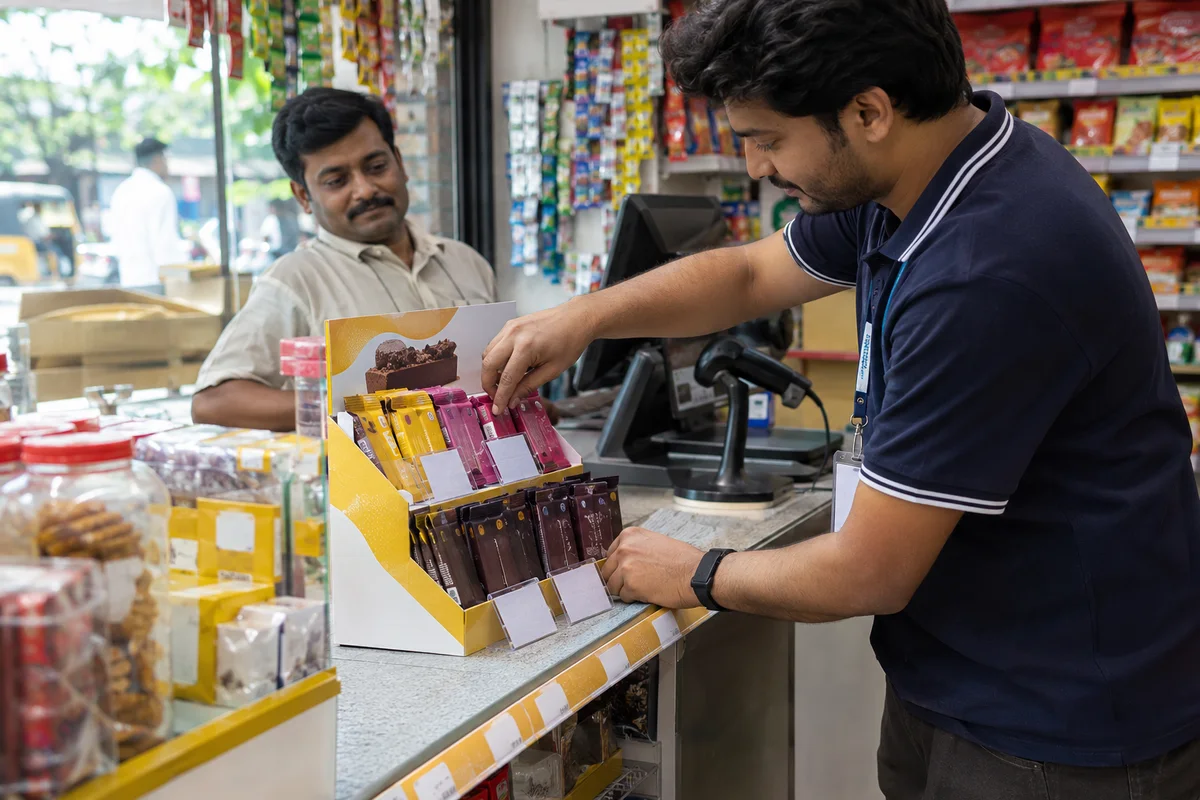
A buyer asks the shopkeeper which one to take. The shopkeeper points at what is nearest, what has a clear price card, or what the brand has taught them to explain. Material at that moment does a job that no advertisement can do from outside the shop.
Scope, fee, reporting and term are agreed in writing after we have read your brief and spoken to you.
In one paragraph
Point-of-sale marketing is the printed and physical material at the counter and shelf that decides the last choice between brands. GullySales designs it to fit real shop space, adds a QR code to your WhatsApp catalogue or warranty page, checks that it is put up, and gets outdated scheme material removed.
The failure happens after the print order. The standee is too wide for a kirana, the wobbler hides the pack, and last Diwali's scheme card still hangs beside this month's price.
This page covers the material and its upkeep. If the problem is stock, shelf position and pricing checks, retail execution and merchandising is the better fit. If you first need shops to agree to stock and display you, retailer marketing comes first. If the question is what the scheme itself should be, that is trade promotion planning.
Who it is for
This is written for you if these sound familiar.
- Manufacturers whose product is chosen at a dealer's counter after a short conversation with the shopkeeper
- Brands sending the same standee to a kirana, a chain outlet and an exclusive showroom, and finding it fits none of them
- Appliance, mobile, paint, tile and hardware makers who need a demo unit or feature card beside the competitor's
- Businesses that want a counter QR code to open a WhatsApp catalogue, a warranty registration page or a service request
- Companies running seasonal schemes whose old cards never come down
Not for
It is not the right fit if.
- You sell only online or by direct visits and no customer ever stands at someone else's counter
- Dealers have not agreed to display your brand at all. That needs retailer marketing before any material is printed.
- You want the shop to charge a fixed price. Retail pricing instructions are for your own legal adviser, not for a display card.
The problem
Does this sound like your business?
Common situations this work addresses.
“The standee is in the godown, not the shop”
Dispatch shows the carton reached the dealer. Nobody has confirmed that anything was put up where a customer looks.
“Our price card says one thing and the scheme says another”
A shelf strip from the last offer sits beside a new one. The customer reads the wrong figure, and the dealer argues at the billing counter.
“The material does not fit the shop”
A large floor standee is blocked by a stack of cartons. A counter box is too deep for a glass-top counter with a till on it.
“Customers ask for the catalogue and we have none to show”
The dealer cannot recall every size and model. A printed QR code to your WhatsApp catalogue would answer the question without a brochure.
What we do
The work we can include.
Each deliverable and the purpose it serves. Your written scope confirms what is included, who is responsible, and what it costs.
Material list by outlet type
A list of the standees, shelf strips, wobblers, price and feature cards, counter display boxes and billing-counter cards that suit each outlet you sell through. You approve the list before any design starts.
Size sheet from real shop space
Measured dimensions taken from sample counters and shelf edges, with what each outlet type can hold. Artwork is cut to those sizes, not to a printer's default.
Artwork for each piece
Print-ready files with the product name, the feature or price line, and your approved wording on offers. You sign off each proof.
QR code and landing destination
A QR code on the card that opens your WhatsApp catalogue, your warranty registration page or a service request form. The code is tested on a phone before print, and the destination stays under your own account.
Demo unit and display brief
For products a customer wants to touch or switch on, a written brief for the demo unit: where it stands, what is shown, and who at the shop explains it.
Installation and visit checklist
A short checklist with fixed photo angles for your field staff or dealers, so a visit records what was put up, where, and in what condition.
Withdrawal list for outdated schemes
A dated list of which cards and strips belong to which scheme, with the date each must come down. It goes to dealers with the replacement material.
How the result is measured
- Outlets with each piece put up, separate from pieces dispatched
- Material in the right place and readable at the counter
- Outdated scheme material still showing after its end date
- QR scans into the WhatsApp catalogue or warranty page, where the destination records them
- Enquiries traced to counter material
- Dealer requests for replacement or resizing
Recorded as a baseline before work starts, so every later report has an honest comparison.
Before you decide
Agree the work. Know how to judge it.
Point-of-sale marketing: use these checks to prepare, choose the scope, and review what changes.
Bring the right evidence
Map existing partners, their territories, and the customers they serve. Review active selling and repeat orders separately from the number of partners signed up.
Make the scope clear
Agree partner fit, territory rules, onboarding, and support responsibilities. Clarify how direct enquiries and partner enquiries are assigned before starting recruitment.
Check the work in use
Follow a partner enquiry through to an order and the next purchase. Check whether the partner has the product knowledge and material needed to sell without repeated intervention.
Know when to change course
If current partners cannot sell because supply or support is weak, resolve that before recruiting more. A bigger network can spread the same problem further.
These are discussion points, not a fixed package. GullySales confirms the deliverables, responsibilities, fee, and term in writing after reading your brief and speaking with you.
How it works
How the point-of-sale marketing work runs
The work itself, in order. How an engagement starts, from your brief to a written scope, is set out on our method page.
- 1
Outlet and product choice
You tell us the outlets you sell through and the products that need a push at the counter. We agree which pieces suit which outlet.
- 2
Space measurement
Your field team or a dealer sends photographs and measurements of counters and shelves. We fit sizes to them before any artwork begins.
- 3
Artwork and QR approval
You approve each proof, the offer wording and the QR destination. Anything that states a price or scheme is checked against your written scheme note.
- 4
Print and dispatch handoff
The approved files go to your printer or ours as agreed in writing, with quantities by dealer. Dispatch records which outlet got which piece.
- 5
Store-visit check
Photographs or visits confirm the material is up, readable and in the right place. Gaps go to the responsible dealer or field representative.
- 6
Scheme withdrawal
When a scheme ends, the withdrawal list is sent and a recheck confirms old material has come down.
Before you hire anyone
Do this first yourself.
Walk into three of your own outlets as a customer and write down what you see before ordering any print.
- Photograph the counter and shelf at three dealers: one kirana, one larger shop and one exclusive outlet, with a tape measure in the frame.
- Note which of your cards, strips or standees are up, and which belong to a scheme that has ended.
- List the questions the shopkeeper had to answer from memory about your product.
- Check that the price on every card matches the price declared on the pack.
- Open your WhatsApp catalogue or warranty page on a phone and see whether a customer could use it standing at a counter.
- Ask each dealer which piece they would actually put up, and where.
Judge any provider
What to ask any provider of this service.
Useful whoever you choose, including us.
- How do you fit sizes to the real counters and shelves of our dealers?
- Who checks that the material is put up, and how is that shown?
- How do you take down outdated scheme material?
- Where does the QR code open, and whose account holds that destination?
- What happens when a card carries a price or offer that conflicts with the pack or the scheme note?
- Which costs are print and which are your time?
Where this fits
Three pieces of sales work, in this order.
This work sits inside sales process design, at stage 1, prospecting and lead generation. The audit comes before it, and sales management keeps it running.
Step 1
Sales audit
Find where deals are being lost and what to fix first.
Start here if you cannot say where orders are lost.
Step 2 · you are here
Sales process design
One written way to sell, from first enquiry to repeat order.
Start here if every salesperson sells differently.
Step 3
Sales management
A target, a review routine and someone who owns the number.
Start here if the team has targets and no routine.
FAQ
Questions owners ask before they call.
Not here? More answers, or ask on WhatsApp.
Where does this stop and retail execution begin?
Do you decide the scheme printed on the card?
Can a QR code tell us which shop produced an enquiry?
Who puts the material up?
Do the cards have to show the printed maximum retail price?
What does it cost, and how long does it take?
How long is the contract?
Who will actually do the work?
What do you need from us?
By industry
Point-of-sale marketing, written for your industry.
Your next practical step
Tell us what you are trying to grow, and we will read it before we call.
Eight short steps, mostly taps. Skip anything you would rather answer on the call.