Household products brands · Branding
Your bottle has to be picked up by a homemaker who came for another brand.
Branding for a household products brand is the name, the colour, the fragrance and the one promise that make a bottle recognisable on a crowded shelf and easy for a retailer to recommend. GullySales writes the positioning, tests the pack from counter distance and keeps it the same on every carton, board and listing.
Scope, fee, reporting and term are agreed in writing after we have read your brief and spoken to you.

What branding means
Branding is what a customer remembers about your business beyond the product, including your name, colours, tone of voice and what you are known for locally. GullySales sets or corrects this once and applies it consistently across your website, signage and adverts so the business looks like one company everywhere.
Also for household products brands
- SEO for household products brands
- Social media marketing for household products brands
- Digital marketing for household products brands
- Content marketing for household products brands
- Lead generation for household products brands
- Sales management for household products brands
- Outdoor advertising for household products brands
- Website development for household products brands
Sales and marketing for household products brands, the overview.
Last updated 6 Oct 2026.
For household products brands
Where it usually goes wrong, and what we would do.
“Your range looks like one product in four bottles”
Floor cleaner, toilet cleaner and glass cleaner differ only in small print, so shoppers and salesmen pick the wrong one.
“A copy is easiest when the pack is plain”
A white bottle with a blue label is copied in a back-street unit in a month. A distinct cap, shape and seal make the copy easier to spot.
“The fragrance carries the brand more than the logo”
A homemaker remembers a lemon floor cleaner by its smell and asks for it by that. If the fragrance has no name, there is no way to ask.
What we do
What we deliver for household products brands.
Every deliverable, what it covers for you, and the result it is there to produce. Nothing here is an extra.
A positioning sentence and a plain voice
One sentence on who the cleaner is for, which job it does and why it beats the leader on the same shelf, with the words to use and to avoid.
Result: Every board, post and label says the same thing.
A range plan with a colour code
A logic for names, colours and caps across floor, toilet, glass and dish products, so a salesman and a shopper can tell them apart at once.
Result: The right bottle is picked first time.
A shelf test of the pack
The pack seen from the counter and the shelf, beside the two leaders, and on a phone screen, with a list of what to fix before the next print run.
Result: The bottle is noticed in the two seconds a shopper gives it.
Features that help spot a copy
A batch code, a seal and a cap that are hard to imitate, with a one-page guide for retailers and distributors on how to tell the genuine pack.
Result: A shopkeeper can check a doubtful carton.
A label review in general terms
Declarations, precautions text and language, read against the rules for this kind of product by your adviser, with changes listed for the printer.
Result: The pack is ready for a chain's check.
Brand rules for boards, cartons and vans
A short guide with colours, the logo's clear space and the pack photographs to use, for the printer, the painter and the distributor.
Result: Shop boards and vans look like one brand.
How the result is measured
- Recognition in customer feedback
- Consistency across channels
- Repeat enquiries by name
Recorded as a baseline before work starts, so every later report has an honest comparison.
Positioning in one sentence
Fill in this sentence before the next print run of labels, and test every pack, board and post against it.
- Who uses it, and for which job
- Name the job, not the age group: the Sunday floor wash, the greasy tiffin box, the hostel bathroom. A brand tied to one job is easier to ask for.
- What it is, in the shopper's words
- Floor cleaner, dishwash liquid, phenyl, washing liquid. Put the plain name on the pack before any coined name, and check it reads in the local script.
- Why you over the leader on the same shelf
- A fragrance your region likes, a bigger fill at the same MRP, a refill pouch, a gentler formula only if your tests support it. Choose one that is true in every town.
- Proof you can point to
- Registrations as they appear on the certificates, a plant video, years of supply to named institutions with their permission. Never borrow a mark your plant does not hold.
- Words to keep off the pack
- Germ-kill, chemical-free, child-safe and eco-friendly need documents behind them. Use them only where your tests and adviser support them, and otherwise state the plain fact.
- The counter test
- Ask a shopkeeper to name the product, the fragrance and the size from two metres. Check the name against the trademark register before it goes on a label.
Who it is for
This is written for these household products brands.
- Detergent powder, bar and liquid brands
- Dishwash gel, liquid and bar makers
- Floor, toilet and glass cleaner brands
- Phenyl, disinfectant and bleach makers
- Mosquito repellent and air freshener brands
- Scrubber, sponge, wipe, mop and broom makers
- Garbage bag, foil, tissue and kitchen roll brands
- Institutional and housekeeping chemical suppliers
Not for
It is not the right fit if.
- The range of products and pack sizes is still changing, so a new identity would be redrawn each time a variant is added or dropped.
- The real problem is a copy of your pack sold nearby, and a new logo would not stop the copier from imitating it as well.
- You have not yet checked whether the brand name is registered and free to use in the states you plan to sell in, so the money spent on design could be lost.
How it works
How the branding work runs
The work itself, in order. How an engagement starts, from your brief to a written scope, is set out on our method page.
- 1
Interview customers and team
We talk to real buyers, won and lost, and to people inside the business who deal with customers daily.
- 2
Review the competitive field
We look at how the nearest competitors present themselves so the position is not accidentally identical.
- 3
Draft the position
A first version of the positioning statement and messaging pillars is written and checked against what customers actually said.
- 4
Test it against real conversations
The draft is tried out in a real sales call or two before it is finalised, since a position that does not survive a real conversation needs rework.
- 5
Hand over the rollout brief
The final position, pillars and not-for list are documented for your team and any agency to apply consistently.
Where this fits
Three pieces of sales work, in this order.
This work sits inside sales process design, at stage 1, prospecting and lead generation. The audit comes before it, and sales management keeps it running.
Step 1
Sales audit
Find where deals are being lost and what to fix first.
Start here if you cannot say where orders are lost.
Step 2 · you are here
Sales process design
One written way to sell, from first enquiry to repeat order.
Start here if every salesperson sells differently.
Step 3
Sales management
A target, a review routine and someone who owns the number.
Start here if the team has targets and no routine.
FAQ
Questions owners ask before they call.
Not here? More answers, or ask on WhatsApp.
Should we rename the brand when we enter a new state?
Is a new logo or a clearer positioning more urgent?
Can we use a name in the local language on the pack?
Can a brand name imply a claim, such as Germ Kill?
How much does it cost?
How long is the contract?
How soon will we see results?
Who will actually do the work?
What do you need from us?
What if we are not happy with the work?
From the blog
Further reading for household products brands.
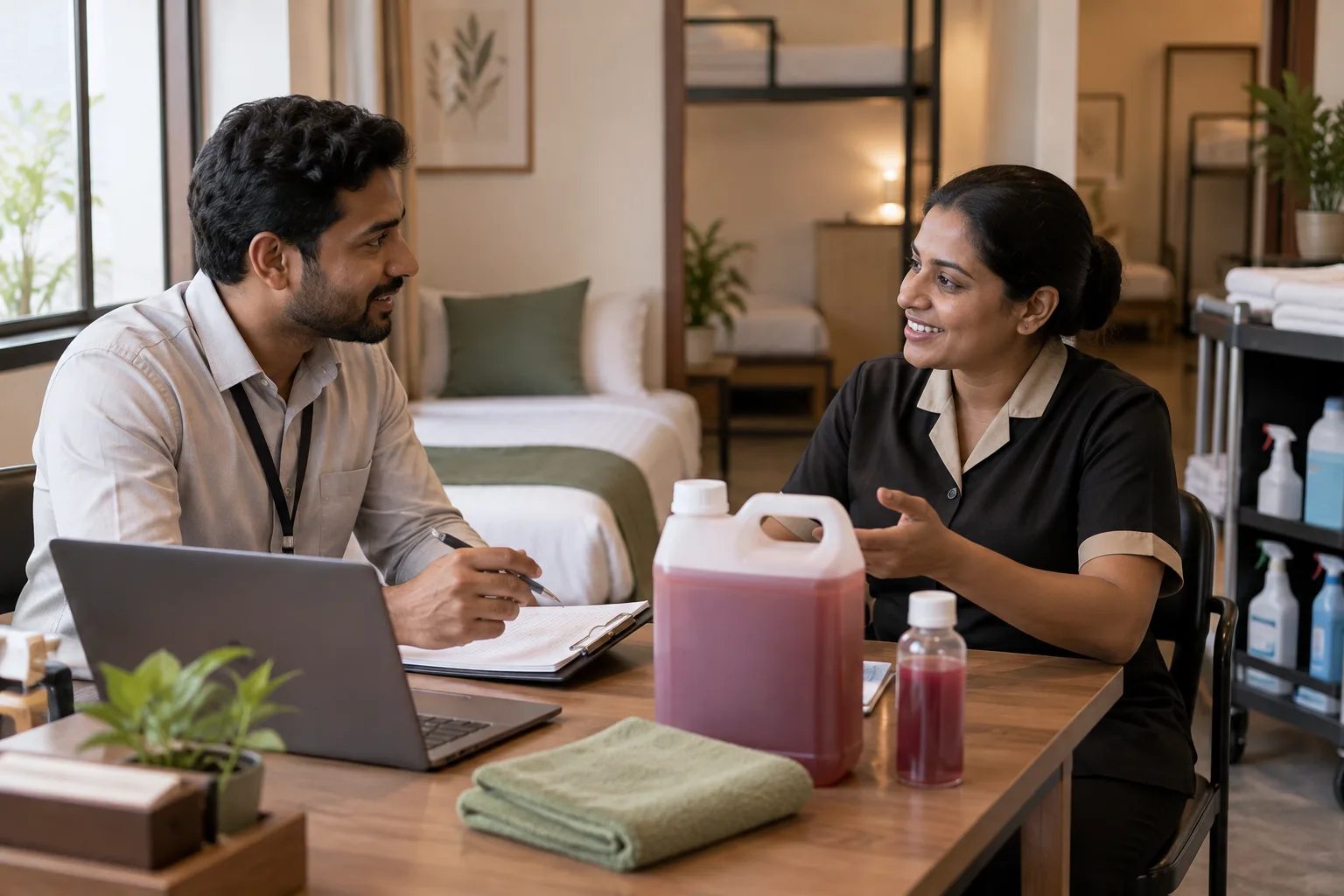 6 min read · 6 Oct 2026Why hostels try your cleaner once and never reorderHostels, PGs and hotels sample a cleaner once and drift to another supplier because nobody asked how the trial went. Here is the follow-up that turns a sample can into a standing order.
 5 min read · 6 Oct 2026How food brands win the trade and the shopperA packed food or household brand is chosen twice: by the distributor, retailer or kitchen that stocks it, then by the shopper who picks it up. Here is what each buyer checks and where brands lose both.
More for household products brands
Everything else we would do for you.
Or start from the overview: sales and marketing for household products brands.
Your next practical step
Tell us what you are trying to grow, and we will read it before we call.
Eight short steps, mostly taps. Skip anything you would rather answer on the call.