Household products brands · Outdoor advertising
Put the board by the cleaning shelf, and the wall where the wholesaler's lorry stops.
Outdoor advertising for a household products brand is shop boards, wall paintings, hoardings and vehicle branding placed on the beats and wholesale routes where your pack is already stocked. GullySales picks sites against the outlet list, checks permissions and artwork, and ties each site to the billing of the shops near it.
Scope, fee, reporting and term are agreed in writing after we have read your brief and spoken to you.

What outdoor advertising means
Outdoor advertising is the hoarding, billboard, bus shelter or digital screen on a road your buyers already use. GullySales picks the sites from where your customers actually come from, coordinates the booking with the media owner, and gives the campaign a traceable route so it is not judged on guesswork.
Also for household products brands
- SEO for household products brands
- Social media marketing for household products brands
- Digital marketing for household products brands
- Content marketing for household products brands
- Branding for household products brands
- Lead generation for household products brands
- Sales management for household products brands
- Website development for household products brands
Sales and marketing for household products brands, the overview.
Last updated 6 Oct 2026.
For household products brands
Where it usually goes wrong, and what we would do.
“A highway hoarding in a district without stock”
A big board sells nothing when the shop below it has never heard of the bottle. Boards belong where the distributor delivers.
“The board shows the brand and not the pack”
A passer-by who sees only a logo cannot tell whether it is detergent or phenyl. The bottle, the job and the price point belong on the board.
“Wholesale markets decide more than passers-by”
The kirana owner chooses stock in a market lane and not on the road. A board on that lane reaches the person who fills a hundred shelves.
What we do
What we deliver for household products brands.
Every deliverable, what it covers for you, and the result it is there to produce. Nothing here is an extra.
A site list built from the outlet list
Shops, wholesale lanes and village routes where the pack is stocked, ranked by the billing near them, with the type of board each suits.
Result: Money is spent where the pack can be bought.
Shop board and glow sign plan
Boards for retailers who agree in writing to stock the range, with the pack, the job and the price point on each.
Result: A board marks a shop that holds your stock.
Wall painting routes
Walls on village and small-town routes chosen from the distributor's beat, with the owner's written consent and a photograph of each wall.
Result: Villages on the route see the pack before the salesman arrives.
Wholesale lane boards
Boards at wholesalers' counters and in the market lane where retailers buy, agreed with the wholesaler.
Result: The person who fills the shelves sees you first.
Distributor vehicle branding
Vans and tempos that deliver to shops, branded with the range and a number for retailers, within local rules.
Result: The vehicle that reaches every shop carries the brand.
A check by shop billing
Billing in shops near each site compared with similar shops far from any, over the same weeks, with a note from retailers on whether shoppers mention it.
Result: You learn which sites to renew.
How the result is measured
- Sites booked
- Proof of display received
- Enquiries quoting the campaign route
Recorded as a baseline before work starts, so every later report has an honest comparison.
How it is bought, and approved
How a household products brand buys outdoor, from shop boards to hoardings, and who has to agree first.
- Shop boards and glow signs
- Bought per shop through a local printer. The retailer's consent and a note on what the retailer will stock come first. Some towns charge a fee on signboards, so ask the local body.
- Wall paintings on village and town routes
- Bought per wall from painters who tour a district. Get the owner's written consent, photograph the wall before and after, and agree how long the painting stays.
- Boards in the wholesale market lane
- Agree with the wholesaler whose wall or shutter carries it, and ask the market association whether any permission is needed. Rules differ by market and change.
- Hoardings and bus shelters
- Bought by site and period from a media owner. Ask to see the local body licence and the landowner's consent, and visit at dusk to see the lighting and which way it faces.
- Distributor vans and tempos
- Bought per vehicle for a period, or agreed with the distributor. Check the local transport rules on vehicle advertising, and keep the wording the same as on the boards.
- How to tell it worked
- Choose sites near shops you already bill, then compare their billing with similar shops far from any site over the same weeks. Ask retailers whether shoppers mention the board.
Who it is for
This is written for these household products brands.
- Detergent powder, bar and liquid brands
- Dishwash gel, liquid and bar makers
- Floor, toilet and glass cleaner brands
- Phenyl, disinfectant and bleach makers
- Mosquito repellent and air freshener brands
- Scrubber, sponge, wipe, mop and broom makers
- Garbage bag, foil, tissue and kitchen roll brands
- Institutional and housekeeping chemical suppliers
Not for
It is not the right fit if.
- The pack is not stocked in the area around the site, so the board would send shoppers to look for a bottle that is not there.
- The brand name and the pack front are still under review, so painted walls and boards would have to be redone.
- No one can check local approval and the landlord's terms for a shop board before it is made, so the site list is not ready to buy.
How it works
How the outdoor advertising work runs
The work itself, in order. How an engagement starts, from your brief to a written scope, is set out on our method page.
- 1
Draw the catchment
We agree the roads, junctions and neighbourhoods your buyer moves through. Owners first name a wider area than their buyers travel, and a clinic in Nagarbhavi does not need the whole of west Bengaluru.
- 2
Survey what is available
We work through the sites on offer inside that catchment and go and stand in front of the ones worth looking at, at the hour your buyer passes. A site that reads well at noon can be dark and hidden by a tree at seven.
- 3
Compare and book
Sites are compared on facing, visibility, illumination, paperwork and cycle length, then booked through the media owner or their agency at a negotiated rate. The booking is written down: site address, size, lit or unlit, start date and cycle.
- 4
Print to specification
Artwork is made to the exact panel size and delivered ahead of mounting day, with a proof you approve before printing.
- 5
Monitor the cycle
We collect mounting and mid-cycle photographs, and take up anything late, torn or unlit with the media owner while the cycle is still running.
Where this fits
Three pieces of sales work, in this order.
This work sits inside sales process design, at stage 1, prospecting and lead generation. The audit comes before it, and sales management keeps it running.
Step 1
Sales audit
Find where deals are being lost and what to fix first.
Start here if you cannot say where orders are lost.
Step 2 · you are here
Sales process design
One written way to sell, from first enquiry to repeat order.
Start here if every salesperson sells differently.
Step 3
Sales management
A target, a review routine and someone who owns the number.
Start here if the team has targets and no routine.
FAQ
Questions owners ask before they call.
Not here? More answers, or ask on WhatsApp.
Is a hoarding worth it for a brand sold in kirana shops?
What goes on the board, the brand or the product?
Who pays the local fee on a shop board?
Does wall painting work in cities?
How long is the contract?
How soon will we see results?
Who will actually do the work?
What do you need from us?
What if we are not happy with the work?
From the blog
Further reading for household products brands.
 6 min read · 6 Oct 2026Why hostels try your cleaner once and never reorderHostels, PGs and hotels sample a cleaner once and drift to another supplier because nobody asked how the trial went. Here is the follow-up that turns a sample can into a standing order.
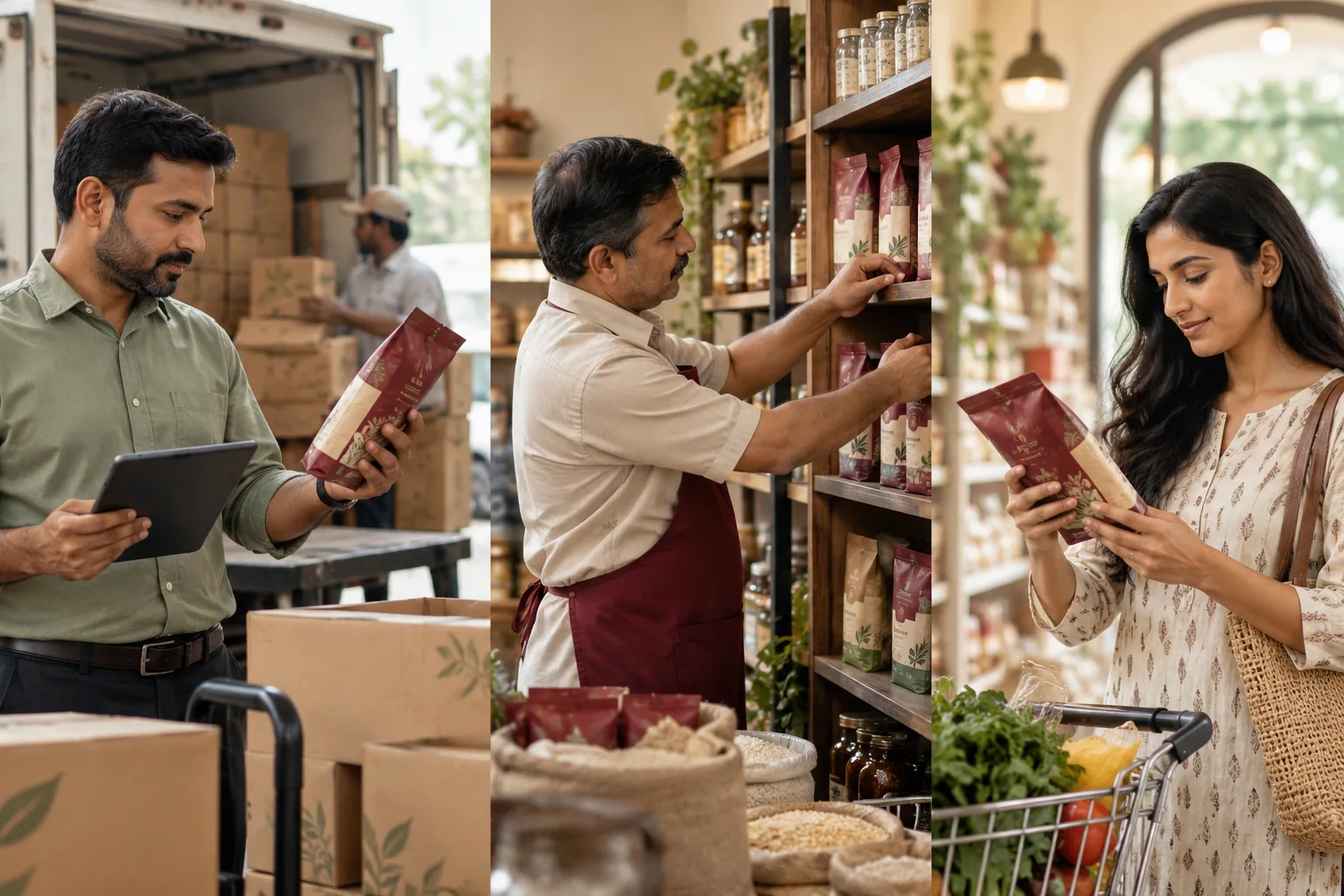 5 min read · 6 Oct 2026How food brands win the trade and the shopperA packed food or household brand is chosen twice: by the distributor, retailer or kitchen that stocks it, then by the shopper who picks it up. Here is what each buyer checks and where brands lose both.
More for household products brands
Everything else we would do for you.
Or start from the overview: sales and marketing for household products brands.
Your next practical step
Tell us what you are trying to grow, and we will read it before we call.
Eight short steps, mostly taps. Skip anything you would rather answer on the call.