Milk collection centres · Other
Win the farmers who bring you milk and the dairy that takes it from you.
At half past five the farmers queue with cans on bikes and cycles. Someone reads the lactometer, someone writes the slip, and the rate on the board decides who comes back tomorrow. A farmer who feels short-changed on one reading takes the cans to the next centre, a kilometre away.
Scope, fee, reporting and term are agreed in writing after we have read your brief and spoken to you.
In one paragraph
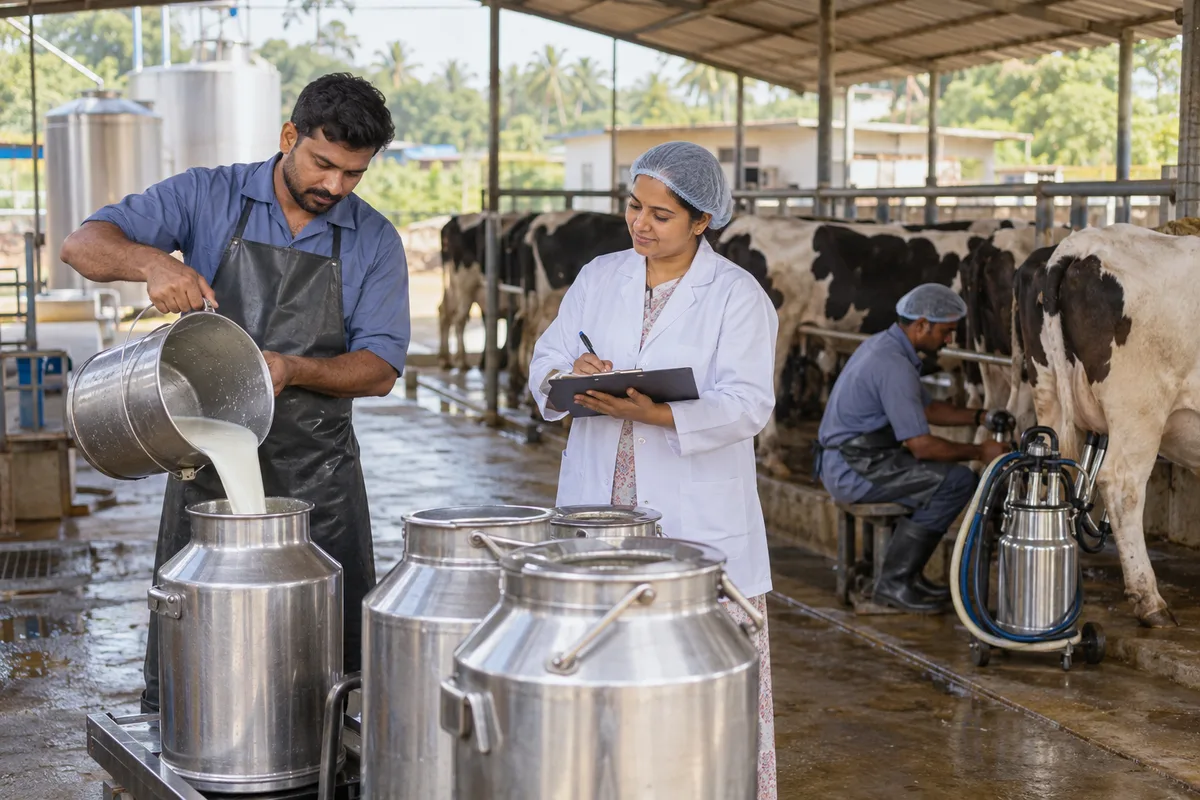
A milk collection centre buys milk from local farmers twice a day, tests it for fat and SNF, chills it and sells it on to a dairy. Marketing for a centre has two audiences. Farmers supply it and dairies buy from it. GullySales prepares the farmer rate chart and message list, and a supply profile for the dairy.
A collection centre is a middleman with two customers who each need to trust it. The farmer needs fair weighing and prompt payment. The dairy needs volume and quality to arrive, every day, without a gap. Where both sides are handled by word of mouth, the centre with the best-known village contact has the advantage.
Last updated 18 Oct 2026.
How buyers decide
How milk collection centres are chosen.
A farmer picks a centre by the rate per litre, the fat and SNF readings, how quickly and how regularly the payment comes, and whether the testing happens in front of the can. Distance counts, since cans ride on a bike. If the neighbour got a better reading yesterday, the lane knows by noon.
A dairy picks its suppliers on daily volume, chilling and cleanliness, adulteration records and whether the collection route can scale when the flush season arrives. A centre that shows its numbers, its testing and its farmer list gets first call when the dairy needs more milk.
The problem
What usually goes wrong for milk collection centres.
What owners tell us on the first call, in their words.
“Farmers move to another centre for a rupee more”
With no other reason to stay, supplier loyalty is only the rate. Trust built through open testing is harder to copy.
“We cannot show a dairy what we have”
Daily litres, number of farmers and fat readings live in a register. When the dairy asks, someone has to compile it by hand.
“Farmers do not know what the rate depends on”
A farmer who sees a drop suspects the centre of cheating. A printed rate chart and a quick explanation prevent the argument.
“Peak season floods us and lean season starves us”
Volume swings with fodder and weather, and the centre has no plan for either end.
“New villages around us do not know we exist”
Farmers in the next village are still carrying cans to a centre ten kilometres away.
What we do
What we do for milk collection centres.
Everything included for milk collection centres.
A supply profile for dairies
A clean one-page summary of your daily litres, farmers, testing method and chilling, ready to share with any dairy.
A farmer rate chart in the local language
A printed and WhatsApp chart that explains fat and SNF and how they set the rate, in the village language and English.
A farmer register and message list
Every supplier with phone number, village, daily litres and payment status, plus a broadcast list for rate notices.
A village recruitment plan
A list of nearby villages without a close centre, with a plan for who visits and what is said.
A Google Business Profile for the centre
A map listing with location, collection timings and phone number.
How the result is measured
- Farmers supplying, new against lost
- Average daily litres by village
- Dairies contacted and replies received
- Farmers reached by each rate notice
- Referrals from existing suppliers
- Payment delays reported by farmers
Recorded as a baseline before work starts, so every later report has an honest comparison.
Every service, written for milk collection centres
Each has its own page: what it involves for milk collection centres, what you get, and what it is measured on.
- Lead generationFind the farmers and dairy buyers who will keep your chilling tank full.
- SEOMake the centre easy to find for the dairy officer searching for a milk source.
- Local SEOShow on the map for the farmers and officers who look for a centre near them.
- Social media marketingUse the village group and the dairy's contact feed, not a brand page nobody follows.
- Content marketingExplain fat, SNF and the rate in the farmer's language, and the supply in the dairy's.
- Buyer personasWrite down the supplier and the buyer you are trying to win, one person at a time.
- CRMKeep every farmer and every dairy contact in one register the whole counter can read.
- Follow-up systemsFollow up the farmer who stopped and the dairy that said maybe, before they forget you.
- WhatsApp marketingSend the rate notice once and have every supplier read it on the same morning.
- Digital marketingSpend effort where farmers and dairy officers actually look, and nowhere else.
- WebsiteGive the dairy officer one page that shows the centre before the visit.
Worth a page and a campaign of their own
Recruiting new farmers in nearby villages · Printed rate chart and testing transparency · Prompt payment record for farmers · Supply profile for dairies · Chilling and cleanliness documentation · Cattle feed sales to supplying farmers · Flush season and lean season planning · Farmer referral programme
Priority campaigns
Campaigns for what milk collection centres most want to sell.
Each one planned around when your buyers decide, and measured against the baseline.
Open testing day
Invite farmers to watch their own sample being tested, with the readings written in front of them.
Neighbour referral
A simple request to each supplying farmer to bring one neighbour, with a small rate-related incentive set by you.
Dairy outreach
A supply profile sent to dairies in your region, followed by a call to the procurement officer.
Flush season preparation
A message to suppliers and to your dairy before the volumes jump, on what you will accept and when.
Beyond search
Where we reach buyers of milk collection centres, beyond Google.
Search matters, but it is rarely the only way this industry's buyers find a supplier.
Farmers in nearby villages
The villages within carrying distance, with a short message and a flyer in the local language.
Dairy procurement officers
The procurement contact at each dairy in your region, with your supply profile addressed to that person.
Veterinary and feed dealers
They deal with farmers all day. A short note on your centre and how you set the rate is left with them to share.
Existing suppliers
A record of each farmer, so the referral request can name the village and the supplier it is going to.
Who it is for
This is written for these milk collection centres.
- Village-level collection centres run by a society or an individual
- Private collection centres supplying one dairy
- Bulk milk coolers at village level
- Chilling centres serving several collection points
- Centres selling to more than one dairy
- Women-run dairy co-operative collection points
- Centres that also sell cattle feed and mineral mixture
- Centres adding milk testing to farmers in new villages
Not for
It is not the right fit if.
- You want a guaranteed Google ranking or a guaranteed number of leads. Nobody honest can promise either.
- You need enquiries by next week and have nobody to answer them.
- You want posts and reach reported, not enquiries and orders.
How it works
How the work runs for milk collection centres
The work itself, in order. How an engagement starts, from your brief to a written scope, is set out on our method page.
- 1
See the centre
Your suppliers, daily litres, rate method, payment cycle and which dairy takes your milk.
- 2
Put the numbers on paper
The supplier list and volumes go into a form that can be shown to a dairy or to a farmer.
- 3
Build the farmer side
The rate chart, message list and village recruitment plan.
- 4
Build the dairy side
The supply profile and the letters to dairies that go with it.
- 5
Count and adjust
New suppliers recruited, suppliers lost, litres collected and dairy enquiries, read against your own register.
Where this fits
Three pieces of sales work, in this order.
GullySales builds every engagement from three pieces of sales work. This page is not one of them, but the same three steps apply to the business behind it.
Step 1
Sales audit
Find where deals are being lost and what to fix first.
Start here if you cannot say where orders are lost.
Step 2
Sales process design
One written way to sell, from first enquiry to repeat order.
Start here if every salesperson sells differently.
Step 3
Sales management
A target, a review routine and someone who owns the number.
Start here if the team has targets and no routine.
FAQ
Questions milk collection centres ask before they call.
Not here? More answers, or ask on WhatsApp.
Do you run the testing or the payments for the centre?
How do we get more farmers to join?
A dairy officer says one day’s milk tested low on fat. How do I handle the dispute?
Is Kannada or Hindi material included?
Do you tell farmers what rate to expect?
How much does it cost?
How long is the contract?
How soon will we see results?
Who will actually do the work?
What do you need from us?
Part of Other. See the other industries in the sector.
Your next practical step
Tell us what you are trying to grow, and we will read it before we call.
Eight short steps, mostly taps. Skip anything you would rather answer on the call.