CCTV and security system installers · Search engine optimisation
Be the installer found in the week after a break-in on that street.
Search engine optimisation for a CCTV installer decides who a shopkeeper or a society secretary finds in the days after an incident nearby. GullySales builds a page for each kind of building you wire and each locality your technicians reach, so the search after the incident lands on your work.
Scope, fee, reporting and term are agreed in writing after we have read your brief and spoken to you.
What search engine optimisation means
Search engine optimisation (SEO) is the work of getting your website to appear when a buyer searches Google for what you sell. GullySales builds pages around real search terms, fixes technical issues that block ranking, and tracks which searches actually bring enquiries.
Also for CCTV and security system installers
- Local SEO for CCTV and security system installers
- Website for CCTV and security system installers
- PPC ads for CCTV and security system installers
- Lead generation for CCTV and security system installers
- Digital marketing for CCTV and security system installers
- Reputation management for CCTV and security system installers
- Branding for CCTV and security system installers
- Social media for CCTV and security system installers
Sales and marketing for CCTV and security system installers, the overview.
Last updated 5 Oct 2026.
For CCTV and security system installers
Where it usually goes wrong, and what we would do.
“The search names a building, not a product”
CCTV for a shop, for a ninety flat society, for a godown and for a school are four different quotes. One services page competes for none of them.
“Price is already in the search box”
People type CCTV installation price for 4 cameras before they type anything else. A page that sets out what a four camera job actually includes gets the call.
“Institutions search for what they must specify”
A school or factory buyer looks up what certification to ask for before writing the requirement. A page that explains the questions to put to a supplier reaches the person drafting it.
What we do
What we deliver for CCTV and security system installers.
Every deliverable, what it covers for you, and the result it is there to produce. Nothing here is an extra.
A page for each kind of building you wire
Separate pages for an independent house, a shop, an apartment society, a godown, a factory and a school, each with the camera count and coverage that job needs.
Result: Every kind of buyer finds a page written about their building.
Locality pages for the areas your team actually reaches
A page only for the localities where you have installed and can show work, naming the markets, layouts and main roads your technicians travel.
Result: The search made after an incident nearby lands on you.
A page setting out what a quote includes
Cameras, recorder, hard disk and days of recording, cabling, conduit, power backup, installation and warranty, priced the way you actually quote it.
Result: Your price stops being compared with a box of cameras.
The certification questions answered in general terms
A page on what a buyer should ask a supplier about testing and certification of the models quoted, with the confirmation left to their own supplier and adviser.
Result: Tender writers find you without you promising anything you cannot.
Installation photographs published without exposing a customer
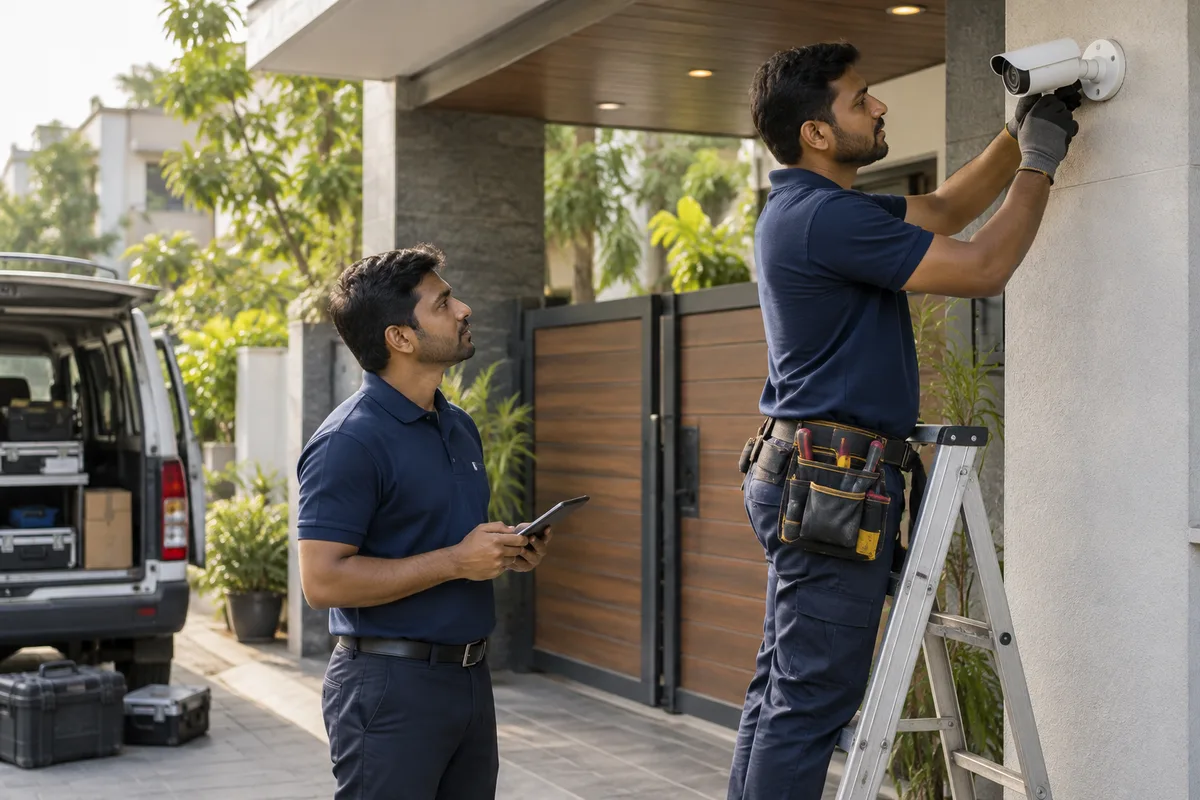
Camera mounts, dressed cable runs and recorder cabinets, published with the customer's permission and with shop boards and door numbers kept out of shot.
Result: The work is visible and nobody's premises are advertised.
A site that opens on mobile data
Page weight, images and load time fixed for a phone on a market street, since that is where the search after an incident is made.
Result: The buyer reaches your number instead of going back.
Reporting by page and locality
Search traffic and enquiries by building type and locality, set against the baseline recorded before work began.
Result: You can see which locality is worth another page.
How the result is measured
- Ranking positions
- Organic traffic
- Enquiries from organic search
Recorded as a baseline before work starts, so every later report has an honest comparison.
Searches your customers type
What a shop owner or society secretary types before calling an installer, and the page that answers it.
- CCTV camera installation for shop price
- A shop page. Say what a package contains: cameras, recorder, storage, cabling and installation. List what the site survey checks and what changes the quote, such as wiring distance.
- apartment CCTV installation for association
- An apartment page. Describe the scope across blocks, who maintains the system, how a committee receives a quote and what the residents may see. Show an anonymised example.
- CCTV installation near me in Whitefield
- A locality page for areas your technicians reach. Name the roads and landmarks, show real installation photographs without exposing a customer, and give a way to book a survey.
- IP camera vs analogue camera
- An explainer for an owner with old cameras. Say what an upgrade involves, what can be reused and when it is not worth it. Honest advice brings the follow-up call.
- CCTV AMC for factory
- An AMC page. State what is covered, what is excluded, how spares are treated and how a fault is reported. Give a response commitment only if you keep it every time.
- CCTV with mobile app viewing for home
- A home page. Explain remote viewing, who controls access, where recordings are stored and for how long. Say what happens to a recording if the internet fails.
Who it is for
This is written for these CCTV and security system installers.
- CCTV installers serving homes and shops
- Security system integrators for businesses and factories
- Apartment and gated community security installers
- Access control and biometric attendance providers
- Intrusion alarm and video door phone installers
- Authorised dealers and distributors of camera brands
- IT and networking firms adding surveillance
- AMC and service-focused security companies
Not for
It is not the right fit if.
- You have no finished installations you can photograph, so building pages would show a buyer nothing to trust
- Your team does not reach the localities you would name, so locality pages would draw calls you cannot serve
How it works
How the search engine optimisation work runs
The work itself, in order. How an engagement starts, from your brief to a written scope, is set out on our method page.
- 1
Audit and baseline
We record where the site stands today: positions, traffic, technical faults and the enquiries search currently produces. Nothing starts until this number is written down.
- 2
Decide what to rank for
We map the searches your buyers use, in your words and theirs, and pick the ones worth the effort for your margin and your capacity.
- 3
Fix the foundations
Technical faults first, because the cheapest gains are there. Then the Business Profile and directory consistency.
- 4
Build the pages
A page for each thing you do, written to answer the question it is searched for, with a clear next step at the end.
- 5
Publish and earn mentions
Content goes out on the calendar. Links and mentions are earned from real relationships, not bought.
- 6
Measure, report, adjust
At an interval agreed in writing we report what moved and what did not, and change the plan when the numbers say so.
Where this fits
Three pieces of sales work, in this order.
This work sits inside sales process design, at stage 1, prospecting and lead generation. The audit comes before it, and sales management keeps it running.
Step 1
Sales audit
Find where deals are being lost and what to fix first.
Start here if you cannot say where orders are lost.
Step 2 · you are here
Sales process design
One written way to sell, from first enquiry to repeat order.
Start here if every salesperson sells differently.
Step 3
Sales management
A target, a review routine and someone who owns the number.
Start here if the team has targets and no routine.
FAQ
Questions owners ask before they call.
Not here? More answers, or ask on WhatsApp.
Do we need a separate page for every area we cover?
How long before search starts bringing enquiries?
Should we list camera brands by name?
Who should hold the Maps listing, the owner or the office staff?
How much does it cost?
How long is the contract?
Who will actually do the work?
What do you need from us?
What if we are not happy with the work?
From the blog
Further reading for CCTV and security system installers.
 6 min read · 23 Jul 2026Local search for niche trades: what to put on the profile and websiteA niche trade is found when its Google profile and website name the exact service, the area served and show photos of real work. This post lists what to write, what to upload and what to leave out.
 6 min read · 9 Jul 2026Quoting after a site visit: a one-page format that gets signedA one-page quotation with scope, price, exclusions and a next step is easier to approve than a long document. This post gives the layout, a worked example and the mistakes to avoid.
 6 min read · 16 Jun 2026Annual maintenance contracts: how a specialist trade turns a job into recurring workAn annual maintenance contract works when it offers scheduled visits with a clear scope after the job and a recorded due date. This post covers what to offer, when to offer it and how to track renewals.
More for CCTV and security system installers
Everything else we would do for you.
Closest to this: search and visibility
Also for CCTV and security system installers
- PPC ads for CCTV and security system installers
- Lead generation for CCTV and security system installers
- Digital marketing for CCTV and security system installers
- Reputation management for CCTV and security system installers
- Branding for CCTV and security system installers
- Social media for CCTV and security system installers
Or start from the overview: sales and marketing for CCTV and security system installers.
Your next practical step
Tell us what you are trying to grow, and we will read it before we call.
Eight short steps, mostly taps. Skip anything you would rather answer on the call.