Environmental testing laboratories · Content marketing
Write the guide the plant officer wishes the last lab had sent before the visit.
Content marketing for an environmental testing laboratory is the writing that answers the questions plants ask before they book a sampling, such as what to prepare and how to read a report. GullySales works on guides, checklists and sample reports that your team can stand behind.
Scope, fee, reporting and term are agreed in writing after we have read your brief and spoken to you.
What content marketing means
Content marketing is writing articles, guides and pages that answer the questions buyers search before they are ready to enquire. This makes your business visible and trusted before the first call. GullySales plans this content from the first conversation onward, choosing topics that match real search demand rather than guesses.
Also for environmental testing laboratories
- Social media marketing for environmental testing laboratories
- Lead generation for environmental testing labs
- SEO for environmental testing laboratories
- Local SEO for environmental testing laboratories
- Buyer personas for environmental testing laboratories
- CRM for environmental testing laboratories
- Follow-up systems for environmental testing laboratories
- WhatsApp marketing for environmental testing laboratories
Sales and marketing for environmental testing laboratories, the overview.
Last updated 18 Oct 2026.
For environmental testing laboratories
Where it usually goes wrong, and what we would do.
“The first question is what to prepare”
An officer new to the role does not know the number of bottles, what preservative or which sampling point the lab will want. A checklist written by the lab saves back-and-forth and shows competence.
“Reading a report is a skill buyers lack”
Units, limits, methods and detection levels confuse a first-time reader. A guide that walks through a sample report builds trust and makes a query on a figure less alarming.
“Never write what the board requires as fact”
Requirements differ by state and authority and change. Content that explains the test and the report, and tells the reader to confirm requirements with the board or a consultant, stays accurate.
“Case studies need care”
A plant rarely agrees to be named. Describe the type of problem and the approach, with the client's written permission for anything specific, and leave out results that suggest guarantees.
What we do
What we deliver for environmental testing laboratories.
Every deliverable, what it covers for you, and the result it is there to produce. Nothing here is an extra.
A sampling preparation checklist
A one-page list per test of what the plant should arrange before the sampler arrives.
Result: The sampler arrives to a site that is ready.
A report reading guide
An annotated sample report explaining each section in plain words.
Result: A first-time reader can follow the report.
A set of test explainers
Short pages covering what each test measures, why plants commission it and how samples are taken.
Result: Search and consultants both have something to link to.
A consultant brief
A document describing your scope, booking arrangements in the lab's own words and the contact for urgent queries.
Result: Consultants can describe you accurately.
A review rota for your quality manager
Every piece read against the accreditation scope before it is published.
Result: Content stays inside what the lab can claim.
How the result is measured
- Pages published
- Organic traffic
- Enquiries from content pages
Recorded as a baseline before work starts, so every later report has an honest comparison.
Posts and pieces to plan
Plan guides a plant officer reads before booking a sample.
- Preparing for a stack monitoring visit
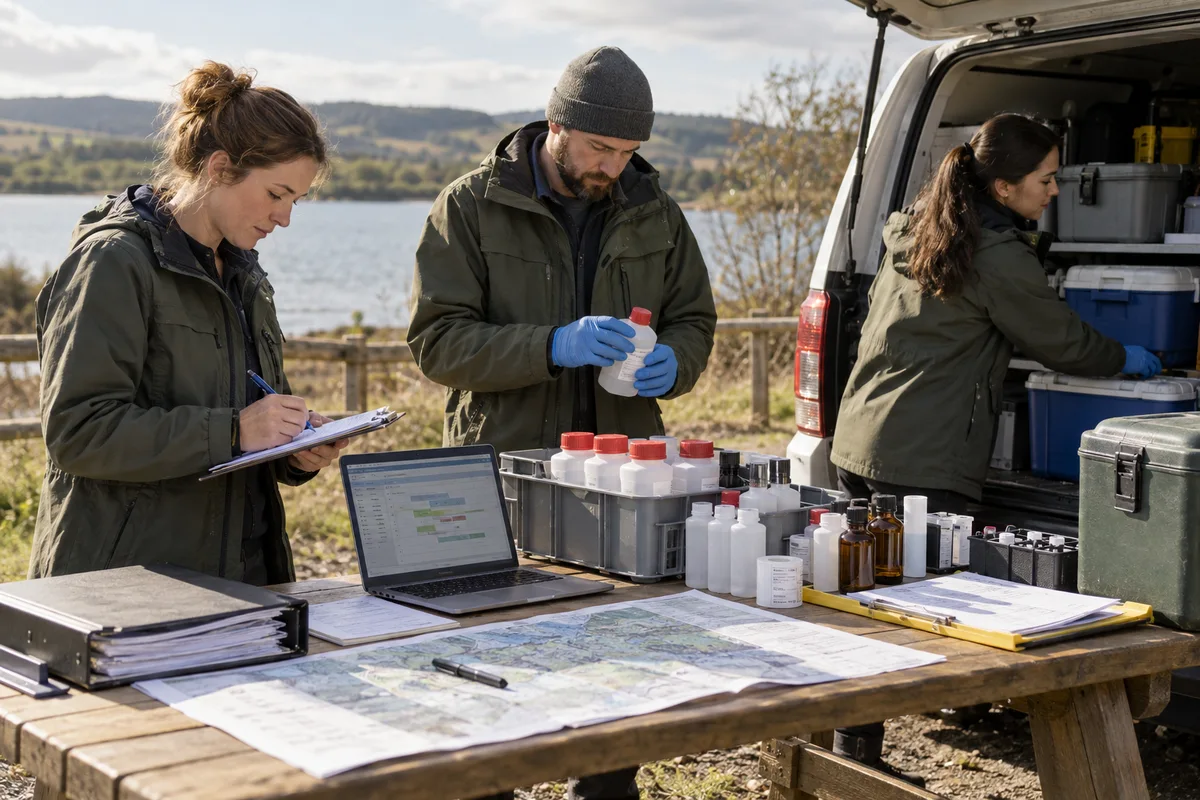
- A checklist of the sampling port, the access, the platform and the process load. Written with the field lead, because they know what is missing on the day.
- How to collect a water sample
- A guide for the plant's own staff, covering bottle, preservative, label and handing over. Printable, so it goes on the notice board.
- Reading your report
- A walk through the sections, units and remarks of a masked report. It answers the call a buyer would otherwise make.
- What a baseline study needs from a lab
- A brief for consultants on matrices, sampling points and data format. Linked to a consultant page and a contact route.
- Why a sample is rejected
- A piece on the reasons a lab turns a sample away, such as wrong container or late arrival. Spares the plant a repeat visit.
Who it is for
This is written for these environmental testing laboratories.
- Water and wastewater testing laboratories for factories and housing societies
- Stack emission and ambient air monitoring agencies
- Soil, sludge and hazardous waste testing laboratories
- Noise, workplace air and occupational hygiene monitoring firms
- Drinking water laboratories serving packaged water, hotels and hospitals
- Laboratories that support consultants with baseline data for clearances
- Mobile and field laboratories that sample at the site
- Laboratories that serve a single industrial cluster such as textile, pharma or food
Not for
It is not the right fit if.
- Your quality manager has no time to review pieces, and a guide with a wrong method would be quoted back to you by a plant officer.
- You cannot publish a sample report even masked, so a guide on reading one would have nothing to show.
How it works
How the content marketing work runs
The work itself, in order. How an engagement starts, from your brief to a written scope, is set out on our method page.
- 1
Agree the plan
Topics and formats come from the content strategy and the buyer-question list. The volume goes into the written scope, agreed with you, not into a number quoted on a call.
- 2
Brief and draft
Each piece starts from its one-page brief and a short conversation with your technical person, recorded if they allow it, so the draft uses their words.
- 3
Check the facts
Your person marks the draft for accuracy and we correct it. Regulated subjects also go to your own adviser, because restrictions on claims apply to articles as much as to advertisements.
- 4
Publish and distribute
The piece goes live on your site, then out through the channels where your buyers already are.
- 5
Read the enquiries and adjust
Results are reported against the baseline recorded before work began. Topics that brought readers but no enquiries are changed or dropped. How often you are reported to is agreed in writing.
Where this fits
Three pieces of sales work, in this order.
This work sits inside sales process design, at stage 0, foundation. The audit comes before it, and sales management keeps it running.
Step 1
Sales audit
Find where deals are being lost and what to fix first.
Start here if you cannot say where orders are lost.
Step 2 · you are here
Sales process design
One written way to sell, from first enquiry to repeat order.
Start here if every salesperson sells differently.
Step 3
Sales management
A target, a review routine and someone who owns the number.
Start here if the team has targets and no routine.
FAQ
Questions owners ask before they call.
Not here? More answers, or ask on WhatsApp.
Who in the lab should review content?
How do we avoid copying competitors?
How do we avoid copying a competitor's guide?
Can we publish a client's results as a case?
How much does it cost?
How long is the contract?
Who will actually do the work?
What do you need from us?
What if we are not happy with the work?
More for environmental testing laboratories
Everything else we would do for you.
Closest to this: content and social
Also for environmental testing laboratories
Or start from the overview: sales and marketing for environmental testing laboratories.
Your next practical step
Tell us what you are trying to grow, and we will read it before we call.
Eight short steps, mostly taps. Skip anything you would rather answer on the call.