Water purifier manufacturers · Dealer lead generation
A household enquiry should reach the dealer who stocks that purifier.
Dealer lead generation for a purifier brand means turning a household's search or toll-free call into an enquiry that lands with the nearest active dealer, picked by pin code. GullySales builds the town pages, the dealer locator and the routing rule, then sets up the record that shows whether the dealer rang back.
Scope, fee, reporting and term are agreed in writing after we have read your brief and spoken to you.
What dealer lead generation means
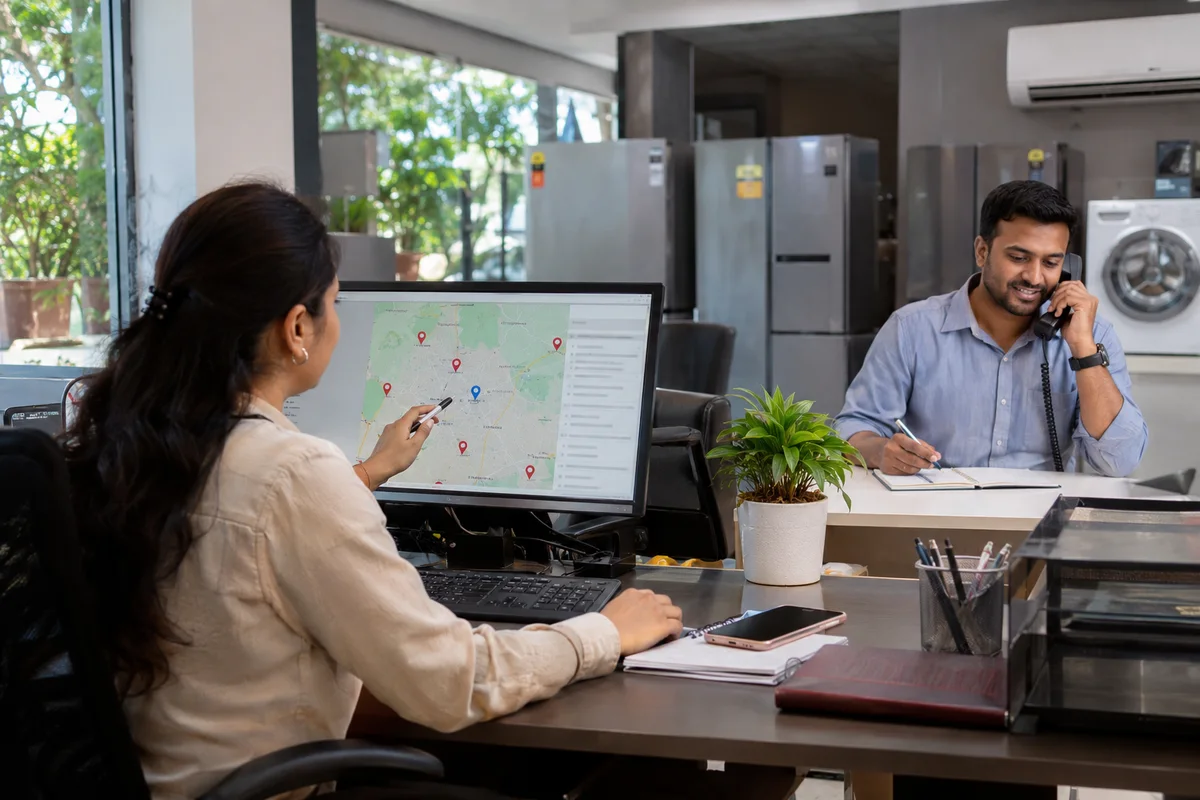
Dealer lead generation brings end-customer enquiries to a manufacturer's dealers through city pages and a dealer locator, then routes each enquiry to the nearest active dealer by pin code. GullySales builds the pages and the routing rule, sets up the record of whether the dealer called, and prepares the escalation path you approve.
Also for water purifier manufacturers
- Outsourced dealer sales support for water purifier manufacturers
- Lead generation for purifier manufacturers
- SEO for water purifier manufacturers
- Social media marketing for purifier brands
- Content marketing for purifier manufacturers
- Buyer personas for purifier manufacturers
- CRM for purifier manufacturers
- Follow-up systems for purifier manufacturers
Sales and marketing for water purifier manufacturers, the overview.
Last updated 14 Nov 2026.
For water purifier manufacturers
Where it usually goes wrong, and what we would do.
“The enquiry goes to a dealer who closed last season”
A dealer list kept in a spreadsheet drifts. Shops shut, owners switch to another brand, two dealers claim one town. A household that fills in a form gets passed to an outlet that no longer answers, and the brand is blamed for the silence.
“Borewell and hard-water searches land on a model table”
Someone searching for a purifier for borewell water wants to know which type suits the supply, and where to see it. A page of specification rows answers neither question, so the visitor leaves for a marketplace listing.
“Online enquiries make dealers feel bypassed”
When the brand collects household leads and keeps them, the dealer sees the website as a rival. Passing the enquiry on with the dealer's name on it turns the same website into a source of customers for the shop.
“Nobody records whether the dealer called”
A lead sent to a dealer and never followed up is worse than no lead, because the household has already been promised a call. Without a log, the sales head hears about it only when the customer complains.
What we do
What we deliver for water purifier manufacturers.
The work available for this need. We agree the deliverables and responsibilities for your engagement in writing.
Town pages with local detail
One page for each town you serve, listing the dealers, the models they stock and who handles installation and service, confirmed by your channel team rather than copied from town to town.
Result: A household in the town finds a named shop and a service contact on one page.
Dealer locator from your master sheet
A pin code search over your dealer list, with an active or paused status that your channel team controls.
Result: A paused or closed outlet stops appearing as soon as your team changes its status.
Water-source enquiry form
A short form asking for name, mobile number, pin code and the source of the household's water, with a consent line naming the dealer who will receive the details.
Result: The dealer opens the call knowing whether the household has borewell, tanker or municipal water.
Written routing rule
A one-page rule for which dealer gets which pin code and what happens where two shops share a town. Your channel head approves it before any enquiry is sent.
Result: Any disputed enquiry can be settled by pointing to the rule.
Dealer call-back log
A simple record of each enquiry sent, the time it reached the dealer and the outcome the dealer reports.
Result: The sales head can see which dealers rang back and which stayed silent.
Escalation path for silent dealers
A step-by-step note for what happens when an enquiry sits unanswered, ending with a call from your area sales executive.
Result: A neglected enquiry has a named person to chase it.
How the result is measured
- Locator searches and enquiry form submissions by town
- Routed enquiries, separate from enquiries received
- Time from enquiry to the dealer's first logged call
Recorded as a baseline before work starts, so every later report has an honest comparison.
Who it is for
This is written for these water purifier manufacturers.
- RO, UV and UF household purifier brands selling through retail dealers
- Brands selling under a private label to kitchen appliance chains
- Commercial and office purifier makers for canteens, schools and clinics
- Under-sink and wall-mounted purifier makers focused on online sales
- Hot and cold dispenser manufacturers for offices
- Assemblers that supply units to regional brands and distributors
- Purifier brands with a franchise or exclusive dealer model
- Makers of domestic water softener and purifier combinations
Before you decide
Agree the work. Know how to judge it.
Dealer lead generation for water purifier manufacturers: use these checks to prepare, choose the scope, and review what changes.
Bring the right evidence
Map existing partners, their territories, and the customers they serve. Review active selling and repeat orders separately from the number of partners signed up.
Make the scope clear
Agree partner fit, territory rules, onboarding, and support responsibilities. Clarify how direct enquiries and partner enquiries are assigned before starting recruitment.
Check the work in use
Follow a partner enquiry through to an order and the next purchase. Check whether the partner has the product knowledge and material needed to sell without repeated intervention.
Know when to change course
If current partners cannot sell because supply or support is weak, resolve that before recruiting more. A bigger network can spread the same problem further.
These are discussion points, not a fixed package. GullySales confirms the deliverables, responsibilities, fee, and term in writing after reading your brief and speaking with you.
Before we start
What to have ready before the work starts.
The records, access and decisions this work needs from water purifier manufacturers. Anything missing is noted in the written scope, with who will supply it.
- The dealer master sheet with territories
- The sheet must show each dealer's town, pin codes and whether the dealer is active. It can be rough. Where territories overlap, the area manager lists the overlap so the routing rule can settle it. Dealers who sell several brands should be marked, because they may stock your model only on request, and a lead routed to them may meet an empty shelf.
- Last season's forwarded leads
- Records of leads forwarded to dealers show who answered. A message trail or a sheet will do. Without them, the first call-back log becomes the baseline and the early readings are marked provisional. Even a partial trail helps: ten forwarded messages with the dealer's reply, or the lack of one, tell us how the old method behaved.
- The area manager's list of silent dealers
- The area manager knows who has stopped responding. A short list with names is enough. If no list exists, silent dealers are identified from the first live weeks of the log.
- A statement of the dealer's margin position
- Dealers accept brand enquiries only if their margin is not undercut. A note from the sales head on online price policy is enough. It should say whether a household that finds a model online is sent to a dealer, or is allowed to buy from the marketplace and be served by a company installer. Without it, enquiry pages show no price and refer the buyer to the dealer.
- A named person to chase silent dealers
- The escalation path needs somebody with authority over dealers. The area manager or sales coordinator will do. Until a person is named, the path stops at a report to the sales head.
How it works
How the dealer lead generation work runs
The work itself, in order. How an engagement starts, from your brief to a written scope, is set out on our method page.
- 1
Go through the dealer sheet town by town
We sit with your area managers and read the dealer master sheet line by line: town, pin code, whether the shop still stocks the purifier, and whether it answered the last forwarded lead. Shops that closed last season are struck off or flagged. You settle every doubt, including whether a shop that sells one brand of purifier beside a pharmacy counter still counts as a dealer. When we finish we hold a clean list marked active, silent or closed.
- 2
Decide who gets a lead when two dealers qualify
Two dealers in one town will both claim the enquiry. Together with your sales head we write the routing rule: nearest by pin code, then stock, then recent call-back record. Exceptions are written down. You decide the order, and the rule is signed before any page goes live. The sheet also states what happens when the first dealer does not respond, and who tells the second dealer that a lead has passed to them. A lead that moves silently from one shop to another is the surest way to start an argument between neighbours.
- 3
Build the town pages and the locator
Town pages carry local detail such as the common water complaint in that area and the dealer shown. The locator is drawn from the clean list. The enquiry form asks the water source first, since a household searching for a borewell fix needs a different answer than one asking about a tap. Your technical head approves the wording.
- 4
Brief the dealers and trial with a few
Dealers hear about the new flow from the area manager, not from a stranger, ideally at a dealer meet or on the visit already planned. We prepare a short briefing note in their language and explain what the brand will send and what is expected back. Three or four dealers take enquiries first, chosen to include one busy town shop and one that has been slow to answer before. You decide which dealers join the trial, and we listen to their complaints.
- 5
Turn on live routing with the call-back log
Once the trial dealers confirm the flow works, routing goes live for the rest of the list. Each enquiry is logged with its source, dealer and whether the dealer called back. The escalation path starts to work for dealers who stay silent, so that a lead left unanswered is raised with the area manager and then with the sales head. You decide who in your team reads the log and acts on gaps.
- 6
Read the call-back record against the old list
We set the new log beside the baseline drawn from the old sheet, showing how many enquiries now reach a dealer who answered, and which towns still have none. You decide which dealers to retain, warn or replace. We report the record as it stands and make no promise about enquiry volumes.
Where this fits
Three pieces of sales work, in this order.
This work sits inside sales process design, at stage 1, prospecting and lead generation. The audit comes before it, and sales management keeps it running.
Step 1
Sales audit
Find where deals are being lost and what to fix first.
Start here if you cannot say where orders are lost.
Step 2 · you are here
Sales process design
One written way to sell, from first enquiry to repeat order.
Start here if every salesperson sells differently.
Step 3
Sales management
A target, a review routine and someone who owns the number.
Start here if the team has targets and no routine.
FAQ
Questions owners ask before they call.
Not here? More answers, or ask on WhatsApp.
Will dealers accept enquiries coming from the brand's website?
What if two dealers in one town both want the enquiry?
What if a dealer asks to see every enquiry the brand receives?
How do we add a new dealer to the locator?
How much does it cost?
How long is the contract?
How soon will we see results?
Who will actually do the work?
What do you need from us?
What if we are not happy with the work?
More for water purifier manufacturers
Related work to consider.
Closest to this: channels and partners
Also for water purifier manufacturers
Or start from the overview: sales and marketing for water purifier manufacturers.
Your next practical step
Tell us what you are trying to grow, and we will read it before we call.
Eight short steps, mostly taps. Skip anything you would rather answer on the call.