Electronic components distributors · Local SEO
Be the counter a buyer finds on the map when a part is needed today.
Local SEO for a components distributor is making your shop, your market lane and your stock show up when an engineer or technician searches near me for a part. GullySales works on the map listing, the city pages and the stock details a nearby buyer checks before making the trip.
Scope, fee, reporting and term are agreed in writing after we have read your brief and spoken to you.
What local SEO means
Local SEO is the work of making your business show up for searches that name your town or locality, such as a service plus an area name. GullySales sets up locality pages, local citations and map listings so nearby customers find you before a competitor across town.
Also for electronic components distributors
- SEO for electronic components distributors
- Website development for electronic components distributors
- Lead generation for electronic components distributors
- Email marketing for electronic components distributors
- CRM for electronic components distributors
- WhatsApp marketing for electronic components distributors
- Sales process for electronic components distributors
- Sales management for electronic components distributors
Sales and marketing for electronic components distributors, the overview.
Last updated 6 Oct 2026.
For electronic components distributors
Where it usually goes wrong, and what we would do.
“The nearby search is a stock question”
A technician with a dead board does not search for a distributor. They search for a part and a place. If your listing names no products, the map shows a shop and the buyer calls the one that does.
“Market-lane names are how buyers think”
Buyers speak of an electronics market, a lane or a nearby landmark, not your postal address. A listing that gives only a street number hides the shop from the people who know the area by its name.
“A call from the map needs a person who can answer it”
The listing sends the buyer to the phone. If the counter cannot say within one call whether the part is on the shelf, the buyer moves to the next number on the map and does not call back.
“Reviews from buyers read differently here”
A reviewer who writes that the part was genuine and the GST invoice came with it tells the next buyer more than a star rating. A review that says only good service tells them nothing about stock.
What we do
What we deliver for electronic components distributors.
Every deliverable, what it covers for you, and the result it is there to produce. Nothing here is an extra.
Map listing built around what you stock
The business name, hours, services and product lines set out the way a buyer searches, with brands and part families named plainly.
Result: The listing answers what you sell before anyone phones.
City and market-lane pages
One page for each city or electronics market you serve, stating the lines held, pickup and courier options, and how to reach the counter.
Result: A search for components in your city lands on a page about your counter.
A reply routine for map calls and messages
A short script for the person who picks up: ask the part number, check the shelf, state the stock and the source, and note the caller.
Result: Every map enquiry is logged with a part number and an outcome.
Review requests tied to genuine invoices
A polite ask sent to the buyer after an order, naming what they bought, with no incentive offered.
Result: Reviews mention parts and invoices, not only service.
Photographs of the counter and the shelf
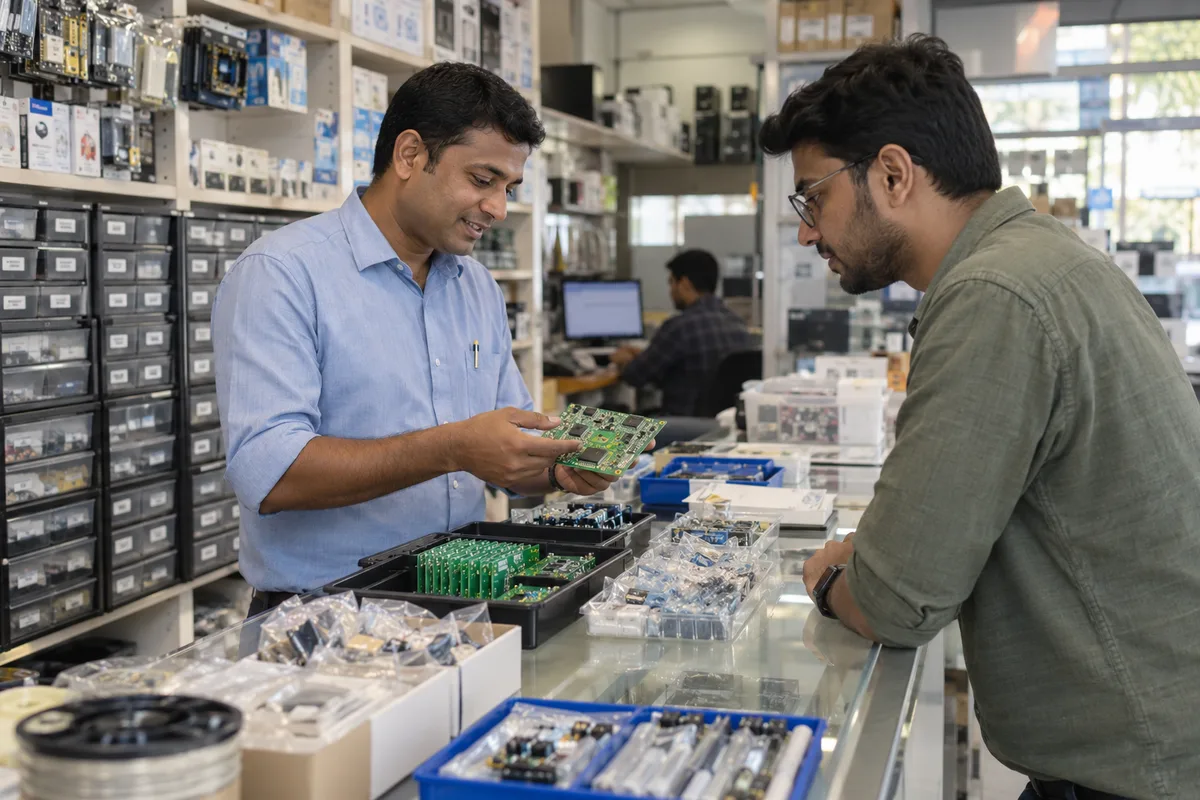
A set of real images of the shop front, the shelf and the packing area, taken so a first-time buyer can recognise the place.
Result: A buyer arriving from the map finds the right door.
How the result is measured
- Map pack ranking
- Local search visibility
- Enquiries by locality
Recorded as a baseline before work starts, so every later report has an honest comparison.
Searches your buyers type
Answer the nearby search with what is on the shelf now.
- electronic components shop near me
- A map listing built around the product lines you hold, with the counter, the market lane and the hours exactly as they are.
- Lamington Road electronic components
- A market-lane page naming the lane, a landmark and the way in, because buyers think in lane names and not in street addresses.
- Arduino and sensor modules store open now
- A page and listing entry for modules and boards, for a student or maker who needs a part today.
- IC and capacitor supplier call
- The phone number on the listing answered by a person who can check stock, since a call from the map expects an immediate reply.
- components shop with courier delivery
- A delivery line in the listing and a page on couriered parts, for the buyer outside your city who finds you on the map.
Who it is for
This is written for these electronic components distributors.
- Authorised distributors for one or two brand lines
- Multi-brand stockists of ICs, passives and connectors
- Independent and excess-stock traders
- Development board, module and sensor suppliers for startups and colleges
- BOM sourcing and kitting firms for contract manufacturers
- Repair spares and service parts counters
- Relay, transformer, battery and power component suppliers
- Importers who source against a customer's RFQ
Not for
It is not the right fit if.
- Nobody can answer a call from the map during opening hours, and a listing that attracts calls would lose them.
- Your opening hours change and no one updates the listing, so a buyer would arrive at a shut counter.
- You sell only through courier to other cities and have no counter anyone can walk into.
How it works
How the local SEO work runs
The work itself, in order. How an engagement starts, from your brief to a written scope, is set out on our method page.
- 1
Write down what is true
Each branch's real address, signboard name, phone, hours and owning Google account go into one record you sign off. Every later listing is copied from it.
- 2
Search as your buyer does
We search each branch on a phone from points around it, in your buyers' words, and note who appears with what reviews and photos.
- 3
Fix the profile first
Ownership first, then name, address, pin, phone, hours and business type. Google can suspend a profile with extra words in its name or an address that is not a real premises.
- 4
Build the branch pages and match the listings
Each real branch gets its own page, and the other listings are changed to agree with it. We write none for towns without a branch, because Google treats near-identical pages as doorway pages.
- 5
Ask, reply and measure
We agree with each branch who asks for reviews, when and how. Results are set against the baseline recorded before work began, and the branch that is behind gets the next round.
Where this fits
Three pieces of sales work, in this order.
This work sits inside sales process design, at stage 1, prospecting and lead generation. The audit comes before it, and sales management keeps it running.
Step 1
Sales audit
Find where deals are being lost and what to fix first.
Start here if you cannot say where orders are lost.
Step 2 · you are here
Sales process design
One written way to sell, from first enquiry to repeat order.
Start here if every salesperson sells differently.
Step 3
Sales management
A target, a review routine and someone who owns the number.
Start here if the team has targets and no routine.
FAQ
Questions owners ask before they call.
Not here? More answers, or ask on WhatsApp.
Should the listing show every part we stock?
We sell mostly by courier. Does a map listing still matter?
What if a competitor in the same lane copies our listing details?
Does the listing need our market lane named?
How much does it cost?
How long is the contract?
How soon will we see results?
Who will actually do the work?
What do you need from us?
What if we are not happy with the work?
From the blog
Further reading for electronic components distributors.
 6 min read · 6 Oct 2026How trade buyers pick a dealer when the brands matchWhen every counter in town carries the same brands, trade buyers choose on stock, delivery, paperwork and returns. This post sets out how contractors, electricians, plumbers and purchase managers compare dealers.
 5 min read · 6 Oct 2026How electronic components distributors answer a BOM enquiryAnswer a BOM in the buyer's own line order, saying for each part whether you hold it, how many, from which source and by what date, and send the firm lines before the open ones.
More for electronic components distributors
Everything else we would do for you.
Closest to this: search and visibility
Also for electronic components distributors
- Lead generation for electronic components distributors
- Email marketing for electronic components distributors
- CRM for electronic components distributors
- WhatsApp marketing for electronic components distributors
- Sales process for electronic components distributors
- Sales management for electronic components distributors
Or start from the overview: sales and marketing for electronic components distributors.
Your next practical step
Tell us what you are trying to grow, and we will read it before we call.
Eight short steps, mostly taps. Skip anything you would rather answer on the call.