Furniture stores and retailers · Local SEO
Be the showroom a customer finds on the map before the sofa is chosen.
Local SEO for a furniture store is the work of appearing in the map results and nearby searches of a customer who wants to see, sit on and measure a piece before paying for it. GullySales works on the showroom listing, the product range shown on it and the reviews that sit beside your name.
Scope, fee, reporting and term are agreed in writing after we have read your brief and spoken to you.

What local SEO means
Local SEO is the work of making your business show up for searches that name your town or locality, such as a service plus an area name. GullySales sets up locality pages, local citations and map listings so nearby customers find you before a competitor across town.
Also for furniture stores and retailers
- SEO for furniture stores and retailers
- Website for furniture stores and retailers
- Apartment advertising for furniture stores and retailers
- Branding for furniture stores and retailers
- Buyer journey mapping for furniture stores and retailers
- Buyer personas for furniture stores and retailers
- Content marketing for furniture stores and retailers
- Digital marketing for furniture stores and retailers
Sales and marketing for furniture stores and retailers, the overview.
Last updated 8 Nov 2026.
For furniture stores and retailers
Where it usually goes wrong, and what we would do.
“A sofa is bought by sitting on it”
The customer searches online for a three-seater, then wants to feel the cushion depth and fabric. That visit is a drive of some distance, so the nearest showrooms with the right range get the first look, and the listing decides who is on that list.
“The listing shows a shop, not what is on the floor”
A profile with one photograph of the signboard tells the customer nothing about dining sets, wardrobes or mattresses. Photographs of each floor section and the products listed on the profile let a nearby customer judge the range before leaving home.
“Several outlets fight each other in Maps”
A store with a main showroom, a warehouse outlet and a clearance shop can end up with listings that share a name and overlap. Maps then shows the wrong address, and the customer drives to a godown that does not sell to walk-ins.
“Reviews are read for delivery and fitting, not only the product”
A buyer scanning the stars looks for words about late delivery, damage in transit and carpenters who did not arrive. A listing with those complaints unanswered loses the visit to the next showroom, whatever the furniture looks like.
What we do
What we deliver for furniture stores and retailers.
Every deliverable, what it covers for you, and the result it is there to produce. Nothing here is an extra.
Showroom profile with floor sections as photographs
A separate set of photographs for the sofa area, bedrooms, dining, office furniture and kitchens, each labelled, with the product list on the profile matched to what is on display.
Result: A customer nearby can see your range before travelling.
One verified profile for each address
Showroom, warehouse outlet and any second branch are given their own profile, with walk-in rules, hours and phone line stated for each address.
Result: The customer is sent to the address that sells to the public.
Service area for delivery and fitting
The localities you deliver to and fit in, written on the profile and on a page for each, drawn from where your past orders actually went.
Result: A customer outside your delivery area is told before the visit, not after.
Replies to delivery and installation reviews
A written answer to each review that mentions delay, damage or fitting, naming the step that failed and what the store changed.
Result: A hesitant reader sees problems handled in public.
Review request at the point of handover
A short ask made when the furniture is installed and the customer is looking at the finished room, with the review link ready on the phone of the fitter or the delivery lead.
Result: New reviews come from customers whose furniture has arrived.
Directions, calls and website taps from the listing
The counts the profile itself reports, recorded before the work starts and read again afterwards, next to the walk-ins the showroom logs.
Result: You can compare listing activity with visits to the floor.
How the result is measured
- Map pack ranking
- Local search visibility
- Enquiries by locality
Recorded as a baseline before work starts, so every later report has an honest comparison.
Searches buyers type
Match each search a nearby buyer types to a listing that answers it.
- sofa showroom near me
- The showroom profile, with photographs of each floor section and a product list that matches what is on display.
- furniture showroom open Sunday near me
- Hours stated for each address, with a note on which address sells to walk-ins and which is a godown.
- mattress shop near me
- The bedroom section photographed and listed on the profile, so a nearby buyer can judge the range.
- modular kitchen showroom in Hyderabad
- A profile and a city page showing the kitchens on display and how to book a measurement visit.
- furniture store with home delivery
- The service area on the profile, listing the localities you deliver to and fit in.
- furniture showroom reviews
- Your replies to reviews that mention delay, damage or fitting, which show a reader how problems are handled.
Who it is for
This is written for these furniture stores and retailers.
- Modular kitchen and interior furniture retailers
- Sofa and living room furniture stores
- Bedroom and mattress retailers
- Office furniture suppliers
- Outdoor and garden furniture retailers
- Custom carpentry and made-to-order furniture makers
- Multi-brand furniture showrooms
- Online-first furniture retailers
Not for
It is not the right fit if.
- You have one address that is not open to the public, so a showroom listing would send people to a closed door.
- Nobody will answer reviews or questions, so an active listing would show only silence.
How it works
How the local SEO work runs
The work itself, in order. How an engagement starts, from your brief to a written scope, is set out on our method page.
- 1
Write down what is true
Each branch's real address, signboard name, phone, hours and owning Google account go into one record you sign off. Every later listing is copied from it.
- 2
Search as your buyer does
We search each branch on a phone from points around it, in your buyers' words, and note who appears with what reviews and photos.
- 3
Fix the profile first
Ownership first, then name, address, pin, phone, hours and business type. Google can suspend a profile with extra words in its name or an address that is not a real premises.
- 4
Build the branch pages and match the listings
Each real branch gets its own page, and the other listings are changed to agree with it. We write none for towns without a branch, because Google treats near-identical pages as doorway pages.
- 5
Ask, reply and measure
We agree with each branch who asks for reviews, when and how. Results are set against the baseline recorded before work began, and the branch that is behind gets the next round.
Where this fits
Three pieces of sales work, in this order.
This work sits inside sales process design, at stage 1, prospecting and lead generation. The audit comes before it, and sales management keeps it running.
Step 1
Sales audit
Find where deals are being lost and what to fix first.
Start here if you cannot say where orders are lost.
Step 2 · you are here
Sales process design
One written way to sell, from first enquiry to repeat order.
Start here if every salesperson sells differently.
Step 3
Sales management
A target, a review routine and someone who owns the number.
Start here if the team has targets and no routine.
FAQ
Questions owners ask before they call.
Not here? More answers, or ask on WhatsApp.
We have a good website but the showroom does not appear on Maps. Why?
Should the warehouse and the showroom share one listing?
Do we list every product on the profile?
How should we ask for a review?
How much does it cost?
How long is the contract?
How soon will we see results?
Who will actually do the work?
What do you need from us?
What if we are not happy with the work?
From the blog
Further reading for furniture stores and retailers.
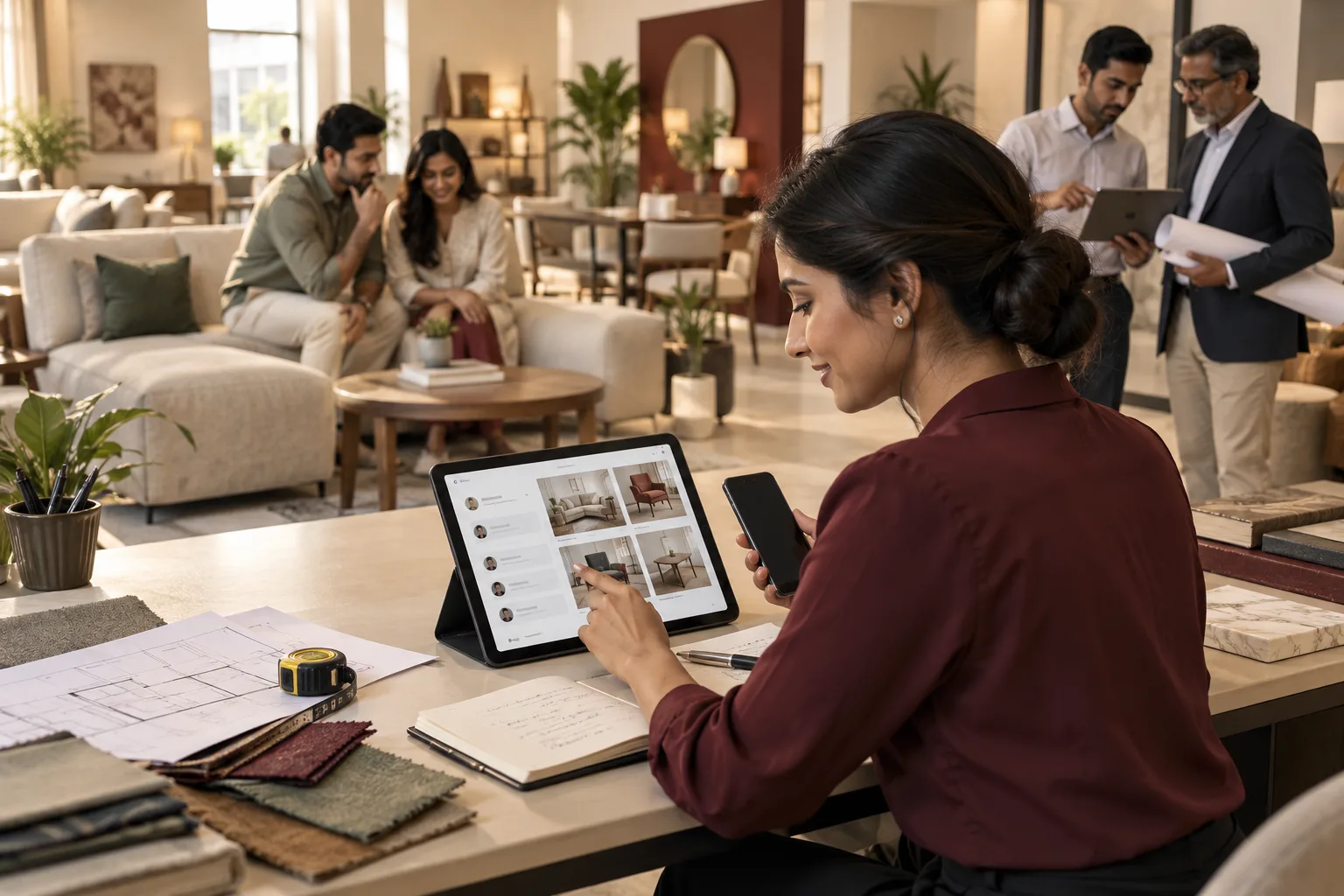 6 min read · 14 Jul 2026How to increase furniture sales when buyers take weeks to decideFurniture sells over several visits and several people. Capture every showroom visitor's number, follow up with the photographs and measurements they asked for, and work the builders and interior designers who send buyers.
 7 min read · 11 Mar 2025How to increase local brand awarenessPick the radius you can serve, then be unavoidable inside it and absent outside it. Maps, a consistent name, a physical presence on the roads people use, and a way to count whether it worked.
 8 min read · 21 Sept 2026Marathi advertising creative: what actually changesMarathi shares Devanagari with Hindi, so Hindi copy passes unnoticed until a Marathi reader spots it. What to change in register, spelling and proofs.
More for furniture stores and retailers
Everything else we would do for you.
Closest to this: search and visibility
Also for furniture stores and retailers
- Apartment advertising for furniture stores and retailers
- Branding for furniture stores and retailers
- Buyer journey mapping for furniture stores and retailers
- Buyer personas for furniture stores and retailers
- Content marketing for furniture stores and retailers
- Digital marketing for furniture stores and retailers
Or start from the overview: sales and marketing for furniture stores and retailers.
Your next practical step
Tell us what you are trying to grow, and we will read it before we call.
Eight short steps, mostly taps. Skip anything you would rather answer on the call.