Inverter, UPS and generator dealers · Local SEO
Be the shop on Maps when the lights have been off since morning.
Local SEO puts your shop on Google Maps for a buyer searching for an inverter dealer or battery shop nearby, with the brands, the services and your real hours. GullySales sets the categories and service area, adds installation photographs, and keeps the listing open when the outages are on.
Scope, fee, reporting and term are agreed in writing after we have read your brief and spoken to you.
What local SEO means
Local SEO is the work of making your business show up for searches that name your town or locality, such as a service plus an area name. GullySales sets up locality pages, local citations and map listings so nearby customers find you before a competitor across town.
Also for inverter, UPS and generator dealers
- SEO for inverter, UPS and generator dealers
- Websites for inverter, UPS and generator dealers
- PPC ads for inverter, UPS and generator dealers
- Lead generation for inverter, UPS and generator dealers
- Digital marketing for inverter, UPS and generator dealers
- Reputation management for inverter, UPS and generator dealers
- Branding and identity for inverter, UPS and generator dealers
- Social media marketing for inverter, UPS and generator dealers
Sales and marketing for inverter, UPS and generator dealers, the overview.
Last updated 5 Oct 2026.
For inverter, UPS and generator dealers
Where it usually goes wrong, and what we would do.
“The service area is how far your technician will drive”
A listing covering the whole city brings calls your team cannot reach the same day, and a same-day visit is the whole reason this buyer called.
“Battery replacement is its own search”
Someone searching for a battery shop nearby wants a replacement today, and listing that as a service catches an enquiry a dealer category never will.
“Photographs of installations beat photographs of stock”
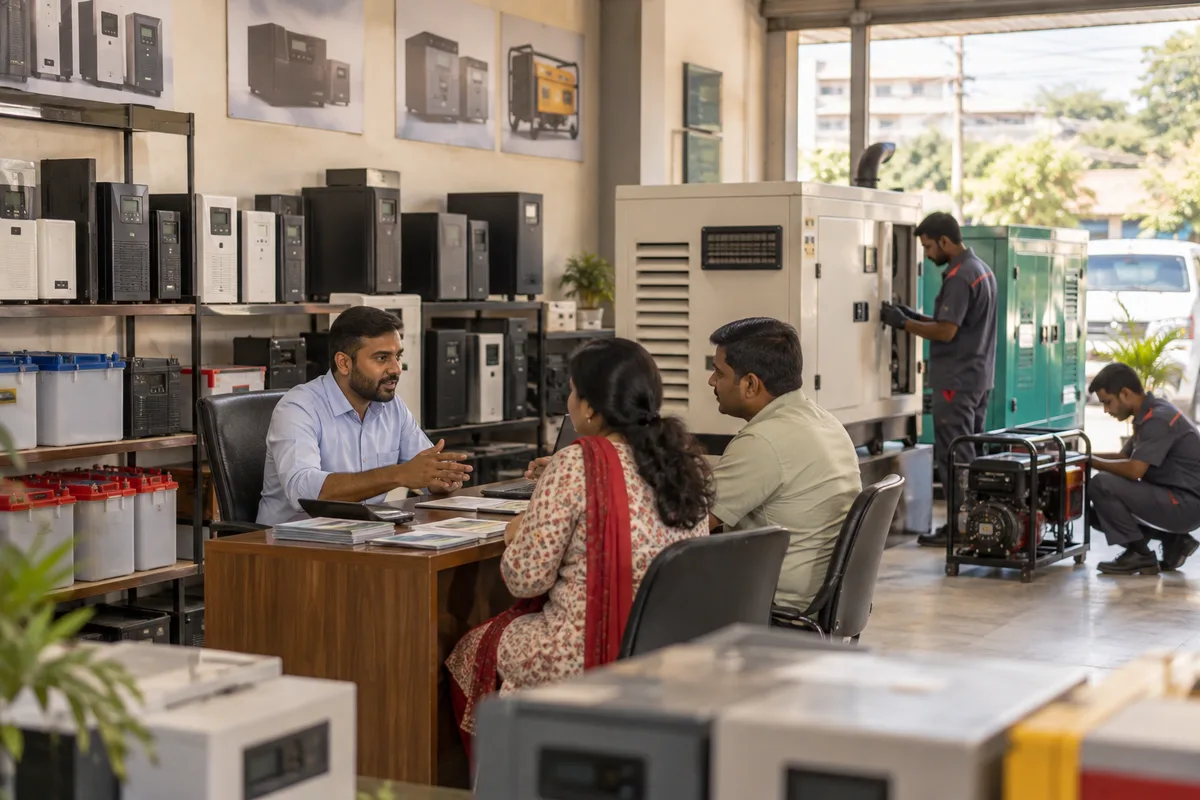
A wall of boxes tells a buyer nothing, while a mounted inverter with tidy wiring in a real home shows the work they are buying.
What we do
What we deliver for inverter, UPS and generator dealers.
Every deliverable, what it covers for you, and the result it is there to produce. Nothing here is an extra.
Categories set to what you sell and service
Categories covering inverter dealer, battery shop, generator supplier and electrical repair, matched to the work you take.
Result: The listing appears for the right searches.
Services entered one at a time
Battery replacement, inverter installation, UPS servicing, genset AMC and stabiliser supply listed individually with their usual response time.
Result: A single service search finds your shop.
A service area drawn on travel time
The localities your technicians can actually reach the same day, listed instead of a whole-city radius.
Result: Calls come from where you can serve.
Installation photographs refreshed
Real home, office and industrial installations photographed with the customer's permission and added on a routine.
Result: A buyer sees the standard of your work.
Hours that hold during outage weeks
Actual hours including Sundays in peak season, with special hours set when the shop stays open late.
Result: Nobody calls a closed number in the middle of a cut.
How the result is measured
- Map pack ranking
- Local search visibility
- Enquiries by locality
Recorded as a baseline before work starts, so every later report has an honest comparison.
What Google weighs here
How a family or an office finds a power backup dealer nearby, and what to fix first.
- Battery shop against inverter dealer
- Choose between inverter supplier, battery store and generator dealer by where most income comes from. A battery-led shop adds the others as secondary categories.
- Capacity and brand as products
- List 150Ah tubular batteries, 3kVA online UPS or 10kVA generators with the brand names you really stock. A buyer searches the capacity and the brand together.
- Old battery exchange
- State whether you take the old battery back against a new one. This is the question asked before the call.
- Photographs of fitted units
- Show a fitted inverter on a shelf, a UPS in a clinic and a generator with its canopy. Fitted units show what the job really is.
- Justdial and IndiaMART
- Offices buying UPS check both. Keep name, godown or shop address and phone identical to the profile.
- Service for other brands
- Say whether you repair brands you do not sell. A customer with a dead battery from another shop searches for exactly that.
Who it is for
This is written for these inverter, UPS and generator dealers.
- Home inverter and battery dealers
- Online UPS dealers for offices, clinics and IT setups
- Diesel and gas generator dealers
- Solar hybrid inverter and battery dealers
- Battery replacement and service centres
- Generator rental and AMC providers
- Industrial power backup and stabiliser suppliers
- Multi-brand power backup stores
Not for
It is not the right fit if.
- Your godown is closed to visitors and you have no service van, so a Maps listing would show a place customers cannot use.
- Phone numbers and hours on your listing differ from the shop's real hours, which would only generate bad reviews.
- You have not decided which products and areas you serve, so the profile would claim more than you can deliver.
How it works
How the local SEO work runs
The work itself, in order. How an engagement starts, from your brief to a written scope, is set out on our method page.
- 1
Write down what is true
Each branch's real address, signboard name, phone, hours and owning Google account go into one record you sign off. Every later listing is copied from it.
- 2
Search as your buyer does
We search each branch on a phone from points around it, in your buyers' words, and note who appears with what reviews and photos.
- 3
Fix the profile first
Ownership first, then name, address, pin, phone, hours and business type. Google can suspend a profile with extra words in its name or an address that is not a real premises.
- 4
Build the branch pages and match the listings
Each real branch gets its own page, and the other listings are changed to agree with it. We write none for towns without a branch, because Google treats near-identical pages as doorway pages.
- 5
Ask, reply and measure
We agree with each branch who asks for reviews, when and how. Results are set against the baseline recorded before work began, and the branch that is behind gets the next round.
Where this fits
Three pieces of sales work, in this order.
This work sits inside sales process design, at stage 1, prospecting and lead generation. The audit comes before it, and sales management keeps it running.
Step 1
Sales audit
Find where deals are being lost and what to fix first.
Start here if you cannot say where orders are lost.
Step 2 · you are here
Sales process design
One written way to sell, from first enquiry to repeat order.
Start here if every salesperson sells differently.
Step 3
Sales management
A target, a review routine and someone who owns the number.
Start here if the team has targets and no routine.
FAQ
Questions owners ask before they call.
Not here? More answers, or ask on WhatsApp.
Does Maps bring generator enquiries too?
We have a godown, not a showroom. Can we still list?
Should we list brand names such as Luminous or Exide?
Customers ask about battery pick-up. Should we put it on the profile?
How much does it cost?
How long is the contract?
How soon will we see results?
Who will actually do the work?
What do you need from us?
What if we are not happy with the work?
From the blog
Further reading for inverter, UPS and generator dealers.
 6 min read · 6 Oct 2026Why power buyers hire the firm that explained the billHomes, societies and factories rarely plan to buy solar, a generator or an audit. This post shows how each buyer chooses between energy and utilities firms, and what the winner did first.
 5 min read · 8 Nov 2025Turning the technician into your best salesperson without upselling dishonestlyHow to train home service technicians to explain a finding, show the evidence and offer options in order of need, so customers decide freely and trust the firm more afterwards.
More for inverter, UPS and generator dealers
Everything else we would do for you.
Closest to this: search and visibility
Also for inverter, UPS and generator dealers
- PPC ads for inverter, UPS and generator dealers
- Lead generation for inverter, UPS and generator dealers
- Digital marketing for inverter, UPS and generator dealers
- Reputation management for inverter, UPS and generator dealers
- Branding and identity for inverter, UPS and generator dealers
- Social media marketing for inverter, UPS and generator dealers
Or start from the overview: sales and marketing for inverter, UPS and generator dealers.
Your next practical step
Tell us what you are trying to grow, and we will read it before we call.
Eight short steps, mostly taps. Skip anything you would rather answer on the call.