Organic food stores · Product label design
A refill jar of jaggery needs a label a shopper can trust at arm's length.
Product label design for an organic food store is the artwork for the labels on its own-brand jars, pouches, oil bottles and refill containers, where a household reads the name, the source and the declarations before it buys. GullySales draws each label for its container and reserves space for the text your certifying body confirms.
Scope, fee, reporting and term are agreed in writing after we have read your brief and spoken to you.
What product label design means
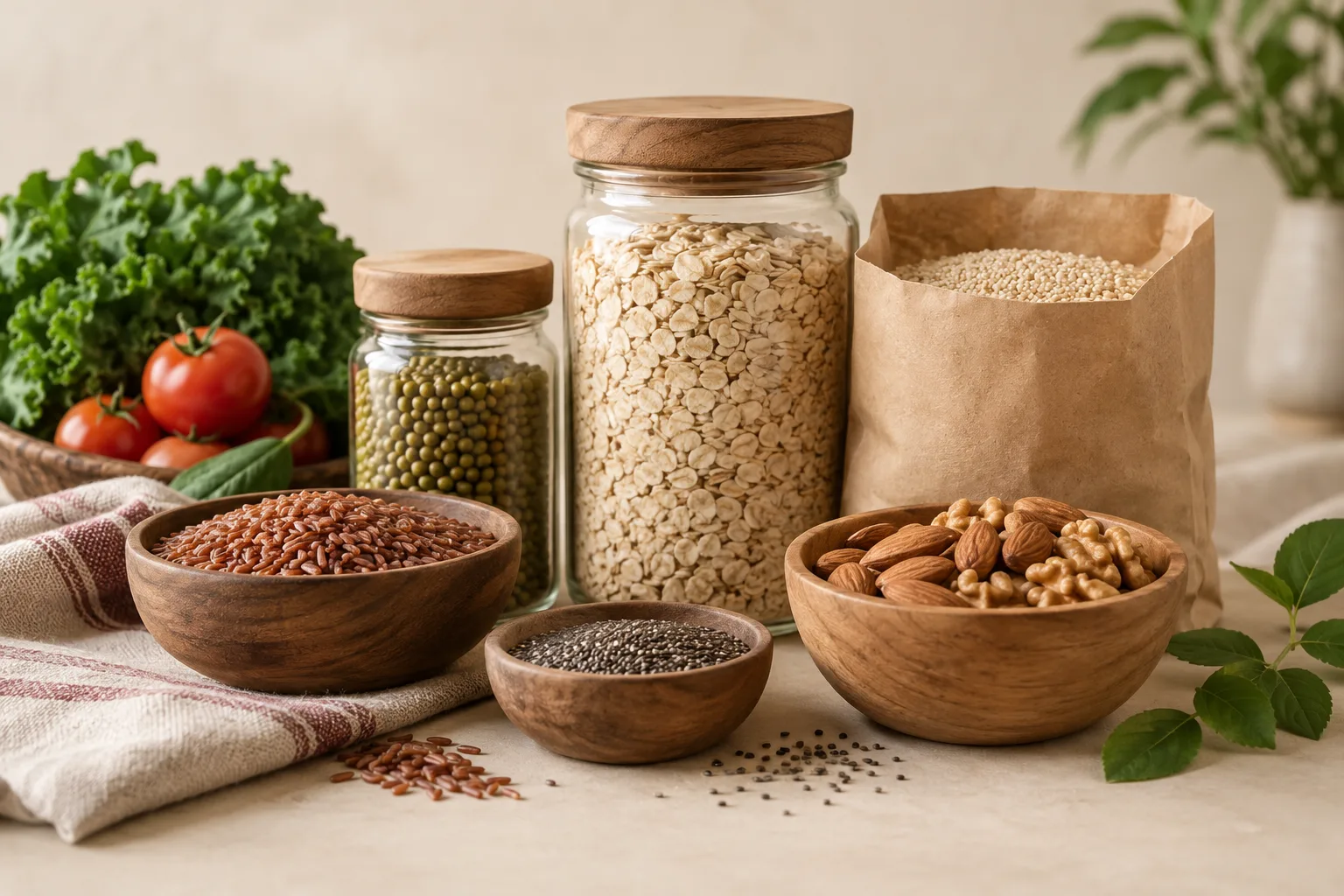
Product label design is the artwork for the printed label, sticker, wrap or sleeve that goes on a bottle, jar, tin, tube, bag or machine. GullySales draws the label for the surface it sits on, places the words you supply, reserves space for mandatory text and hands your label printer files with a specification sheet.
Last updated 14 Nov 2026.
For organic food stores
Where it usually goes wrong, and what we would do.
“Repacked staples carry the shop's name, not the farm's”
An organic store buys millets, pulses, jaggery and oils in sacks and tins, then packs them into its own jars and pouches. The label is the only thing standing between the shopper and a plain bag of grain. If it shows only a product name, the family has no reason to pay more. If it carries a clear source line and a place for the batch, the same bag reads as something the shop stands behind.
“The word organic is a claim with paperwork behind it”
A household that pays extra for organic food reads the label for proof. Which supplier grew it, which certificate covers it and which batch the jar came from are the questions at the counter. The wording belongs to the owner and the certifying body, not to the designer. The label has to leave room for those lines at a readable size, because squeezing them in last is how a shop ends up reprinting.
“Oil, damp and the refrigerator attack the material”
A cold-pressed oil bottle leaves a film on the shoulder where fingers grip it, and a jar kept in a damp kitchen lifts a paper label at the corner. A pulse pouch is handled with floury hands. Choosing the label material and finish for the place the product lives matters as much as the drawing, and the printer has to be told about the oil, the damp and the handling before files are made.
“A range of grains looks the same on a shelf”
Foxtail, little, kodo and barnyard millet sit side by side in near-identical jars. A packer who refills in a hurry, or a shopper who grabs the wrong one, trusts the label to separate them. A changing colour, a large name and a consistent position for the weight and the batch let a range read as a system, so a new grain can be added without redrawing every other label.
What we do
What we deliver for organic food stores.
The work available for this need. We agree the deliverables and responsibilities for your engagement in writing.
A label brief for each container
A short written brief records the container, its material and curve, the label stock, the place it is stored and the shelf or counter where it is read. You approve it before drawing begins, so a later change of jar or bottle is visible as a change to the scope.
Result: You can open the brief and see every container the labels were drawn for.
Directions for the front label
A few directions show the product name, the shop's mark and a place for the source line, drawn on the real jar, pouch or bottle shape. You choose one or combine two, and the chosen direction becomes the base for the whole range.
Result: One front-label direction is chosen and recorded in the brief.
A source and farm line layout
A defined place on the label for the farm group, the region or the supplier name, set in a size a shopper can read without turning the jar. The words come from your supplier records, and your certifying body or adviser confirms what may be said.
Result: The supplier line sits at the same position on every label in the range.
A reserved panel for declarations
A marked area holds the ingredient list, the certification mark where you are entitled to use one, the batch and date space and the barcode. GullySales sets the text you supply and does not write the declarations or decide which mark applies.
Result: Nothing mandatory is squeezed in after the front is finished.
Grain, oil and pulse variants from one system
Every product in the range is laid out from a single system with one clearly changing element, a colour band and a large name. A new millet or a new oil is added by changing that element, not by starting a new label.
Result: A packer can tell two neighbouring jars apart from across the counter.
Print-ready files and a printer sheet
Layered artwork, linked images, fonts supplied or outlined and colour references go to your label printer with a one-page sheet naming the material, the finish and the die line. The printer's proof is compared with the artwork before you approve printing.
Result: The printer's proof matches the artwork you approved.
How the result is measured
- Printer rejections or file queries on label jobs
- Labels reprinted for artwork errors
- Wrong-variant packing mistakes found at dispatch
Recorded as a baseline before work starts, so every later report has an honest comparison.
Who it is for
This is written for these organic food stores.
- Single-shop organic stores in residential localities
- Organic stores that also run a small cafe or a cold-press oil counter
- Farm-direct stores that source from one or two named farmer groups
- Millet and traditional grain shops
- Organic stores that sell by weekly basket or subscription
- Stores inside gated communities that deliver to residents
- Small chains of organic stores in one city
- Organic stores that supply restaurants, cafes and hostels
Before you decide
Agree the work. Know how to judge it.
Product label design for organic food stores: use these checks to prepare, choose the scope, and review what changes.
Bring the right evidence
Collect the sales presentation, website, quotations, and other material buyers actually see. Mark where the description of the business changes or where a claim has no supporting evidence.
Make the scope clear
Agree whether the work concerns the offer, the words, the visual identity, or all of them. List the formats that need updating and who owns the final approval.
Check the work in use
Test the proposed direction on a real sales page or proposal. A buyer should be able to tell who the offer is for, what is different, and what evidence supports it.
Know when to change course
A new identity will not fix an unresolved service problem. Put the delivery issue right before making a stronger public promise about it.
These are discussion points, not a fixed package. GullySales confirms the deliverables, responsibilities, fee, and term in writing after reading your brief and speaking with you.
Before we start
What to have ready before the work starts.
The records, access and decisions this work needs from organic food stores. Anything missing is noted in the written scope, with who will supply it.
- A sample of each container
- Curves, shoulders, seams and caps decide where text can sit. A real jar or a clear photograph with measurements is enough. Without it, the layout is built on a guess and the product name can land on a join the shopper cannot read.
- Supplier certificates and farm names
- A shopper who pays more for organic food looks for proof of origin. The certificates and the names of the farm groups let the source line say something true. When they are missing, the label stays generic and the shop loses the one thing that separates it from a supermarket shelf.
- The label printer's specification
- The die line, the material and the finish come from the printer. The artwork is drawn to that shape and checked against it. Without it, files are rejected for fit or bleed, and the store pays twice for a first batch that never leaves the printer.
- The final wording for declarations
- Ingredient lines, storage notes and the certification mark come from the owner and the certifying body. Near-final wording lets the space be sized properly. Placeholder text suits early directions only, because a later change in length moves the whole layout.
- One person who approves the label
- A label goes onto hundreds of jars and cannot be recalled by message. One named approver, with access to the certifying body or adviser, keeps the artwork from being edited in several hands. Without a name, approval stalls and print dates slip.
How it works
How the product label design work runs
The work itself, in order. How an engagement starts, from your brief to a written scope, is set out on our method page.
- 1
Gather the containers and the printer's die line
Work starts from the jars, pouches and bottles the store really uses, brought in or photographed with measurements, and from the die line your label printer supplies. If the container is not settled, it is agreed first, because every later decision follows its curve, its seam and its cap.
- 2
List every product and every variant
You supply the full list: each grain, each oil, each jaggery type, each pack size and the refill options. A late addition after approval can break the colour logic, so we ask for the whole range now, including the seasonal items you may stock only for a short time.
- 3
Collect the source and certificate records
Your supplier certificates, farm names and batch records are read so that the source line has facts behind it. The owner and the certifying body decide what the label may say. Where a record is missing, the line stays out of the artwork until it arrives.
- 4
Draw the front label directions
A few directions are drawn for the front alone, on the actual container, so the choice is about the idea and not the detail. The store team picks a direction in a meeting and the decision is written into the brief, along with the reasons.
- 5
Build the range and the declaration panel
The chosen front is carried across every product, with the supplied wording placed and the reserved panel marked. The back label, any lid label and the refill sticker follow the same system. Colour references and finish notes are added as the layout settles.
- 6
Review, print proof and compare with the record
Your team checks the look, your certifying body or adviser checks the claims and the declarations, and the printer checks the files. When the proof arrives it is read against the approved artwork and against the figures noted at the start, such as which labels were being reprinted and why.
Where this fits
Three pieces of sales work, in this order.
This work sits inside sales process design, at stage 1, prospecting and lead generation. The audit comes before it, and sales management keeps it running.
Step 1
Sales audit
Find where deals are being lost and what to fix first.
Start here if you cannot say where orders are lost.
Step 2 · you are here
Sales process design
One written way to sell, from first enquiry to repeat order.
Start here if every salesperson sells differently.
Step 3
Sales management
A target, a review routine and someone who owns the number.
Start here if the team has targets and no routine.
FAQ
Questions owners ask before they call.
Not here? More answers, or ask on WhatsApp.
Can the label say the product is organic?
Do you write the ingredient list and the declarations?
What if I repack grain and oil from bulk into my own jars?
Will the label survive oil and damp?
Can the label link to the farm story on my website?
I sell a few hundred items. Do all of them need new labels?
How much does it cost?
How long is the contract?
How soon will we see results?
Who will actually do the work?
More for organic food stores
Related work to consider.
Or start from the overview: sales and marketing for organic food stores.
Your next practical step
Tell us what you are trying to grow, and we will read it before we call.
Eight short steps, mostly taps. Skip anything you would rather answer on the call.