Product label design · Marketing
The label is stuck on the product, and still nobody can read it.
A spice maker changes the pack size and finds the new label hides the ingredient panel under a curved shoulder. A pump manufacturer prints rating plates that peel in the workshop. A dental clinic relabels its take-home care kits and the instructions are too small to read at the sink.
Scope, fee, reporting and term are agreed in writing after we have read your brief and spoken to you.
In one paragraph
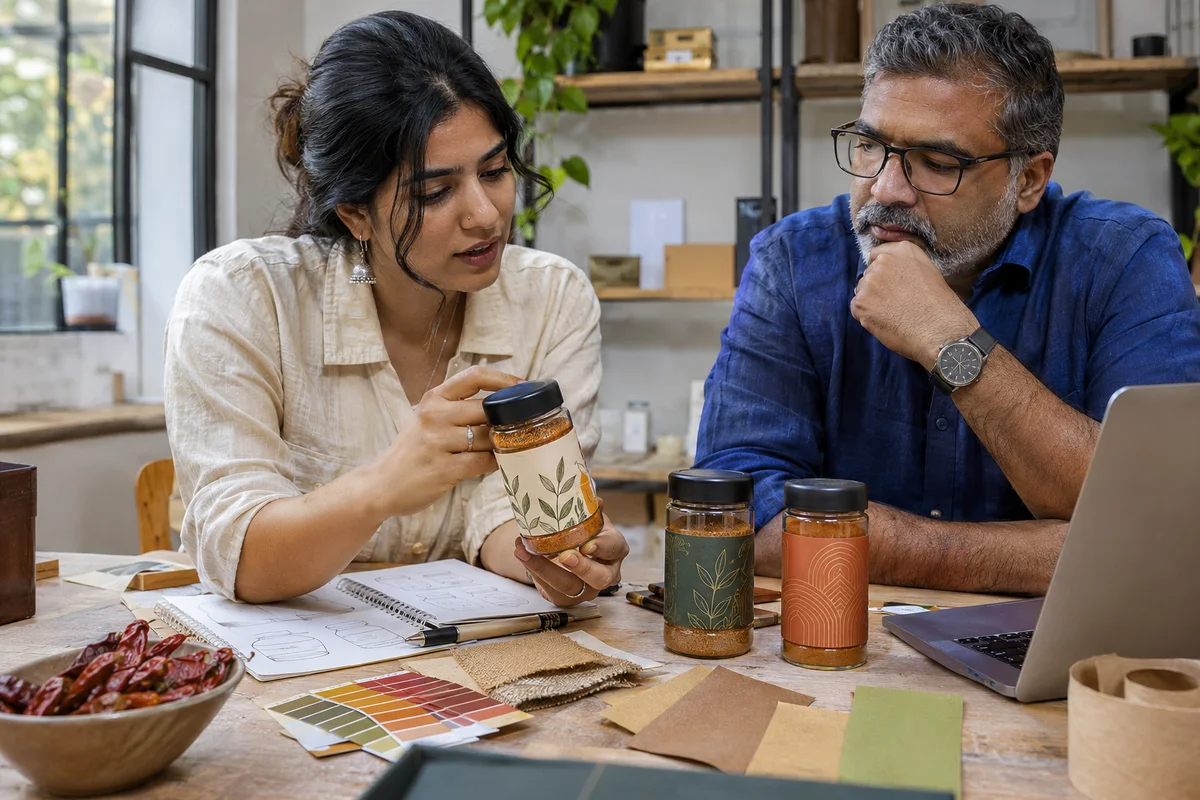
Product label design is the artwork for the printed label, sticker, wrap or sleeve that goes on a bottle, jar, tin, tube, bag or machine. GullySales draws the label for the surface it sits on, places the words you supply, reserves space for mandatory text and hands your label printer files with a specification sheet.
This page covers one printed surface: the label. It looks at the shape of the product it wraps, the material it is printed on, the distance it is read from and the information that has to sit on it. One label, a set of sizes or a range of variants can all be scoped here.
The wording, the container, the printing and the application are separate scopes. GullySales draws to the label printer's specification and the regulator's rules that you supply, and your own people approve every claim, declaration and legal line before the label goes to print.
Who it is for
This is written for you if these sound familiar.
- A food or drink maker whose bottles, jars or tins need a label that fits a curved surface and a crowded shelf.
- A cosmetic, wellness or pharmacy-adjacent business preparing labels with mandatory text and a clean front.
- An engineering or chemical manufacturer that needs durable product labels and data plates for the workshop or the field.
- A shop or online seller who relabels bought-in stock under its own brand.
- A restaurant, bakery or caterer labelling takeaway items and jars sold at the counter.
- A business whose label printer has rejected supplied artwork for fit, bleed or colour.
Before you decide
When this may not be the right fit.
- A business that needs the carton, box or full outer pack designed rather than a label on a container. Product packaging and box design draws every face of the pack.
- A business that needs the label text written first, such as the description, usage lines and call to action. Product packaging copywriting writes the words, and can be scoped alongside this page.
- A business whose product has no name or brand identity yet. Product branding settles the name and the parent brand rule before any label is drawn.
The problem
Does this sound like your business?
Common situations this work addresses.
“The label wraps badly and the text vanishes round the curve”
A flat design on screen can run over the edge of a bottle or into the seam of a tin. Key words land on the part nobody can see, and a shopper must turn the product to find its name.
“The label printer rejects the files”
Files arrive with missing fonts, no allowance for trimming, the wrong colour setup or a die line that does not match the printer's tool. The job is delayed and each side blames the other for the fault.
“The legal panel is squeezed in at the last minute”
Mandatory text is added after the front is finished, so it gets whatever space is left, set small and crowded. The regulator's rules may then not be met, and the label must be redrawn.
“Variants look the same and get packed in the wrong box”
Flavours or models carry nearly identical labels. Packers and dealers mix them up, shoppers pick the wrong one and complaints follow, because nothing on the label separates one variant from the next.
Choose the right scope
Start with the work your business needs.
A single label
One product with one container and one label, drawn from brief to print-ready files. Suited to a new product or one whose label was made by the printer's default and never designed, and scoped to end at file handover.
A set of sizes and variants
A range of strengths, flavours or sizes drawn as one system. The shared parts are designed once and each variant is laid out and named, so packers and shoppers can tell them apart at a glance.
A refresh of an existing label
A current label redrawn to fix legibility, fit or consistency while keeping the cues regular buyers know. The brief records what stays, what changes and which mandatory text must not move.
A version for another buyer or market
A second label for a different audience, such as a trade pack beside a consumer pack. The look stays related while the information, the reading distance and the rules you supply for that buyer change.
What we do
The work we can include.
Each deliverable and the purpose it serves. Your written scope confirms what is included, who is responsible, and what it costs.
A label brief signed off in writing
A short brief records the product, the container and its material, the surface the label sits on, the reading distance and the information that must appear. You approve it before drawing begins, so later changes are visible as changes.
Label layout directions
A few directions show the front label with name, image or mark and hierarchy, drawn on the actual container shape. You choose or combine, and the chosen direction becomes the base for every variant.
The full label artwork
The chosen direction is carried across the front, back and any wrap, neck or lid label. Each part has its job, and the placement of the supplied words is set with attention to the curve and the seam.
A reserved area for mandatory text
A marked area on the artwork is held for declarations, batch and date marking and the barcode. The wording, and any panel format a regulator requires, comes from you and your adviser, not from the designer.
Variant and size versions
Where you sell flavours, strengths, sizes or models, each is laid out from one system with a clear changing element. Names and colours keep variants apart at a glance for packers, dealers and shoppers.
A label mock-up on the container
A rendered view shows the label on the container from the front, the side and in a row. It is a review aid and not a physical sample, and it helps you spot hidden text before printing.
Print-ready files and a specification sheet
Layered files, linked images, fonts supplied or outlined, colour references and a one-page sheet go to the label printer. The sheet names the material, the finish and the die line used, so questions are settled on paper.
How the result is measured
- Printer rejections or file queries on label jobs
- Labels reprinted for artwork errors
- Wrong-variant packing mistakes found at dispatch
- Customer questions about what is in the product or how to use it
- Dealer calls asking which label is which
- Labels that match the approved proof when delivered
Recorded as a baseline before work starts, so every later report has an honest comparison.
Marketing and sales together
The label is what a dealer reads at the counter and a buyer reads at home.
Your field team notes which labels dealers ask about, which variants get confused and which customers return for the wrong item. The order desk records wrong-variant orders and complaints about unreadable text. Those notes go to the label owner before the next print run, so the fix reaches the artwork.
Decisions to make before the work starts
What is not included
Writing the label text, the container, printing, application, physical samples, regulatory submissions and photography you do not supply are separate scopes. Product packaging copywriting can be scoped with this page so the words and the label artwork are prepared together.
What stays your decision
Ingredient and nutrition lists, usage and safety wording, mandatory declarations, claims, prices, offers and trade mark use stay with you and your adviser. GullySales reserves the space and sets the text you supply. Any trade mark check is your adviser's task.
Where outside rules apply
A regulator sets what a label on a regulated product must show, and the label printer sets what the material and process can print. A retailer or marketplace may add rules of its own. GullySales works to the specifications you supply and flags a conflict.
This or a nearby service
Which piece of work fits your situation.
These services sit close to each other. The line between them, in plain words.
- Product packaging and box design
- Choose product packaging and box design when the carton, box or whole outer pack is the artwork and every face must work together. Choose product label design when the container exists and only the printed label, sticker or wrap on it needs drawing.
- Product packaging copywriting
- Choose product packaging copywriting when the label layout is settled and the words are missing, long or unclear. Choose product label design when the words exist and the open problem is how they fit the container, read at distance and print.
- Product branding
- Choose product branding when the product has no name, no line identity or no rule for how the parent brand appears, so the label has nothing to carry. Choose product label design when those are settled and the label artwork is what remains.
A sample of the output
A label zone map shows where each piece of information sits and who supplies it.
This map divides one label into zones. Each row names a zone, the information it holds, the rule that governs its placement and who provides the content. The designer, adviser and printer all work from it.
| Zone | Information it holds | Placement rule | Content comes from |
|---|---|---|---|
| Name zone | Product name and variant | Visible from the front, clear of the seam | Owner |
| Descriptor zone | Short line saying what the product is | Directly below the name, readable at counter distance | Owner |
| Mandatory text zone | Declarations, address and marks the regulator requires | Reserved block, wording fixed by the adviser | Adviser and regulator |
| Barcode zone | Barcode and batch or date marking | Flat area clear of curves and folds | Owner and printer |
| Usage zone | How to use, store or care for the product | Back label, set larger than the legal block | Owner |
| Variant band | Colour or tag that separates each variant | Same position on every label in the range | Designer |
Before we start
What we need from you.
The work depends on these. Each says why it is needed and what happens when it is missing.
- The label printer's die line and material
- The label's size, shape, material and finish come from the printer's tooling. A die line and a material name let the artwork be drawn correctly. Without them, the layout is built for a guess and may not fit the container.
- A sample of the container
- Curves, tapers, seams, caps and ridges decide where text can sit. A physical sample or a clear photograph with measurements from your supplier is enough. Without one, text may land on a join and the label is redrawn.
- The supplied label wording
- The name, descriptor, usage lines and declarations should be written in near-final form by you or a copywriter. Placeholder text suits early directions only, because later wording changes can move the whole layout.
- A list of every variant and size
- Labels for the full range are designed as one system, so the list of flavours, strengths and sizes must be complete. A late variant added after sign-off can break the colour logic and send the range back to the start.
- Where the product is stored and read
- A label in a wet kitchen, a chilled cabinet or a dusty workshop has different needs from one on a dry shelf. A short description of the setting lets the designer and printer plan for it, and without it durability is untested.
How it works
How the product label design work runs
The work itself, in order. How an engagement starts, from your brief to a written scope, is set out on our method page.
- 1
Read the brief and the printer's die line
Work starts from your product description, brand files and the die line from your label printer. If the container or label size is not settled, it is agreed with the printer first, because the artwork is drawn to that shape.
- 2
Check the container, the material and the setting
The container is studied in the hand and on the shelf, along with the label material and the place it lives: a kitchen, a workshop, a chilled cabinet or a counter. This sets the reading distance and what the label must survive.
- 3
Draw label directions
A few directions are drawn for the front label alone, so the choice is about the idea and not the detail. You and your team choose, and the decision is recorded in the brief.
- 4
Build the full label and its variants
The chosen front is carried onto every label part and every variant, with supplied words placed and mandatory areas marked. Colour references and finish notes are added as the layout settles.
- 5
Review with your team, adviser and printer
Your product owner reviews the look, your adviser checks the claims and declarations, and the printer checks the files against their process. Changes are handled as the written scope sets out.
- 6
Hand over files and a specification sheet
Print-ready files, colour references and the specification sheet are delivered with a file list. The proof from the label printer is compared with the artwork, and approval to print stays with you.
Before you hire anyone
Do this first yourself.
A few checks at your own bench or counter will show what the label must fit and survive before anyone draws it.
- Photograph the container from the front, the side and the base, and measure the flat area where a label can sit.
- Hold the product at the distance a buyer reads from and note which words you can still read.
- Write the full list of text that must appear and mark the lines your adviser or regulator must approve.
- List every flavour, strength and size you sell now and plan to add, so the label can be built as a system.
- Ask your label printer for their die line, material options and the files they accept.
Judge any provider
What to ask any provider of this service.
Useful whoever you choose, including us.
- Will you draw to my container and my printer's die line, and what do you do if either changes?
- How will you show me that the text still reads on the curve and across the seam?
- Where does mandatory text go in your layout, and who decides its wording?
- What do you send my label printer, and who answers their questions about the files?
- How do you make variants easy to tell apart for packers and dealers?
Where this fits
Three pieces of sales work, in this order.
This work sits inside sales process design, at stage 0, foundation. The audit comes before it, and sales management keeps it running.
Step 1
Sales audit
Find where deals are being lost and what to fix first.
Start here if you cannot say where orders are lost.
Step 2 · you are here
Sales process design
One written way to sell, from first enquiry to repeat order.
Start here if every salesperson sells differently.
Step 3
Sales management
A target, a review routine and someone who owns the number.
Start here if the team has targets and no routine.
FAQ
Questions owners ask before they call.
Not here? More answers, or ask on WhatsApp.
Who owns the finished label artwork and files?
How are changes handled after the label is drawn?
Who approves the claims and declarations on the label?
Do you need to see the actual container?
Will the printed label match the colours on screen?
Can you design labels for a set of sizes and variants?
By industry
Product label design, written for your industry.
Related services
Often bought with this, or instead of it.
Your next practical step
Tell us what you are trying to grow, and we will read it before we call.
Eight short steps, mostly taps. Skip anything you would rather answer on the call.