Industries · Technology
Your best project is under NDA and your buyer wants proof today.
A finance head in Pune has a bank's circular on her desk and an auditor's deadline. She does not search for a vendor. She rings the auditor, who gives her two names, and then she opens both websites to see whether either looks like it has done this before. A founder in Bengaluru who needs an app built does the same with three other founders. A plant head whose line stops at night asks his maintenance engineer who the integrator was last time.
Scope, fee, reporting and term are agreed in writing after we have read your brief and spoken to you.

In one paragraph
This page is for owners of IT, software, security, automation and connectivity firms, and for the repair counters and broadband providers at the retail end. What differs here is that buyers check you with a peer or an engineer before they fill in a form, and the first order is rarely the last.
So the shortlist exists before your website is seen. Technology buying is spread over people who fear different things: one feels the pain, one checks the architecture or the security, one signs. The strongest work is often under an NDA, the demo is only as good as the buyer's own data, and most firms sell one engagement at a time and hope someone remembers to ask for the next. At the other end of the sector, a laptop owner or a new tenant decides in minutes, and the shop or provider that answers first usually wins.
For example, a managed IT firm in Hebbal is called by a growing distributor after its only IT person resigns. The owner asks for a quote, gets a proposal with a list of tools, and signs with the firm whose proposal also said who would answer the phone on a Saturday. The pages below take each trade in turn.
Last updated 15 Oct 2026. Rules for regulated trades differ by state and professional body, and they change. Each page describes them in general terms only.
11 industries
Each trade here sells differently, so each has its own page.
Open the one that matches your business. Each lists the work we would do and why it fits that trade.
 Business automation and RPA companiesBuyers have met a bot that broke and a vendor who vanished, so a pilot with an agreed pass mark and a named owner for support afterwards carries the sale.
 Cloud and DevOps service companiesA bill shock, an outage or a resigning engineer sets the search going, and a fixed-scope assessment has to lead into the migration, not end with a report.
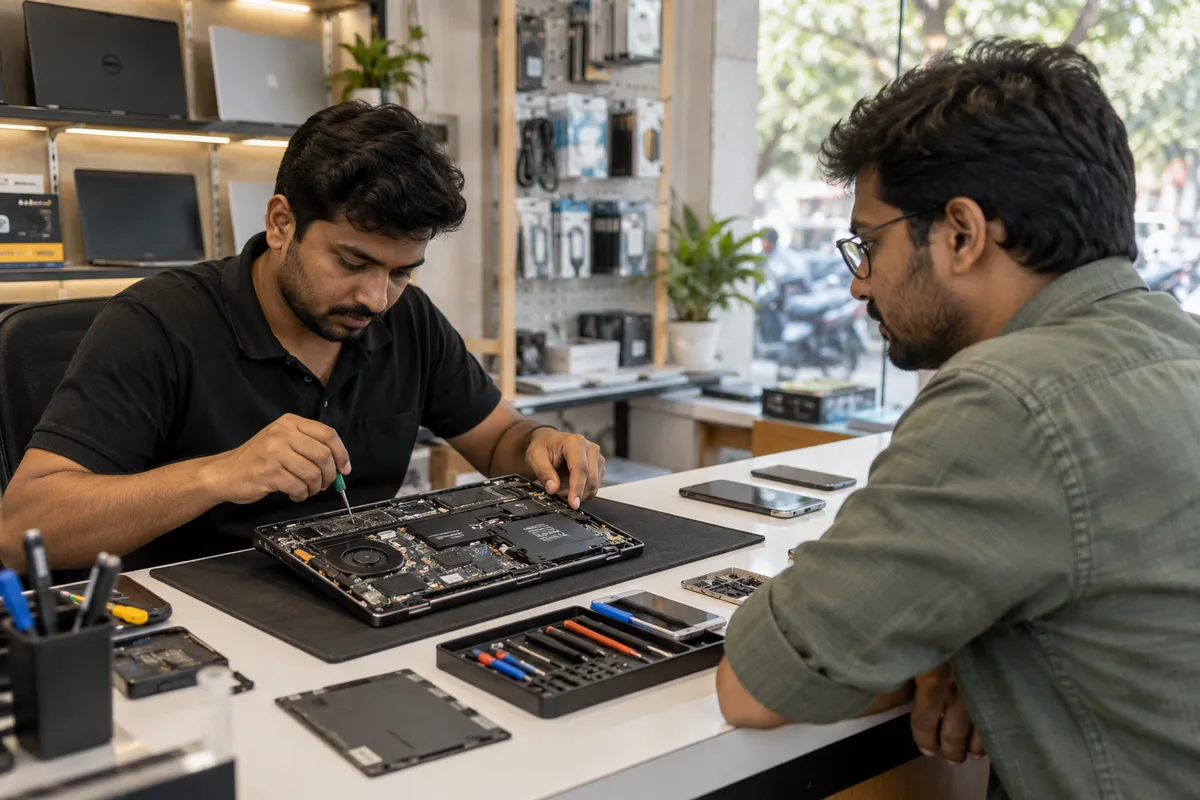 Computer and mobile repair shopsSomeone with a dead laptop calls the nearest shop that picks up, so a correct map listing and a call when the repair is ready bring them back.
 Cybersecurity companiesA CISO about to show an outsider every gap wants credentials first, then your answer to the customer's security questionnaire sitting ready on the site.
 ERP software providersA manufacturer's owner likes the demo and his accountant quietly blocks it, so the first fix is a demo built around closing entries and GST reports in his own trade.
 Industrial automation companiesPlant heads and maintenance engineers remember who fixed their last line, so a page for one kind of line, with a reference visit offered, beats a list of brands.
 IT services and networking companiesOffices ring after a move or a ransomware scare, and the project ends with no annual maintenance contract unless someone writes the renewal date down.
 Managed IT service providersThe finance head who signs sees a quiet year as an expensive one, so the proposal and the follow-up must show what the agreement actually covered.
 Software development companiesFounders back a team whose product they cannot yet see, so we would begin with NDA-safe case studies and the named engineers who would write the code.
 Telecom and broadband providersA PG owner or tenant picks a connection at move-in, so a quick feasibility check for the building and a good first month decide who cancels.
 Website design and development companiesAn owner scared of a website that never goes live needs to see the plan before the price, and the quote that spells out who supplies content wins.
How buyers choose
What decides who wins in technology.
A name is given before you are searched for
Buyers ask a peer, a chartered accountant, an auditor or the vendor's partner manager first. Search, LinkedIn and review sites are used afterwards, to check a name already in hand. Being findable for the exact problem, such as an AWS cost spike or a closing-entries mismatch, makes that check come out well.
Narrow reads as deep
A site listing every platform, every industry and every service tells a prospect nothing about their own trouble. One page for one trade, one system or one kind of deadline, written so an engineer finds it accurate, is the page that gets forwarded inside the buyer's company.
Proof has to survive an NDA
The strongest projects usually cannot be named. Describe the problem, the systems and what changed in terms a technical reader can test, and offer a reference call when the client agrees. Invented logos and figures lose deals the moment someone checks.
Three people decide, and each fears something else
The person with the pain fills the form. The IT head or CTO checks risk and architecture. The finance head or owner asks about the audit trail, the renewal and what happens if you leave. A process that talks only to the first person loses to one that has already answered the other two.
Free demos and pilots are where deals leak
Buyers ask for a customised demo, an assessment or a proof of concept and then take the plan to a cheaper vendor. A short scope, a pass mark agreed beforehand and one named person who follows up afterwards keep the effort from becoming a gift.
The retail end is won in minutes
A repair shop or a broadband provider is chosen by whoever answers first and looks nearby. Map listing, a reply on WhatsApp and a clear answer on availability matter more than a brochure. These buyers are quick to leave and quick to tell their building group.
From the blog
Reading for technology owners.
 5 min read · 6 Oct 2026How buyers choose between IT, software and SaaS vendorsTechnology buyers take a name from a peer, test it against an engineer and sign after a finance check. This post follows the choice in four stages and shows where vendors drop out.
 8 min read · 21 Sept 2026How to advertise to CTOs and CIOsThe CIO signs and rarely shortlists. Reach the engineer who runs the evaluation, be easy to verify in the security review, and know the renewal date.
 6 min read · 18 Aug 2026A proof-of-concept agreement: what to fix before you startA free pilot turns into free work when scope, success measure and decision date are left vague. Here are the clauses to write down first, with sample wording and when to refuse the pilot.
Questions
Questions technology owners ask.
Not answered here? Ask on WhatsApp or call, and you will speak to someone who does the work.
How do I show proof when my clients will not let me name them?
Should I give every prospect a free demo or pilot?
Do Clutch, G2 and partner directories matter for an Indian firm?
How do I turn a one-off project into a retainer or annual contract?
Is cold outreach still worth doing when buyers get so much email?
Not sure which page fits? See every industry or tell us what you need, and we will start from what you sell.
Your brief
Tell us what you need, and we will read it before we call.
Eight short steps about your business, what you want and who decides. Most questions are a tap, and you can skip any you would rather answer on the call.
Your next practical step
Tell us what you are trying to grow, and we will read it before we call.
Eight short steps, mostly taps. Skip anything you would rather answer on the call.