Professional makeup artists · Follow up systems
Chase the quiet bride politely, with a message ready for each step.
A follow-up system for a makeup artist is a set of written next steps for each stage: after the rate, after the trial, after the advance and after the wedding. GullySales drafts the messages and the reminders so nothing depends on a free hour.
Scope, fee, reporting and term are agreed in writing after we have read your brief and spoken to you.
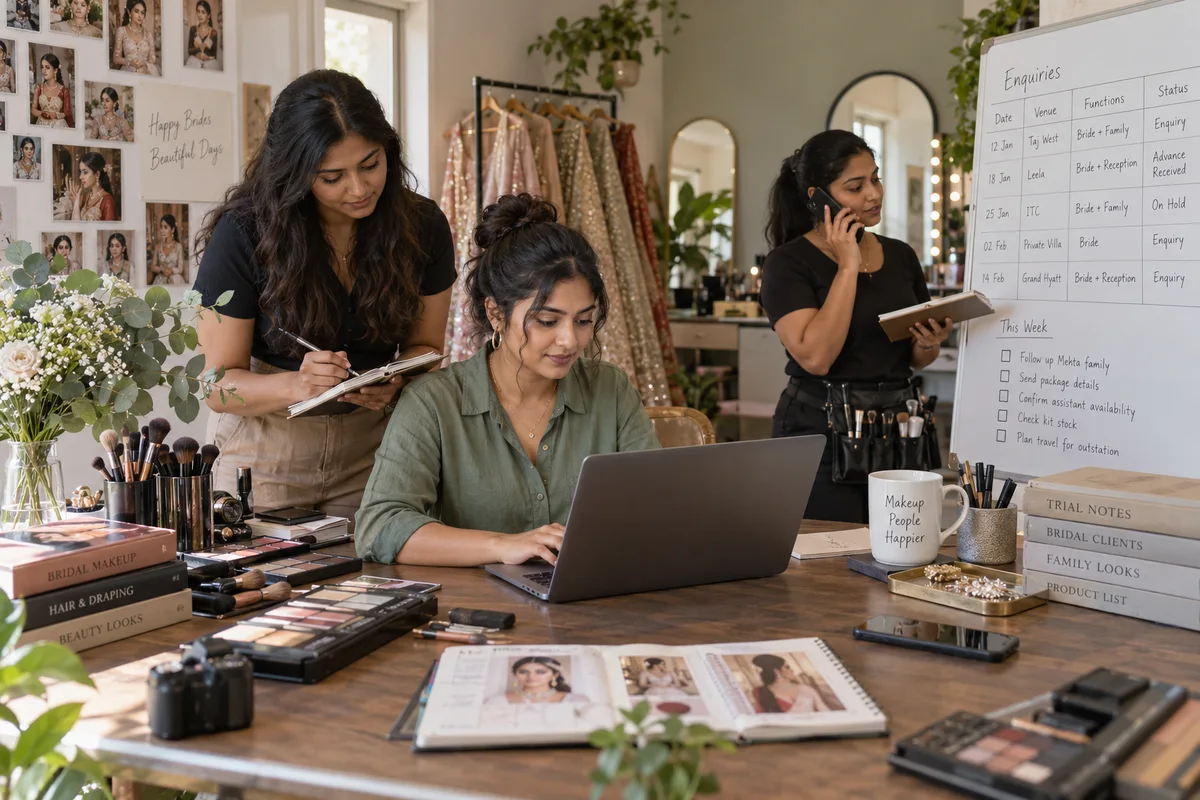
What follow up systems means
A follow-up system is the set routine for calling, messaging or emailing an enquiry more than once, since most buyers do not decide on the first conversation. GullySales sets the number and timing of follow-ups so an undecided buyer keeps hearing from you until they decide either way.
Also for professional makeup artists
Sales and marketing for professional makeup artists, the overview.
Last updated 14 Nov 2026.
For professional makeup artists
Where it usually goes wrong, and what we would do.
“Silence after the rate card is normal and still costs a booking”
A bride who goes quiet is comparing, not refusing. A short second message that offers a trial slot and states how long the date is held moves the conversation on. No message at all lets another artist fill the space.
“A trial that ends with no decision is a lost trial”
The bride leaves happy, discusses it at home and the date is still unsecured. A closing line at the end of the trial, naming the advance and the hold date, converts a good session into a booking.
“Pressure damages a trade built on trust”
A message that rushes a bride, or invents a rival who wants the date, reads as pressure. Be plain: the date is free until a stated day, and after that it is released. A bride respects clarity and resents tactics.
“After the wedding is also a follow-up”
A thank-you, a request for a review and a note to the photographer all come after the event. Skipped in wedding season, they are the messages that bring next season's referrals.
What we do
What we deliver for professional makeup artists.
The work available for this need. We agree the deliverables and responsibilities for your engagement in writing.
A message for each stage
Written replies for after the rate, after the trial, after the advance, the week before and after the wedding.
Result: A message ready to paste at every stage.
A hold-date rule
A plain statement of how long a date is held without an advance, used in every reply.
Result: The bride knows when the date is released.
Reminders in your calendar
A reminder against each enquiry for the next message to send.
Result: No enquiry sits without a next step.
A closing line for the trial
A short, polite wording to finish a trial with the advance and the hold date.
Result: Each trial ends with a clear next step.
A post-wedding routine
A thank-you, a review request with consent for photographs and a note to the referring photographer.
Result: Every wedding closes with the same three messages.
How the result is measured
- Follow-up completion rate
- Average number of follow-ups before close
- Enquiries closed after repeat follow-up
Recorded as a baseline before work starts, so every later report has an honest comparison.
What to capture or send
Each stage of a bridal booking needs its own short message.
- After the rate card
- A reply that thanks the bride, restates the date asked and offers a trial slot, with no discount and no push.
- Before a hold lapses
- A courteous note that the date is held until a stated day, so the bride knows when the choice is the bride's to make.
- After the trial
- A message with what was agreed, the look chosen and the advance steps, so nothing depends on memory.
- Before the wedding morning
- A confirmation of the reporting time, the venue and the contact on the day, sent to the bride or the family member in charge.
- After the wedding
- A thank-you with a review request, and a note to the photographer who recommended you.
Who it is for
This is written for these professional makeup artists.
- Bridal makeup artists working from a home studio
- Freelance artists who travel to the venue or the home
- Artists who also do hairstyling and saree draping
- Party, engagement and reception makeup specialists
- Editorial, fashion and ad-shoot makeup artists
- Film, TV and OTT makeup artists and hair-and-makeup crews
- Prosthetic and special effects makeup artists
- Makeup artists who also teach masterclasses
- Teams of three or four artists under one name for large wedding parties
Before you decide
When this may not be the right fit.
- You do not yet have a hold rule for dates, so a reminder would promise a date you have not decided to keep.
- You cannot reply to a bride's answer, and a chain of messages from you would only invite replies you leave unanswered.
- You are tempted to use follow-up to press brides who have already said no, which harms the name you are building.
Before you decide
Agree the work. Know how to judge it.
Follow-up systems for makeup artists: use these checks to prepare, choose the scope, and review what changes.
Bring the right evidence
Trace recent enquiries from arrival to the last recorded action. Include a won enquiry, an unsuitable one, and one that went quiet, with personal details removed for the initial discussion.
Make the scope clear
Agree who accepts each enquiry, what makes it qualified, and how ownership changes. Include a rule for missed replies and a clear reason for closing an enquiry.
Check the work in use
Pick an enquiry at random and ask the team to find its owner, latest conversation, and next action. Check that the record agrees with what actually happened.
Know when to change course
If no one has capacity to respond, assign that responsibility before buying more leads. Automation can support the owner, but it cannot replace an unresolved handover.
These are discussion points, not a fixed package. GullySales confirms the deliverables, responsibilities, fee, and term in writing after reading your brief and speaking with you.
Before we start
What to have ready before the work starts.
The records, access and decisions this work needs from professional makeup artists. Anything missing is noted in the written scope, with who will supply it.
- Chats that stopped after your rate
- A sample of chats that ended after the rate card, with the reply sent. They show which messages work. If you delete chats, we write from your memory.
- Your hold and cancellation terms
- What you say about holding a date and about cancelling. The rule is built on it. If nothing is fixed, you decide before we write. A cancellation that you refused to refund in the past is a useful example for the wording.
- A list of stages you actually have
- The stages between first message and wedding day for your work. A film artist and a bridal artist differ. We use your stages and not a template. If you also take party and engagement bookings, list their stages too.
- A calendar app you open each morning
- The calendar where reminders will sit. If you use a paper diary, we place them there. A reminder in a place you do not look is of no use. Set alerts so the reminder appears with the message text attached.
- Your view on voice notes
- Say whether you send voice notes to brides, as some prefer them. We write the messages for text and mark which could be a voice note.
How it works
How the follow up systems work runs
The work itself, in order. How an engagement starts, from your brief to a written scope, is set out on our method page.
- 1
List the points where brides go quiet
We go through your last season and mark where chats stopped: after the rate, after the trial, after the advance request. You say how you replied. The list of silences decides which messages are written first. The count of silences is not a measure of failure, since some brides decide without telling anyone.
- 2
Write a message for each stage
For each stage we draft a short message in your voice: after the rate card, after the trial, after the advance, before the wedding and after. You read them and remove any that feel pushy. Each message ends with an easy next step. The message after the rate card, for example, answers the question the rate card raises and does not repeat the card.
- 3
Set the hold-date rule
A date held for a bride cannot be held for ever. We write the rule that says how a hold begins, what ends it and what you say when it lapses. You decide the terms. It is shown to the bride in the first reply. A hold that ends is noted in the record, so the date can go to the next enquiry.
- 4
Close the trial with a plain line
After a trial, we write a closing line that states the look agreed, the date held and the advance that secures it. You say it aloud or send it. The bride leaves knowing the next step. Where a bride brings family to the trial, the closing line is written to be read by both.
- 5
Put reminders in your calendar
Each stage gets a reminder in the calendar you already use, with the message ready to paste. We test with three live enquiries. You adjust the reminders that do not fit a working morning. A reminder for the day before the wedding confirms the call time and the venue, and one after the wedding asks for a review.
- 6
Read bookings against the old silences
We count how many chats ended in silence at each stage before, and again after the routine has run for a season. You decide which messages to change. You decide which messages stay as they are, which are shortened and which stage needs a call and not a text, and the rest wait for the next season's silences.
Where this fits
Three pieces of sales work, in this order.
This work sits inside sales process design, at stage 2, qualification. The audit comes before it, and sales management keeps it running.
Step 1
Sales audit
Find where deals are being lost and what to fix first.
Start here if you cannot say where orders are lost.
Step 2 · you are here
Sales process design
One written way to sell, from first enquiry to repeat order.
Start here if every salesperson sells differently.
Step 3
Sales management
A target, a review routine and someone who owns the number.
Start here if the team has targets and no routine.
FAQ
Questions owners ask before they call.
Not here? More answers, or ask on WhatsApp.
How long should I follow up with a bride?
What if the bride says the bride is still deciding?
Should I send voice notes or text?
What if the bride replies after the hold has lapsed?
What if the bride never replies at all?
Should I follow up with a bride who booked someone else?
How much does it cost?
How long is the contract?
Who will actually do the work?
What do you need from us?
More for professional makeup artists
Related work to consider.
Closest to this: leads and follow-up
Also for professional makeup artists
Or start from the overview: sales and marketing for professional makeup artists.
Your next practical step
Tell us what you are trying to grow, and we will read it before we call.
Eight short steps, mostly taps. Skip anything you would rather answer on the call.